
By Sulagna Saha April 16, 2026
Collected at: https://www.rcrwireless.com/20260416/quantum/fast-charging-quantum-batteries-could-make-devices-run-forever
Quantum batteries could enable wireless charging, allowing systems to stay in a state of constant charging, says James Quach, whose team has developed a working prototype of a quantum battery that charges in quadrillionths of a second
In sum — what to know:
A quantum demo: Scientists in Australia showcased a full quantum battery cycle in a device, in what they say is a first-time demonstration.
Double breakthrough: According to the team, the proof of concept (PoC) charged in quadrillionths of a second, as well as stored energy for six orders of magnitude, proving viability for real-world applications.
A big step: The experiment marks a major step towards quantum batteries wirelessly charging systems, unlocking everlasting battery life.
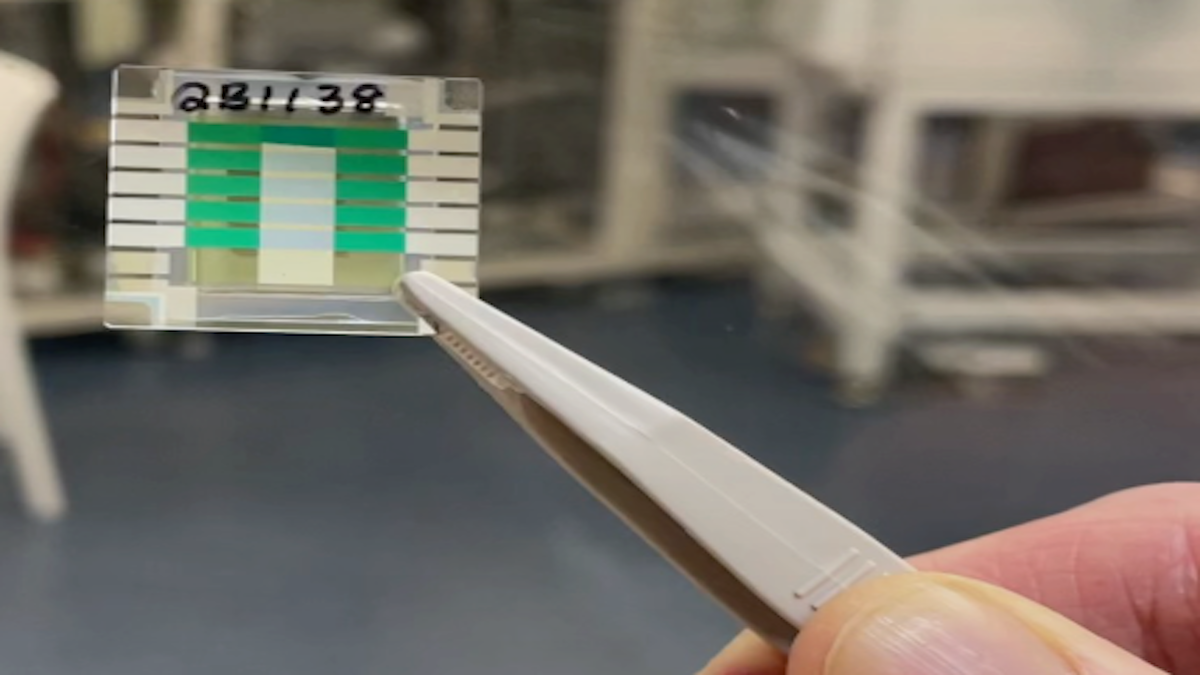
Researchers at the CSIRO, Royal Melbourne Institute of Technology, and University of Melbourne, have developed a working prototype of a quantum battery, demonstrating the complete cycle from charge to discharge in a device for the first time.
Conventional batteries store and release energy through chemical reactions — first converting electrical energy into chemical energy during charging, and reversing it back to electrical energy during discharging. Their performance scales linearly with size: the larger the batteries, the more charge they can hold. The problem, however, is that larger batteries take longer to charge.
The reverse is true for quantum batteries. Quantum batteries are designed on the principles of quantum physics, which make them potentially more efficient and powerful.
James Quach, lead researcher for the team, explained, “The key difference is that, here, charging and energy transfer are governed by quantum coherence and collective interactions, rather than chemistry. This enables fundamentally new behavior, such as faster-than-classical charging.”

Besides charging rapidly, bigger quantum batteries also charge in less time. This is in part due to the phenomenon of collective effects between particles which cause storage units in quantum batteries to behave collectively, rather than independently. So hypothetically, if there are N number of units, and each of them takes a second to charge, while charging simultaneously, they would each take 1∕√N seconds to fully charge. As a result, a battery that is twice as large will charge in half the time of a smaller battery. This is superextensivity, a unique quantum effect observed only in quantum batteries, where charging and discharging power outpace the size of the system.
But on the flip side, quantum batteries lose charge very quickly, making them unsuitable for practical use. The new PoC marks a significant departure from this. The prototype charged in quadrillionths of a second, and stored the energy for six orders of magnitude. Although that only amounts to a few nanoseconds, it still marks a critical step toward making quantum batteries commercially viable.
Quach and his team showcased a full battery cycle from light absorption to storage to electrical power output under realistic conditions, room temperature, and steady-state operation, demonstrating superextensivity and potential for performance improvement under low-light conditions.
“In our system, light is absorbed and stored in electronic states of molecules that are strongly coupled to light inside a microcavity. This creates hybrid light–matter states, or polaritons, which allow the system to behave collectively rather than as independent units,” Quach said.
“As more molecules participate, the interaction with light becomes stronger, scaling roughly as the square root of the number of molecules. This means the system absorbs energy more efficiently as it gets larger. So the charging time actually decreases with size.”
The PoC builds on several years of theoretical and experimental work. Earlier studies demonstrated individual effects, such as enhanced absorption, but this is the first time, all of the quantum advantages were cohesively achieved.
According to Quach, the most promising use cases for quantum batteries today are quantum systems and sensors, advanced photonics, solar power systems, and autonomous systems like drones. He added that in the future, quantum batteries could power larger systems such as electric vehicles.
The batteries charge wirelessly which opens up possibility for remote charging. “A particularly exciting possibility is continuous or wireless energy delivery, where devices are effectively always charging rather than needing to stop and recharge,” he said. This could potentially mean that devices never run out of charge.
The research, published on Nature.com, stirs strong interest in the potential of quantum batteries among research communities and the wider scientific press. However, commercial production is not imminent. The protoype is still quite small at this stage and designed strictly to prove the physics behind quantum batteries.
“We are still at an early stage, but this is an important milestone,” Quach said. The next steps would be to scale up, expand storage capacity and time, and integrate with multiple devices so the battery can be used to charge real devices.
Leave a Reply