
By James Blackman April 16, 2026
Collected at: https://www.rcrwireless.com/20260416/industry-4-0/robots-physical-ai-industry
Industrial humanoid robots and physical AI are moving from pilot to production – as Siemens, Nvidia, and lots of private 5G providers (including Nokia) roll up to Hannover Messe.
In summary – what to know:
Siemens et al – demonstrate humanoid robots achieving real factory performance, signalling physical AI readiness for industrial deployment at scale.
Hannover Messe – will spotlight physical AI ecosystems, combining robotics, simulation, and edge connectivity and compute to transform industrial operations.
Industry bodies – are urging stronger policy and integration frameworks to scale industrial AI, highlighting humanoid robotics as a defining frontier for Europe.
RCR is not going this year, for one reason or another, but the story from Hannover Messe next week (April 20-24) is already written: about physical AI in Industry 4.0. It was a subtext in yesterday’s discussion with Ericsson, of course, about the role of private 5G in the broader enterprise market; and it has appeared in keynote plotlines at most industry events through 2026 – at CES, PTC, MWC, GTC; as written in these pages. But Hannover Messe is the one so far as hard-nosed edge AI goes, and the big beasts of industrial tech will be there: ABB and Bosch, BMW and VW, AWS and Microsoft, IBM and SAP, Honeywell and Rockwell, KUKA and Fanuc, and so on. Physical AI is their bag.
As an aside, Ericsson and Nokia will be there, too, and the latter’s appearance further unravels this weird narrative thread that RCR has been pulling over the last six months – that the Finnish firm is quitting the one market it is winning: private industrial networks. Nokia will be represented in Hanover next week by its enterprise campus edge (ECE) division, which is on the chopping block – and which, unlike five years ago, will be welcomed in the home of Industrie 4.0 like an old familiar, and as a strong voice in telecoms; which is still selling lots of RAN-based 5G solutions to factories and mines. But maybe the stand was already booked, or maybe it will find a buyer.
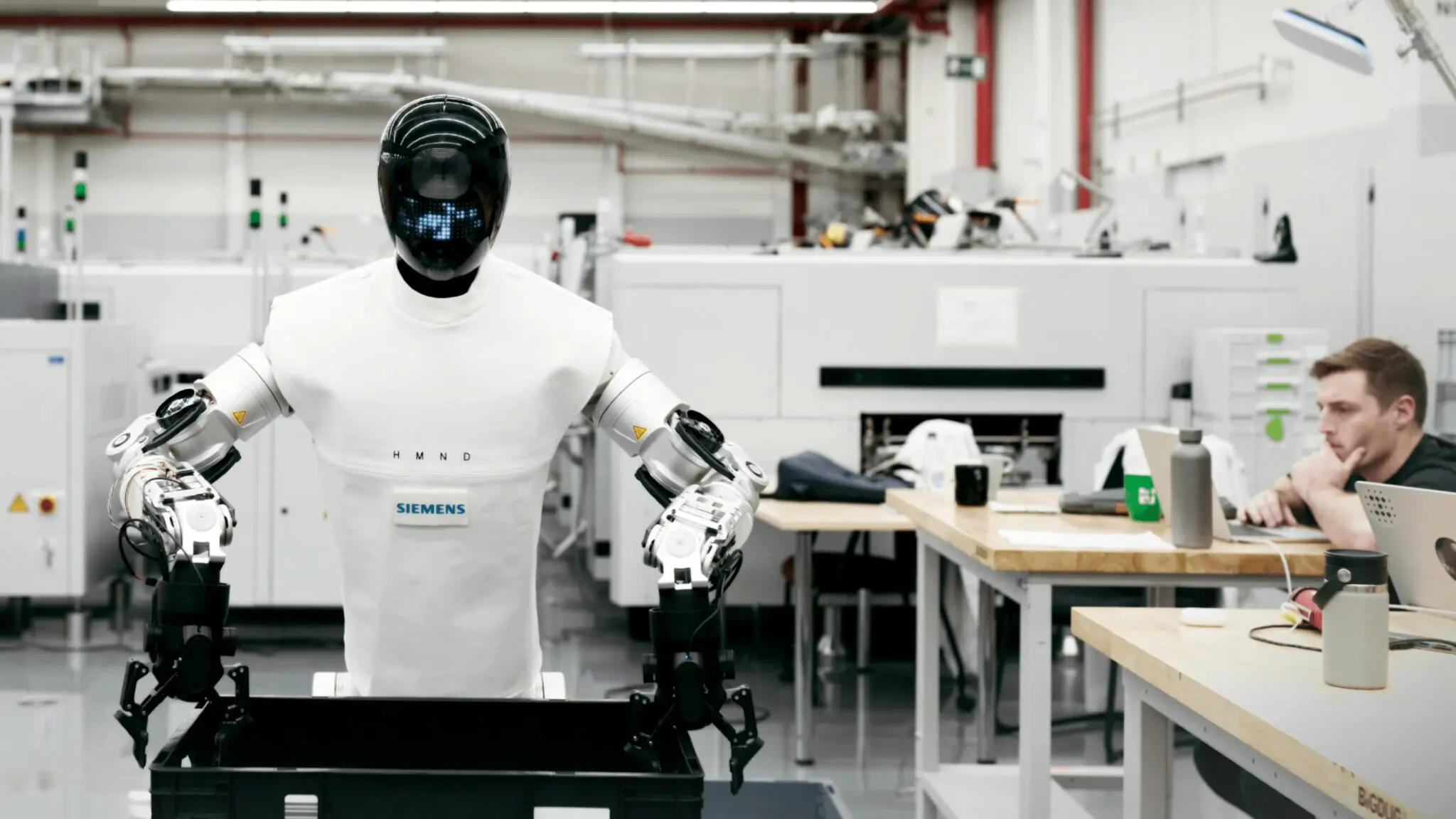
But that’s not the point, really. Because also in attendance next week, casting longer and wider shadows, will be Siemens, which might call Hanover Messe home, and Nvidia, which might call anywhere home. There will be more from both companies next week – you can put your hard hat on it. But the Munich-based industrial juggernaut, with its own developing sideline in private industrial 5G, has issued a press notice today (April 16) to discuss physical AI, as brought to life in humanoid robots on factory floors. It has tested industry-geared humanoids from UK-based robotics firm Humanoid at its factory in the southern city of Erlangen – where it also has a 5G test lab.
Nvidia is involved, as well. Siemens has a “strategic partnership” with the US chipmaker, announced at CES, with a remit to build the “world’s first fully AI-driven, adaptive manufacturing sites”. The Humanoid robot, called HMND 01 Alpha, is built using Nvidia’s physical AI ‘stack’ – including its Jetson Thor architecture for edge compute, Isaac Sim platform for simulation, and its Isaac Lab framework for reinforcement learning and policy training. The tests at Erlangen have seen the HMND 01 Alpha deployed in logistics operations to “autonomously execute” tote-handling tasks – picking, transporting, and placing containers for human operators.
Siemens said: “All target performance metrics were met, including a throughput of 60 tote moves per hour, uptime exceeding eight hours, and autonomous pick-and-place success rates above 90 percent.” Nvidia’s Blackwell-based architecture has seen development timelines for Humanoid’s robots go from about 18 months to just seven, apparently – notably for it to “optimize actuator selection [and] joint strength and mass distribution”. Deepu Talla, vice president of robotics and edge AI at Nvidia, commented: “This deployment paves the way for humanoid robots meeting real production targets on a live factory floor.”
Artem Sokolov, chief executive and founder at Humanoid, said: “Together, we’ve proven that humanoid robots are ready for real-world industrial deployment.” In marketing, Siemens hailed the collaboration as a “landmark milestone in the journey to bring physical AI from vision to industrial reality”, as well as the “dawn of physical AI in manufacturing”.
The firm made no mention of private 5G, but logic says the Siemens narrative will incorporate its new networking proposition besides; it referenced the underpinnings for physical AI as “world-class AI compute and simulation, a proven robotics platform, and the deep industrial automation infrastructure to tie it all together”. It also talked about OT integration – “real-time data exchange with production systems and autonomous guided vehicles (AGVs), synchronized workflows with machinery and human operators, and adaptive behavior that responds dynamically to changing conditions. Without this deep integration, even the most sophisticated robot remains an isolated feature.”
AGVs are a stand-up case for private networks, of course; and Siemens made a passing mention. All the integrated componentry, including networking bits, is available via its Xcelerator platform, it said – “from a comprehensive digital twin to AI-enabled perception, to integrated control and PLC-robot interfaces, along with fleet management, industrial communication networks and high-performance drives”.
Meanwhile, German machinery and equipment manufacturers association VDMA has issued a new position paper on industrial AI ahead of Hannover Messe, calling for better “framework conditions” for industrial companies to adopt AI. The organization, a key voice in the Industry 4.0 movement, with about 3,500 members across the broader manufacturing industry in Europe, reckons humanoid robotics represent a “particularly promising field for the future”, and “the premier class of industrial AI”. Its new paper calls for a “scalable digital single market, a more integrated European capital market, and a clear political prioritization of industry-driven innovation ecosystems”.
As such, the VDMA wants an innovation-friendly implementation of the EU AI Act as well as a coordinated European robotics strategy. Hartmut Rauen, deputy executive director at the VDMA, commented: “Humanoid robots will establish a new class of machines. They will find applications in industry, logistics, healthcare, the home, and agriculture. Quantitatively and qualitatively, a central future field of industrial society is emerging here, one that European industry must occupy…. Germany and Europe have an exceptionally strong industrial base.”
He went on: “Our machinery and equipment manufacturing industry is a technological leader – from automation technology to sensor technology and image processing to production excellence. We also have hundreds of high-performing software companies in our ecosystem. This industrial domain knowledge is the real key to market dominance in the age of Industrial AI. Those who understand the processes will also successfully deploy AI.”
The VDMA press note states: “Industrial AI only realizes its full potential when it is systematically integrated into industrial processes, established architectures, and entire value chains. Standards such as OPC UA and the associated industry-specific companion specifications, digital twins, and industry-driven data spaces – for example, within the framework of Manufacturing-X – create the prerequisites for this. They enable data to be used securely, interoperably, and scalably – even across companies and allow AI applications to be transitioned from the pilot phase to continuous industrial operation.”
Leave a Reply