

April 24, 2026 by Ingrid Fadelli, Phys.org
Collected at: https://phys.org/news/2026-04-approach-ultra-rare-sextillion-isotopes.html
The detection and study of isotopes, atoms of the same element that have different numbers of neutrons, could expand the scope of physics research and enable new scientific discoveries. So far, rare isotopes have been primarily detected using a technique known as accelerator mass spectrometry (AMS), which accelerates atoms, to then measure their mass and charge.
Despite its widespread use, AMS is not always precise at the ultra-rare level, as it is susceptible to what is known as background interference. This essentially means that similar atoms or neighboring isotopes can produce misleading signals that reduce the accuracy and precision of measurements.
Researchers at the University of Science and Technology of China and the Chinese Academy of Sciences recently developed a new technique for detecting and counting individual atoms called Atom Trap Trace Analysis (ATTA).
Using this technique, outlined in a paper published in Nature Physics, they successfully detected the rare radioactive isotope argon-42 (⁴²Ar) in the atmosphere at an abundance of one part in 10²¹.
“We have known about the ⁴²Ar challenge for a decade,” Zheng-Tian Lu, co-author of the paper, told Phys.org.
“Scientists searching for dark matter have observed its decay signature in large liquid-argon detectors, but its isotopic abundance at the 10⁻²¹ level had always appeared far out of reach for atom-counting methods. Meanwhile, we had been developing the ATTA method for analyzing ³⁹Ar, whose environmental abundance is at a much more reasonable level of 10⁻¹⁶.”
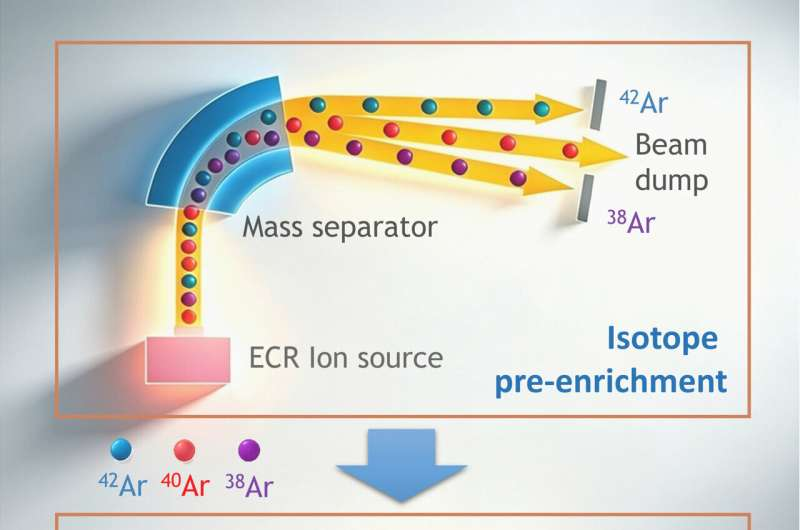
42Ar analysis. Argon samples first undergo isotopic pre-enrichment to remove 40Ar. The enriched argon samples are then introduced into an atom trap for single-atom counting of 42Ar. Credit: Zhao-Feng Wan and Wei Jiang.
Trapping, isolating, and counting atoms
Lu and his colleagues were originally trying to estimate the age of long ice cylinders extracted from the Tibetan Plateau glacier and trace deep ocean currents using an approach known as ³⁹Ar dating. Over time, the radioactive isotope ³⁹Ar breaks down and ³⁹Ar dating entails measuring how much of this isotope is left in a sample to determine how old it is.
“Driven by the demands of these applications, we continuously pushed for higher counting rates and efficiencies in our argon ATTA instrument,” explained Lu.
“About three years ago, it occurred to us that the technique had advanced to the point that it was possible to take on the ⁴²Ar challenge. It was simply very exciting to push the detection limit of atom counting forward by four to five orders of magnitude.”
The detection and characterization of the rare ⁴²Ar isotope could help to identify unwanted signals associated with natural radiation that could be picked up by dark matter detectors. This could inform future dark matter searches, ensuring that researchers do not mistake noise signals for those associated with dark matter. In addition, the detection of ⁴²Ar could open new possibilities for the tracing and dating of environmental samples.
To detect the rare isotope, Lu and his colleagues used a two-step approach. Firstly, they processed an argon gas sample to increase the relative amount of ⁴²Ar inside it, using a technique called pre-enrichment. This process was carried out with a high-flux mass spectrometer, a machine that separates atoms based on their mass.
This initial step removed the abundant isotope ⁴⁰Ar from the gas sample, while increasing the count rate of the rare ⁴²Ar isotope by approximately 450 times.
Notably, the researchers also kept the ³⁸Ar isotope in their sample and used it as a reference, comparing it to ⁴²Ar to ensure the accuracy of their measurements.
“As a second step, we analyzed the enriched sample with ATTA,” explained Lu. “This technique uses resonant laser light to slow down, capture, and detect individual atoms of a specific isotope. ATTA has perfect selectivity: when we tune the laser frequencies to the resonance of ⁴²Ar, only ⁴²Ar atoms are captured and counted.
“No other atomic or molecular species can be mistaken for a ⁴²Ar atom in the trap. Its detection limit is determined solely by the counting rate and measurement duration—a unique characteristic among trace analysis methods.”
Over a 43-day period, the researchers counted 204 individual ⁴²Ar atoms in their sample. Their calculations suggest that the rare isotope had an atmospheric abundance of (6.1 ± 0.5) × 10⁻²¹.
Advancing environmental dating and enabling new physics experiments
This study could soon open new possibilities both for the analysis of environmental samples and for advanced physics research. The team showed that it is now possible to detect and analyze extremely rare isotopes, introducing a promising approach to achieve this.
“We demonstrated that isotopes as rare as 10⁻²¹ can now be analyzed by atom counting—pushing the detection limit four to five orders of magnitude beyond what was previously possible,” said Lu.
“This is the first direct analysis of atmospheric ⁴²Ar, and our result helps resolve discrepancies among earlier decay-counting experiments. Our method can characterize backgrounds for next-generation liquid-argon detectors, where ⁴²Ar decay produces unwanted noise in dark matter searches.”
In the future, the approach introduced by Lu and his colleagues could be adapted and used to analyze other ultra-rare isotopes that have never been detected before. Meanwhile, the researchers plan to continue improving their ATTA technique, to achieve higher count rates and boost its efficiency. This could allow them to analyze smaller samples faster than ever before.
“We also aim to further improve the sensitivity,” added Lu. “These advances will not only benefit future applications of ⁴²Ar but also improve the analysis of isotope tracers already in use, including ³⁹Ar and ⁸¹Kr. For example, with higher throughput of ³⁹Ar analysis, more seawater samples can be analyzed to meet the needs of oceanographic studies. We would also be interested to learn whether there are other ultra-rare isotopes that scientists in different disciplines would like to detect.”
Publication details
Z.-F. Wan et al, Detection of atmospheric ⁴²Ar at the 10⁻²¹ level by atom counting, Nature Physics (2026). DOI: 10.1038/s41567-026-03257-9.
Journal information: Nature Physics
Leave a Reply