
April 24, 2026 by Paul Arnold, Phys.org
Collected at: https://phys.org/news/2026-04-carbon-nanotubes-gap-copper.html
Carbon nanotubes are one technology that many observers believe hasn’t quite lived up to the extreme hype that surrounded them when they first appeared on the scene in the late 1990s. At that time, much was made of their extraordinary electrical, thermal, and mechanical properties, with predictions that they would revolutionize materials science, electronics, and daily life. But could we be closer to realizing some of that promise?
In a paper published in the journal Science, researchers describe a method for adding a chemical to carbon nanotube bundles that brings them closer to copper’s ability to conduct electricity.
Carbon nanotubes are nanoscale hollow cylinders of carbon atoms, a structure that allows electricity to flow through them with very low resistance. However, when you bundle millions of them together, as you would need for practical applications like power lines and electrical wiring, they lose some of their exceptional conductivity. Electrons move easily along individual nanotubes, but transferring charge between neighboring tubes in a bundle is much less efficient.
Realizing the nanotube dream
To address this problem, researchers in Spain used a process called intercalation. In chemistry, this is the inclusion of an ion or molecule into a material. It usually happens in layered structures, but in this case, the team inserted the molecules into tiny channels between the nanotubes.
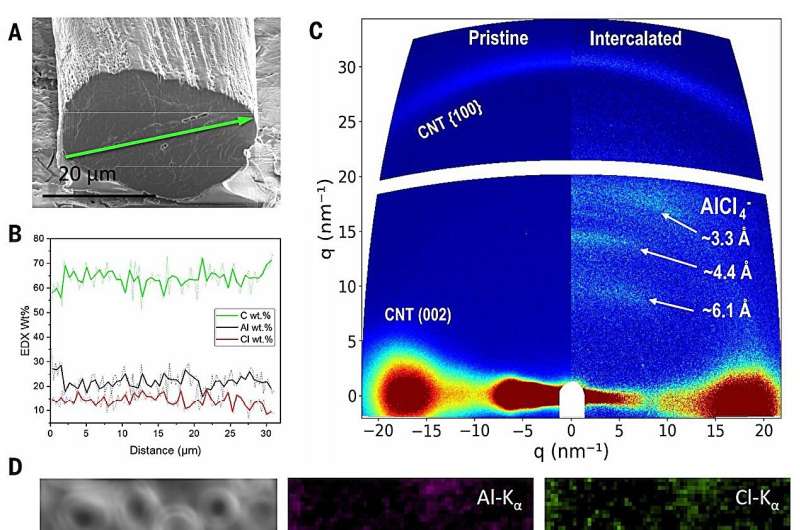
They did this by bathing high-quality fibers made of double-walled carbon nanotubes in a vapor containing aluminum trichloride (AlCl3) for 24 hours, which led to the formulation of tetrachloroaluminate ions (AlCl4⁻). These ions diffused into the natural gaps and formed ordered structures within the fibers. This significantly increased conductivity without making the fibers brittle.
To assess the new material’s performance, the scientists pulled the fibers to breaking point to measure their strength and ran an electric current through them under different conditions. The results were impressive.
“These fibers are five times stronger and half the weight of conventional overhead cables while remaining stable in dry conditions,” noted the study authors in their paper. “Specific conductivity values reach 17,345 Siemens-meter squared per kilogram, which is superior to that of metals.”
Challenges to overcome
Despite these gains, a few challenges remain before these fibers can replace copper wires. The biggest limitation is their sensitivity to moisture. When exposed to humidity, performance gradually declines over time as the ions react with water, which affects how easily electricity can flow. However, the researchers overcame this snag by encasing the fibers in a simple plastic sheath.
Among the next steps for the team are improving fiber stability and scaling up production.
Publication details
A. I. de Isidro-Gómez et al, Intercalated carbon nanotube fibers with high specific electrical conductivity, Science (2026). DOI: 10.1126/science.aeb0673
Journal information: Science
Leave a Reply