
April 23, 2026 by Karyn Hede, Pacific Northwest National Laboratory
Collected at: https://phys.org/news/2026-04-ai-accurate-quantum-chemistry.html
The most demanding calculations in quantum chemistry can now be solved with graphics processing unit (GPU) supercomputers. A recently published study shows that software adapted to use GPU hardware can provide not just speed, but also the accuracy needed to solve complex chemistry problems. The work solved the two chemical structures often seen as too complex and expensive to tackle. The advance, published in the Journal of Chemical Theory and Computation, could allow researchers to make meaningful progress in designing new catalysts and improve predicted behaviors of magnetic and electronic materials.
Specifically, the research team—led by computational chemists from NVIDIA, Sandbox AQ, the Wigner Research Centre in Hungary, the Institute for Advanced Study of the Technical University of Munich in Germany, and the Department of Energy’s Pacific Northwest National Laboratory—showed that NVIDIA Blackwell architecture effectively tackles complex simulations. Here, the researchers used a mixture of mathematically precise and approximated approaches to accomplish their goal.
“Our study shows that AI-oriented hardware can do more than provide speed—it can also power chemically accurate, strongly correlated quantum chemistry at the frontier of what is computationally feasible,” said Sotiris Xantheas, a computational chemist at PNNL and study author. Xantheas also serves as the principal investigator of Scalable Predictive methods for Excitations and Correlated phenomena (SPEC), a Department of Energy initiative.
The study’s senior author, Örs Legeza, of Wigner and TUM, specializes in developing and using a numerical method called Density Matrix Renormalization Group (DMRG) to solve difficult quantum chemistry problems that involve large numbers of interacting electrons. These types of problems are especially interesting to researchers seeking to understand and ultimately emulate complex energy conversions, such as catalysis and semiconductor behavior.
AI speeds solutions for chemical conversion
To demonstrate the mixed-precision method, the research team chose to solve the structures of the active compounds of FeMoco, which helps catalyze the conversion of atmospheric nitrogen to ammonia, a key component of fertilizer, and cytochrome P450, an important liver enzyme. These two enzymes are seen as benchmarks for computational methods and serve as exemplars of the kinds of practical chemical structures researchers would like to solve. But until now, solving these types of structures has proven too complex and time-consuming for even the most advanced computing platforms.
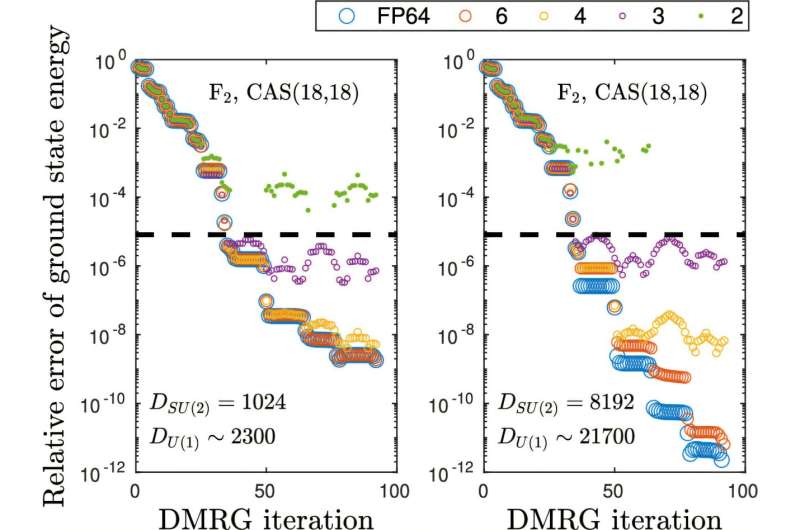
The research team solved the problems by combining DMRG with techniques emulating FP64 arithmetic through reduced precision compute resources developed for handling AI workloads. Their strategy involved tolerating less precision where it wasn’t necessary and reserving high precision for the calculations that demand it. The result was the first quantum chemistry calculation using FP64 emulation that achieved chemical accuracy.
“By demonstrating that mixed-precision DMRG with emulated FP64 can reach chemical accuracy for challenging active spaces, we’ve opened a practical path to using next-generation Blackwell systems for problems in catalysis, bioinorganic chemistry, and materials science that were previously far harder to access,” said Legeza.
The research team successfully demonstrated that it is possible to creatively combine leading-edge GPU technologies with advanced scientific computing methods. Chemists can now benefit from the massive computational capabilities available in GPUs for tackling today’s thorniest scientific computing challenges.
Calculations once considered prohibitively difficult could become routine on these next-generation accelerator platforms, the research team suggests.
“This study shows that NVIDIA Blackwell hardware can not only deliver on the frontier of AI but also impact the physical economy by developing new materials purely in silico,” said Adam Lewis, Head of Innovation, AI Sim, at SandboxAQ.
More information
Cole Brower et al, Mixed-PrecisionAb InitioTensor Network State Methods Adapted for NVIDIA Blackwell Technology via Emulated FP64 Arithmetic, Journal of Chemical Theory and Computation (2026). DOI: 10.1021/acs.jctc.6c00203
Leave a Reply