
Jack Loughran Thu 23 Apr 2026
Collected at: https://eandt.theiet.org/2026/04/23/artemis-ii-proved-low-cost-laser-links-can-transform-data-transmissions-space
The recent Artemis II mission around the Moon has proven the reliability of relatively cheap, laser-based communication technology for space missions, a space research and technology company has said.
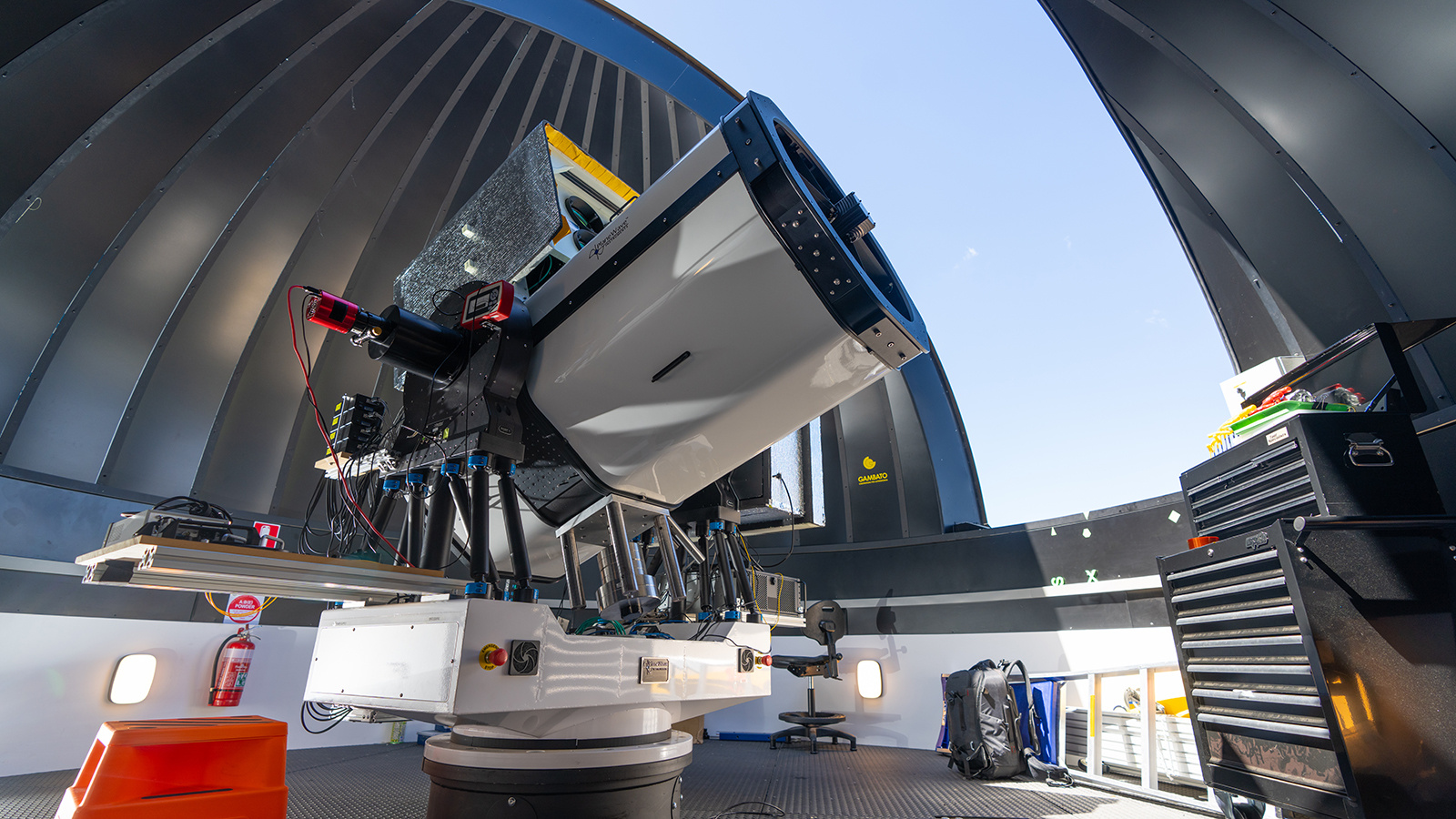
Observable Space, which specialises in space optics and laser communications, worked with Quantum Opus to create a system that can drastically improve data rates in space compared to traditional radio transmissions.
The technology enabled high-definition video to broadcast live from the Orion space capsule and back-and-forth video calls with President Donald Trump among others.
Nasa’s Apollo missions, which took place in the 1960s and early 1970s, deployed the Unified S-Band system, which operated in the 2GHz microwave range to broadcast voice, telemetry and television signals into a single radio carrier. While this was cutting-edge for the time, it was limited by the physics of radio waves, which spread out over long distances and have limited bandwidth.
On the other hand, the laser-based system developed by Observable Space was able to utilise the maximum data rate of 260 megabits per second during the Artemis mission, which is roughly 5,000 times the data rate achieved during Apollo 11. While only a fraction of that data rate was actually used during the mission, it demonstrated its capabilities for future space programmes that could require vastly higher data throughput.
Artemis II sent most of the data back to Earth via the Orion Artemis II Optical Communications System, which interfaces with ground stations in California and New Mexico among other research centres. Observable Space said the system was relatively “low cost” considering its capabilities, with reports suggesting Nasa spent less than $5m on it.
The demonstration also used Southern Hemisphere optical links for the first time, helping to fill in a large portion of the ‘blind spot’ created by only using US ground stations. Even as the Earth rotated away from the primary US-based ground stations, the hardware was able to maintain the high-speed connection.
Observable Space said that in the future, numerous low-cost ground stations could be deployed across the world so that a constant connection can be maintained, no matter the orientation of the spacecraft and the Earth, as well as local weather patterns, which could obscure the connection of specific ground stations.
“The successful downlinking of data and streaming of live HD video from the spacecraft on Artemis II isn’t just a technical win – it’s the beginning of a new era of connectivity,” said former Nasa astronaut and Quantum Opus co-founder Dr Josh Cassada. “The high-efficiency SNSPDs [superconducting nanowire single-photon detectors], with their world-class timing performance, were the key to processing these 1550nm pulses for an incredible data stream from the lunar environment. We aren’t just receiving video; we’re building the first nodes of a space-based Quantum Internet.”
Leave a Reply