
April 6, 2026 by The University of Hong Kong
Collected at: https://techxplore.com/news/2026-04-memristor-chip-combines-memory-edge.html
A cross-institutional research team has developed Co-Located Authentication and Processing (CLAP), a privacy-preserving system that overcomes the trade-off between security and performance in edge computing devices. The study, titled “Privacy-preserving data analysis using a memristor chip with co-located authentication and processing,” is published in Science Advances. The team was led by Professor Ngai Wong and Dr. Zhengwu Liu from the Department of Electrical and Computer Engineering in the Faculty of Engineering at The University of Hong Kong (HKU), in collaboration with Tsinghua University and the Southern University of Science and Technology.
How CLAP tackles edge security
The CLAP system integrates authentication and processing functions within a unified memristor-based platform, offering critical security protection for applications ranging from wearable medical devices to industrial IoT. This innovation addresses major vulnerabilities in current edge computing systems.
Edge computing devices—from wearable health monitors to industrial sensors—face a critical security challenge: how to protect sensitive data while maintaining efficient on-device processing.
Recent incidents have demonstrated how attackers could remotely manipulate insulin pump dosages or exploit vulnerabilities in hundreds of thousands of cardiac devices, highlighting the urgent need for intrinsically secure solutions in resource-constrained scenarios where every milliwatt of power and square millimeter of silicon matters.
Memristors at the heart of CLAP
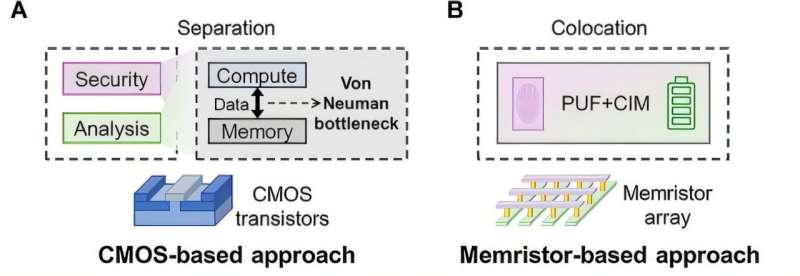
The key innovation lies in memristors—emerging electronic components that store data and perform calculations in the same location, unlike conventional computers where memory and processing are separated.
Beyond this compute-in-memory advantage, memristors also possess inherent physical randomness—tiny, unavoidable variations between individual devices. This randomness serves as a unique security identifier for device authentication while the compute-in-memory capability enables efficient data analysis.
Dr. Liu explained, “We exploit both characteristics simultaneously. Current solutions separate security from analysis modules and memory from computation units, creating significant hardware and energy overheads—prohibitive for resource-limited edge applications. Our hardware-level integration maintains authentication reliability and computational accuracy without traditional inefficiencies.”
Real-world demonstrations and impact
The team demonstrated CLAP’s versatility in diverse information processing tasks, including discrete wavelet transform, discrete Fourier transform, compressed sensing, and multi-layer perceptron neural networks.
As a proof-of-concept, the researchers showcased secure electrocardiogram (ECG) data collection in health care monitoring, achieving device authentication with an area under the curve of 99.46% and efficient signal compression with an 18.67% root-mean-squared difference. The results are remarkable, with a 146-fold energy efficiency gain and nearly 18-fold area reduction compared to conventional implementations.
“This technology represents a significant milestone in secure edge computing,” noted Professor Wong.
“These improvements are critical for any resource-constrained application, from medical implants to industrial IoT sensors. We’re moving toward a future where security is not an add-on module but an intrinsic property of the computing hardware itself.”
Publication details
Zhengwu Liu et al, Privacy-preserving data analysis using a memristor chip with colocated authentication and processing, Science Advances (2026). DOI: 10.1126/sciadv.ady5485
Journal information: Science Advances
Leave a Reply