
December 31, 2025 by Ingrid Fadelli, Phys.org
Collected at: https://phys.org/news/2025-12-physicists-flaw-quantum-resource-theorem.html
Quantum information theory is a field of study that examines how quantum technologies store and process information. Over the past decades, researchers have introduced several new quantum information frameworks and theories that are informing the development of quantum computers and other devices that operate leveraging quantum mechanical effects.
These include so-called resource theories, which outline the transformations that can take place in quantum systems when only a limited number of operations are allowed.
In 2008, two scientists at Imperial College London introduced what they termed the generalized quantum Stein’s lemma, a mathematical theorem that describes how well quantum states can be distinguished from one another. In this generalized setting, one typically considers multiple identical copies of a specific state (the null hypothesis) and tests them against a composite alternative hypothesis, i.e., a set of states (e.g., resource-free states).
Researchers at the Chinese University of Hong Kong, Shenzhen (CUHK-Shenzhen) and the University of Tokyo re-examined this mathematical theorem and tried to fix a flaw of the theorem that was first identified a few years ago.
Their paper, published in Nature Physics, introduces new rules that repair the gap in the quantum Stein’s lemma, restoring confidence in the theorem and improving the current understanding of quantum information systems.
“The generalized quantum Stein’s lemma is a statement concerning a generalization of the quantum Stein’s lemma in quantum hypothesis testing,” Masahito Hayashi, co-author of the paper, told Phys.org.
“The claim was first articulated by Brandão and Plenio in 2008. A key point is that, in this generalized setting, the second argument of the quantum relative entropy is taken to be a composite hypothesis, and five conditions are imposed on that composite alternative. However, it was discovered in recent years that there is a gap in the existing proof.”
Fixing the gap in the quantum Stein’s lemma
The flaw in the quantum Stein’s lemma was first identified in 2021, after a team of physicists posted a paper that contained ideas rooted in the theorem.
Marco Tomamichel, a professor at National University of Singapore (NUS) spotted an issue with the researchers’ paper, which the authors traced back to the original theorem introduced by Brandão and Plenio in 2008.
“Later, Berta and his colleagues published a paper explicitly describing the gap and its consequences,” said Hayashi.
“This is how the gap in Brandão–Plenio’s earlier work became widely known. As this result is foundational in quantum resource theory, and because many papers depended on it, many researchers investigated whether the claim could be repaired with a correct proof. For example, Yamasaki and Kuroiwa posted a paper aimed at resolving the issue, but that proof also turned out to contain a gap.”
Around this time, Hayashi was conducting extensive research in the field of quantum information theory and had already tested several quantum hypotheses. Nonetheless, he was not yet closely familiar with the newly identified gap in the theorem and had not tried to repair it.
“I initially heard about this issue second-hand, and the person conveying it did not accurately specify the five conditions imposed on the composite alternative hypothesis,” said Hayashi.
“For instance, if the composite hypothesis is not convex, it is easy to construct counterexamples—yet that condition was not communicated while the closedness of the composite hypothesis is one of the five conditions.”
Based on the information he had acquired at the time, Hayashi thought that a generalization for the theorem would not possible hold, thus he did not try to derive one.
In May 2024, however, he attended an international workshop at University of Granada where he learned more about the theorem and changed his mind.
“At this workshop, my co-author Hayata Yamasaki explained the conjectured generalized quantum Stein’s lemma and, crucially, stated the five conditions on the composite alternative hypothesis correctly and clearly,” said Hayashi.
“Because the explanation was easy to follow, Hayashi began—during the latter half of the workshop and while traveling to the next meeting—to examine whether the claim could be proved.”
Hayashi first tried to tackle the flaw in the theorem drawing from the mathematical concept of Schur duality rooted in so-called group representation theory. While proofs for the generalized quantum Stein’s lemma generally consider five technical conditions, he excluded one of them, namely the assumption that the allowed set of states remains valid after part of the system is discarded.
“After developing a rough proof of the theorem, I sent it to Yamasaki for checking,” said Hayashi. “After several rounds of exchange, the proof was completed and we moved on to generalizing the resource conversion theory. During this phase, Yamasaki first wrote down the main ideas, and I refined and modified them.”
A reliable mathematical basis for designing quantum technologies
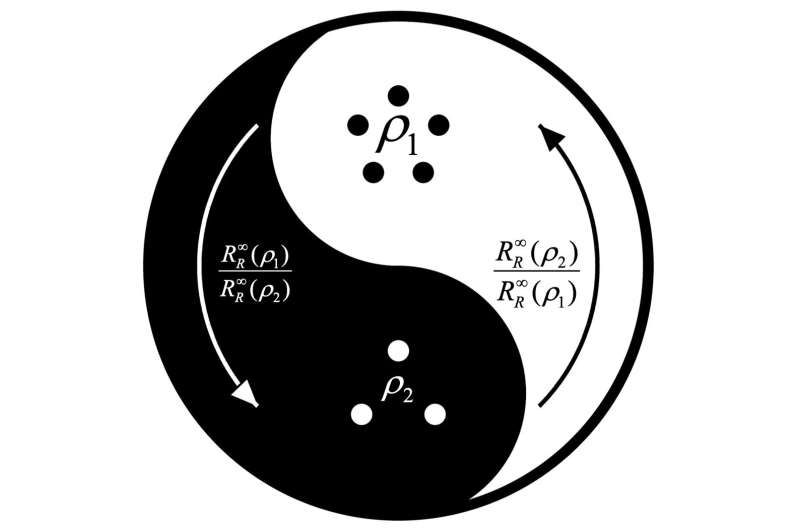
Ultimately, Hayashi and Yamasaki were able to fix the issue with the quantum Stein’s lemma, confirming that quantum resources obey a law similar to the second law of thermodynamics. Their effort offers a more reliable framework for understanding what can be achieved by quantum technologies.
Hayashi presented their work at NUS during a seminar organized by Tomamichel. On this occasion, the professor, who was the first to identify a flaw with the original theorem, confirmed the correctness of their proof.
“At this stage, the proof still assumed one of the five conditions: closure under permutations,” explained Hayashi. “However, that assumption was used only in constructing a pinching operation. Standard pinching techniques typically require that the number of distinct eigenvalues be bounded polynomially for the number of copies, and in the original approach, the permutation-closure condition ensured this requirement.”
In some mathematical proofs, scientists need to analyze so-called eigenvalues, numbers that capture the essential properties of a matrix. If the number of eigenvalues is too large, which in this context would occur when considering very large quantum systems, the theorem might be difficult to apply.
“To handle the case where the number of eigenvalues is not polynomial, we used a technique introduced in an earlier paper, which works by replacing a matrix with another matrix whose number of eigenvalues is polynomial and then carrying out the argument,” said Hayashi.
“Using this technique, we succeeded in removing the permutation-closure assumption and could then submit the final version of the paper to Nature Physics.”
The recent paper by Hayashi and his colleague could have important implications for both quantum information theory and for the development of quantum technologies.
In the future, their updated version of the generalized quantum Stein’s lemma could be used by quantum engineers to optimize quantum algorithms and better predict what their systems can realistically achieve.
“With this result, we succeeded in re-establishing the ‘second law’ in quantum resource theories,” said Hayashi.
“In other words, the conversion of various types of quantum resources can—under an appropriate class of conversion rules—now be discussed in a unified way in terms of conversion rates. As a continuation of this work, we plan to further develop resource theories for dynamical resources and have already obtained some results in this direction.”
More information: Masahito Hayashi et al, The generalized quantum Stein’s lemma and the second law of quantum resource theories, Nature Physics (2025). DOI: 10.1038/s41567-025-03047-9.
Journal information: Nature Physics
Leave a Reply