
December 31, 2025 by David Appell, Phys.org
Collected at: https://phys.org/news/2025-12-real-life-niels-bohr-theoretical.html
Scientists in China have performed an experiment first proposed by Albert Einstein almost a century ago when he sought to disprove the quantum mechanical principle of complementarity put forth by Niels Bohr and his school of physicists. Bohr claimed there are properties of particles that cannot simultaneously be measured. The new result backs up the Copenhagen school yet again, with the potential to shed light on other, less settled questions in quantum mechanics.
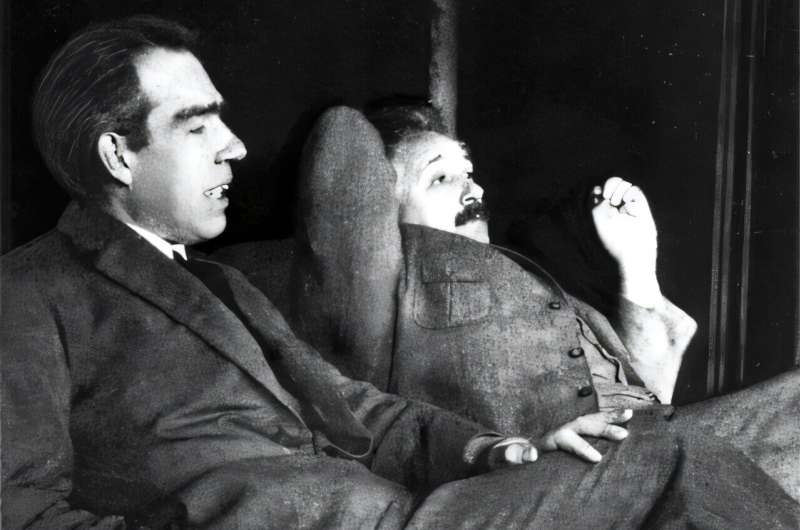
When they met at physics conferences, Albert Einstein and Niels Bohr liked to kick back and debate about quantum mechanics. Einstein, always skeptical of the standard picture of quantum mechanics then being developed, liked to claim he had found holes and inconsistencies in Bohr’s interpretation, and Bohr was always up for the challenge.
At the 1927 Solvay conference in Brussels, the two Nobel Laureates had perhaps their most famous parley, with Einstein famously proclaiming, “God does not play dice with the universe.” In particular, Einstein proposed an experiment he thought would reveal the essential contradiction in the principle of complementarity, which held that pairs of properties of particles, such as position and momentum, and frequency and lifetime, cannot be measured at the same time. Complementarity undergirds the concepts of wave-particle duality and Heisenberg’s uncertainty principle.
Einstein imagined an experiment with two narrow slits aligned horizontally. With that alone, particles aimed at the slits would display interference fringes on a display screen behind the slits; this is the standard double-slit experiment first described for light by Thomas Young in 1801 and performed for electrons in 1927, showing their wave-like nature.
In an extension of this experiment, Einstein proposed the particles first pass through a single slit, also horizontally aligned. This single slit was to be held on top and bottom by momentum-sensitive springs.
So, particles headed for the upper of the two later slits would impact a downward momentum on the single slit as it recoiled, showing their particle nature. But after the double slits and the resulting interference pattern, revealing the particles’ wave-like nature. But such fringes would, Einstein claimed, contradict the complementarity principle. Bohr disagreed.
The experiment performed by Jian-Wei Pan of the University of Science and Technology of China and colleagues backed Bohr’s position; their paper has been published in Physical Review Letters.
Bohr’s argument was that precisely measuring the particle’s momentum would, according to the uncertainty principle, leave a large uncertainty in the particle’s position, resulting in a blurring of the interference fringes. That is exactly what has been observed in the new research.
In Pan and colleagues’ experiment, the particle was a photon, the quantum particle of light, and acting as the single slit was a single rubidium (Rb) atom trapped in place by an optical tweezer.
The atom was cooled so that it was its ground state in its three-dimensional harmonic potential. In their experimental design, this single atom serves as an ultralight beam splitter, with its momentum entangled with the incoming photon’s momentum and the uncertainty in its momentum brought down to that of a single photon.
Varying the trap depth of the optical tweezer dynamically tuned the rubidium atom’s intrinsic momentum uncertainty, which in turn made the fringes more or less blurry, in accordance with the complementarity principle and Bohr’s prediction.
One complication was heating of the atom, caused by frequency drifts in the focused lasers forming the trap. The latter ramped the tweezer’s depth up and down, scattering incoming photons.
The team was able to calibrate for the effect of atom heating by extracting the residual temperature using scanning Raman spectroscopy in real time.
Raman spectroscopy uses laser light to probe molecular vibrations. Laser light of a single wavelength is directed onto a sample. While most of the light scatters elastically, with no change in energy, a small fraction scatters inelastically and the change in frequency (energy) reveals the presence of chemical bonds, composition and molecular interactions.
The ratio of the higher frequency to the lower frequency is directly proportional to the thermal population of the vibrational modes of the atom, which follow a Bose-Einstein distribution. The atom’s temperature could be extracted in this way.
From a modern point of view, the authors write, “the Einstein-Bohr interference visibility is determined by the degree of quantum entanglement in the momentum degree of freedom between the photon and the slit.”
They also investigated the difference between the quantum limit and the classical heating of the atom motional states, which allows observation of the quantum-to-classical transitions.
While the complementarity principle of quantum mechanics has long been borne out by experiments, realizing and settling an old and famous debate based on a thought experiment is always noteworthy. The team now anticipates using quantum state tomography to determine the quantum state of the quantum slit, directly probing entanglement. As well, gradually increasing the slit’s mass will enable a probe of the interplay between decoherence and entanglement.
More information: Yu-Chen Zhang et al, Tunable Einstein-Bohr Recoiling-Slit Gedankenexperiment at the Quantum Limit, Physical Review Letters (2025). DOI: 10.1103/93zb-lws3
Journal information: Physical Review Letters
Leave a Reply