
By University College London April 28, 2025
Collected at: https://scitechdaily.com/geoengineering-goes-polar-a-faster-riskier-way-to-cool-the-earth/
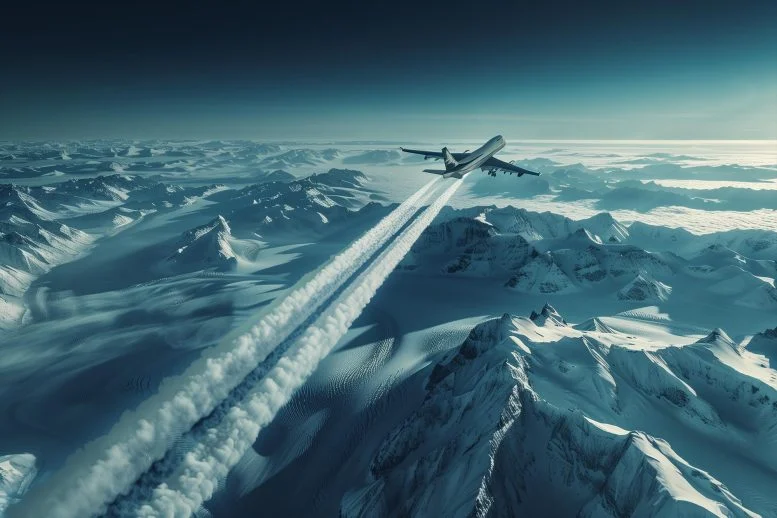
Scientists have discovered that cooling the planet by injecting sunlight-reflecting particles into the atmosphere could be achieved using existing large aircraft, not requiring expensive new planes.
By targeting the polar regions at lower altitudes, this method could offer a faster, albeit less powerful, way to combat climate change. However, it demands more aerosol, risks side effects like acid rain, and doesn’t replace the urgent need to cut emissions. Despite its limitations, this approach could buy time while longer-term climate solutions are developed.
Existing Planes Could Enable Planet Cooling
A new modeling study led by researchers at UCL (University College London) suggests that cooling the planet by reflecting sunlight back into space could be achieved using existing large aircraft, without the need to develop specially designed planes.
Until now, most research into this method, known as stratospheric aerosol injection, assumed that it would need to be carried out in the tropics, requiring custom-built aircraft capable of reaching altitudes of 20 kilometers or more to deploy the particles effectively.
New Simulations Show Polar Approach Potential
In the new study, published today (April 28) in the journal Earth’s Future, scientists used computer simulations to test different deployment strategies. They found that injecting particles at an altitude of around 13 kilometers over the polar regions could still significantly cool the planet, although less effectively than higher-altitude injections closer to the equator. Importantly, existing commercial jets like the Boeing 777F are capable of reaching these lower stratospheric altitudes.
Lead author Alistair Duffey, a PhD student in UCL’s Department of Earth Sciences, explained: “Solar geoengineering comes with serious risks and much more research is needed to understand its impacts. However, our study suggests that it is easier to cool the planet with this particular intervention than we thought. This has implications for how quickly stratospheric aerosol injection could be started and by who.
“There are downsides to this polar low-altitude strategy. At this lower altitude, stratospheric aerosol injection is about one-third as effective. That means that we would need to use three times the amount of aerosol to have the same effect on global temperature, increasing side effects such as acid rain. The strategy would also be less effective at cooling the tropics, where the direct vulnerability to warming is highest.
“However, climate change is a serious problem and it is vital to understand all our options, so that policy-makers have the evidence they need to make informed decisions.”
Comprehensive Modeling with UKESM1
The researchers ran simulations in the UK’s Earth System Model 1 (UKESM1), a computer model of the climate, to estimate the impact of stratospheric aerosol injection. By adding sulfur dioxide, which goes on to form tiny reflective particles, at different altitudes, latitudes, and seasons, they were able to quantify the effectiveness of different deployment strategies.
They said that low-altitude deployment of stratospheric aerosol injection could only work if it was done close to the Earth’s polar regions. To be effective, particles need to be created in the stratosphere, a layer of the atmosphere above the top of most clouds, and this layer is closer to the ground nearer to the poles.
Advantages of the Stratosphere Over the Troposphere
In the troposphere – the lowermost layer of the atmosphere – any aerosol particles would disappear quickly as they are caught up in clouds and rained out. However, the stratosphere is dry, stable, and free of clouds, meaning that added particles would stay up for months or years.
The researchers estimated that injecting 12 million tonnes of sulfur dioxide a year at 13 km in the local spring and summer of each hemisphere would cool the planet by around 0.6°C. This is roughly the same amount added to the atmosphere by the eruption of the Mount Pinatubo volcano in 1991, which also produced an observable dip in global temperatures.
Geographic Focus for Aerosol Injection
In the simulation, the sulfur dioxide was added at latitudes of 60 degrees north and south of the equator. That is roughly the latitude of Oslo in Norway and Anchorage in Alaska; in the south, that would be below the southernmost tip of South America.
This strategy is not as effective as injecting sulfur dioxide at 20km because the particles do not stay in the stratosphere for as long, i.e., for only a few months at 13km rather than for up to several years at 20km.
Accelerated Timeline with Existing Aircraft
However, a low-altitude strategy using existing aircraft could begin sooner than a high-altitude approach, with the researchers noting an earlier study finding that designing and certifying high-flying aircraft might take a decade and cost several billion dollars.
Co-author Wake Smith, a Lecturer at Yale School of the Environment, part of Yale University, said: “Although pre-existing aircraft would still require a substantial modification program to be able to function as deployment tankers, this route would be much quicker than designing a novel high-flying aircraft.”
Long-Term Caution and Need for Emissions Reductions
The strategy is not a quick fix – any stratospheric aerosol injection would need to be introduced gradually, and reduced gradually, to avoid catastrophic impacts from sudden warming or cooling. Nor would it eliminate the need for emissions reductions.
Co-author Dr. Matthew Henry, of the University of Exeter, said: “Stratospheric aerosol injection is certainly not a replacement for greenhouse gas emission reductions as any potential negative side effects increase with the amount of cooling: we can only achieve long-term climate stability with net zero.”
Reference: 28 April 2025, Earth’s Future.
DOI: 10.1029/2024EF005567
The study received funding from the UK’s Natural Environment Research Council (NERC).
Leave a Reply