
By RIKEN May 2, 2025
Collected at: https://scitechdaily.com/quantum-code-cracked-scientists-solve-20-year-puzzle-behind-entanglement-purity/
Scientists have achieved a major leap in quantum technology by deriving an exact mathematical expression crucial for refining noisy quantum entanglement into the pure states needed for advanced quantum computing and communication.
Their work revisits and corrects flawed theories from two decades ago, pushing the theoretical frontier far ahead of experimental capabilities and setting the stage for future breakthroughs once technology catches up.
Breakthrough in Quantum Technology Modeling
A RIKEN mathematical physicist, together with a collaborator, has derived an exact mathematical expression for a process that plays a critical role in many quantum technologies. This theoretical breakthrough could help accelerate progress in fields like quantum computing and quantum communication.
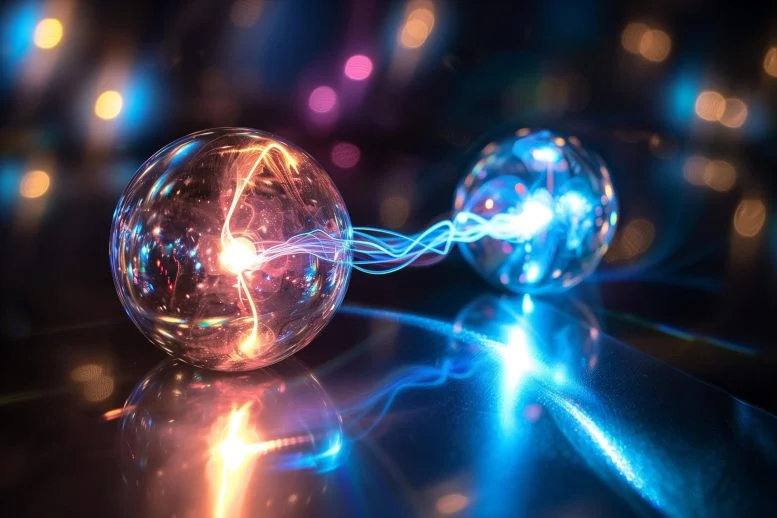
Many next-generation quantum technologies rely on quantum entanglement, a strange but powerful phenomenon once famously described by Einstein as “spooky action at a distance.” Entanglement occurs when two or more particles become so deeply linked that changes to one instantly affect the other, even if they’re separated by vast distances. These connections produce quantum correlations that go far beyond what classical physics can achieve.
The Mystery of Quantum Entanglement
For quantum technologies to work reliably, they need pure, noiseless entangled states. However, due to imperfections in current quantum systems, the entangled states produced in real-world labs are often weak and noisy.
To overcome this challenge, scientists use a process called entanglement distillation (or entanglement purification). This technique takes multiple noisy entangled states and refines them into fewer, but much stronger, entangled pairs, closer to the ideal needed for practical use.
“Entanglement distillation is essential because there is this gap between the pure entanglement that quantum protocols require and the noisy entanglement we can prepare in the lab,” explains Bartosz Regula of the RIKEN Center for Quantum Computing.
Closing the Gap Between Theory and Practice
But mathematically determining how fast entanglement can be distilled from noisy quantum states is extremely challenging.
“Except for some very special cases, we’re unable to evaluate the rate of entanglement distillation,” says Regula. “This greatly limits our understanding of entanglement distillation.”
Now, Regula and Ludovico Lami of the University of Amsterdam in the Netherlands have derived an exact expression for less stringent conditions. This is only the second time that such an exact expression has been derived in the field.
The advance helps shed light on a question that goes back two decades. “A series of papers about 20 years ago claimed to have shown some connections between entanglement distillation and relative entropy,” notes Regula. “But these questions have received renewed attention in recent years because the original mathematical proofs they were based on were found to contain a flaw.”
Revisiting a Two-Decade-Old Quantum Puzzle
Regula was surprised when an exact expression fell out. “We suspected that there might be a relationship,” says Regula. “But it was a nice surprise when we were able find an exact expression for it.”
Because the expression is based on an approximation involving a large number of quantum states, it will be a while before experiments reach a scale where the expression becomes applicable.
“This is a case where theory is far ahead of experiments,” says Regula. “To see these rates, we’d need to manipulate many, many quantum systems at the same time, but experimentalists currently struggle to manipulate tens or hundreds of quantum bits.
Reference: “Distillable entanglement under dually non-entangling operations” by Ludovico Lami, and Bartosz Regula, 22 November 2024, Nature Communications.
DOI: 10.1038/s41467-024-54201-5
Leave a Reply