
Arezki Amiri Published on December 31, 2024
Collected at: https://dailygalaxy.com/2024/12/nasa-discovers-massive-planet-bigger-than-earth-with-gas-tied-exclusively-to-living-organisms/
Breaking astronomical news: NASA‘s James Webb Space Telescope has unveiled a groundbreaking find—an exoplanet not only significantly larger than Earth, but also with signs of a gas only produced by living organisms on our planet. Could this be the closest we’ve come to proving life exists beyond Earth?
Space travel insurance
K2-18 B: A Colossal Planet with Life-like Gas
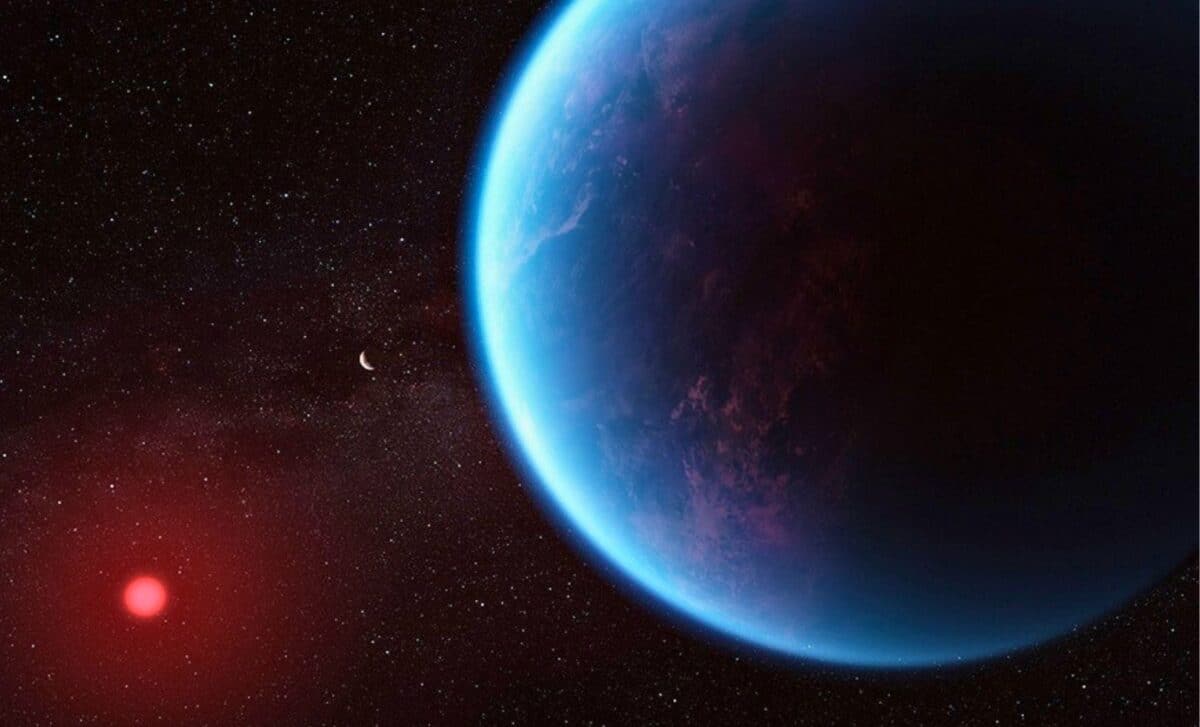
Named K2-18 b, this intriguing exoplanet is located 120 light-years away in the constellation Leo, orbiting a red dwarf star known as K2-18. This star is significantly smaller and cooler than our Sun, creating a potentially habitable environment for planets within its orbit. K2-18 b is a sub-Neptune-class exoplanet, a type absent from our solar system, with 2.6 times Earth’s radius and 8.6 times its mass.
First identified by NASA‘s K2 mission in 2015, the planet has become a focal point of atmospheric studies due to its unique size and position in the habitable zone. Recent investigations using the James Webb Space Telescope have provided groundbreaking insights into its atmosphere.
Space travel insurance
Atmospheric composition highlights:
- Methane and Carbon Dioxide: Strong evidence of carbon-bearing molecules, indicative of active processes.
- Potential Dimethyl Sulfide (DMS): On Earth, this molecule is produced exclusively by marine life, making its potential detection on K2-18 b particularly exciting.

Illustration: NASA, CSA, ESA, R. Crawford (STScI), J. Olmsted (STScI), Science: N. Madhusudhan (Cambridge University)
Is K2-18 B a Hycean World?
The presence of methane, carbon dioxide, and a potential absence of ammonia support the hypothesis that K2-18 b could be a Hycean exoplanet. These planets are defined by their hydrogen-rich atmospheres and possible water-covered surfaces, making them promising candidates in the search for extraterrestrial life.
Lead researcher Nikku Madhusudhan emphasized, “Traditionally, the search for life on exoplanets has focused on smaller rocky planets, but larger Hycean worlds are significantly more conducive to atmospheric observations.”
However, the planet’s size suggests challenges. It likely has a mantle of high-pressure ice beneath its hydrogen-rich atmosphere and ocean, which could be too hot to sustain life as we know it.
Key characteristics of K2-18 b:
| Property | Details |
|---|---|
| Distance from Earth | 120 light-years |
| Location | Constellation Leo |
| Mass | 8.6 times Earth |
| Radius | 2.6 times Earth |
| Discovery | NASA’s K2 mission (2015) |
Groundbreaking Observations with the James Webb Telescope
The advanced capabilities of the James Webb Space Telescope have been instrumental in characterizing K2-18 b’s atmosphere. By analyzing light as it passes through the planet’s atmosphere during transits, scientists identified its molecular composition with unprecedented detail.
Comparison to previous observations:
- Webb’s two transits yielded insights equivalent to eight years of Hubble data.
- Observations revealed robust spectral features, marking a milestone in atmospheric analysis.
The telescope’s Mid-Infrared Instrument (MIRI) will be used in future observations to confirm the presence of DMS and provide further data on the planet’s environment. “This result was only possible because of the extended wavelength range and unprecedented sensitivity of Webb,” noted Madhusudhan.
Potential Habitability and the Search for Life
Despite its position in the habitable zone, K2-18 b’s habitability remains uncertain. Its massive size and dense atmosphere might create conditions too extreme for life as we know it. However, the detection of DMS, if validated, would be a significant step in the quest to identify life-supporting environments.
Astronomer Savvas Constantinou explained, “Our work here is but an early demonstration of what Webb can observe in habitable-zone exoplanets.”
The Road Ahead
NASA’s continuing exploration of Hycean worlds like K2-18 b is revolutionizing our understanding of exoplanetary environments. Future observations will seek to confirm the presence of DMS and further investigate K2-18 b’s potential to host life.
As Madhusudhan stated, “Our ultimate goal is the identification of life on a habitable exoplanet, which would transform our understanding of our place in the universe.”
This discovery brings us closer to answering humanity’s profound question: Are we alone in the cosmos? With K2-18 b as a beacon of possibility, the universe has never seemed more full of potential.
Leave a Reply