
Arezki Amiri Published on December 31, 2024
Collected at: https://dailygalaxy.com/2024/12/want-to-find-a-black-hole-start-with-the-oldest-rock/
Primordial black holes, theoretical remnants of the Big Bang, have intrigued scientists for decades. Hypothesized to have formed in the first second of the universe’s existence, these black holes may be among the smallest and most elusive cosmic phenomena. Despite their potential importance in explaining the universe’s dark matter and the origins of black holes, their existence remains unconfirmed.
A recent paper by scientists De-Chang Dai of National Dong Hwa University in Taiwan and Dejan Stojkovic of the University of Buffalo in New York, published in Physics of the Dark Universe on September 20, 2023, proposes an innovative way to search for them—by examining ancient rocks and other solid objects right here on Earth.
The Search for Ancient Mysteries
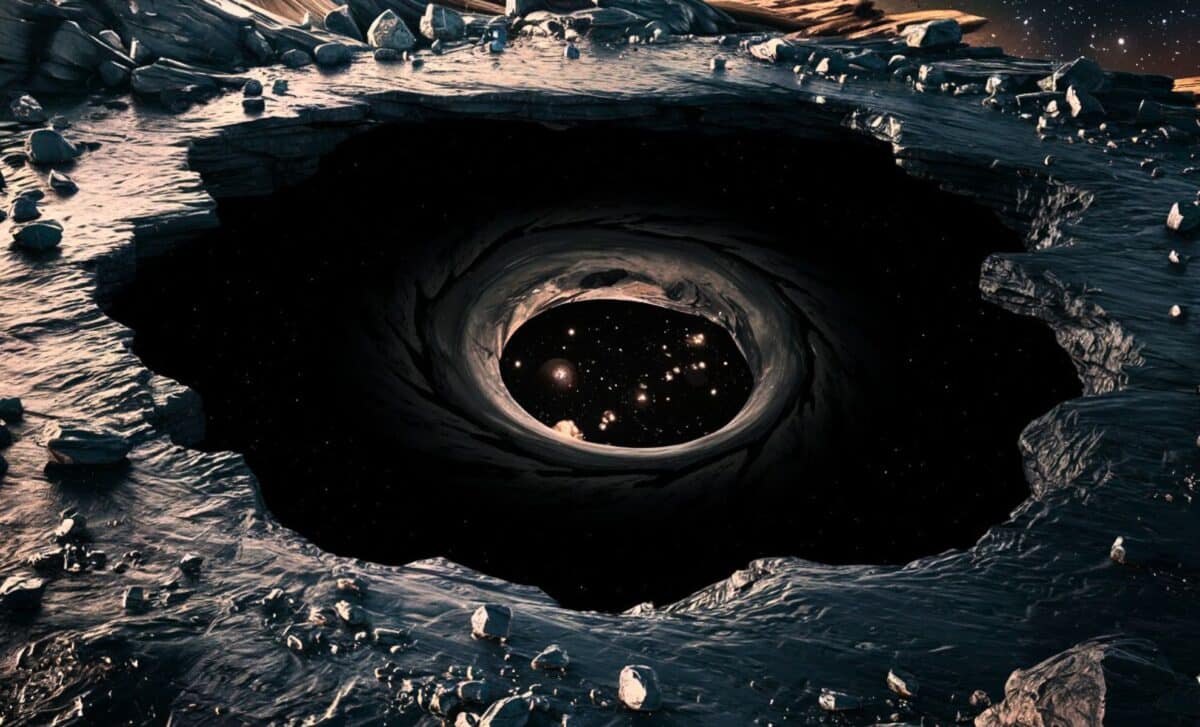
Black holes are often envisioned as massive, star-devouring giants, but primordial black holes could challenge that notion. With masses as small as that of Earth, these black holes would have event horizons barely the size of a dime. The researchers suggest that these tiny, fast-moving primordial black holes might leave microscopic holes in solid matter as they pass through it, consuming everything within their gravitational reach.
According to their calculations:
- A black hole with a mass of 2.2 × 10¹⁹ pounds (10²² grams) could create a hole just 0.1 micron in size.
- Such a hole would be visible under an optical microscope, making detection feasible with minimal equipment.
- The best places to search are in very old rocks, glass, or other solid structures in ancient buildings, where the chance of interaction over billions of years slightly increases.
The odds of finding such evidence remain slim. The researchers estimate that the likelihood of a billion-year-old rock encountering a primordial black hole is just 0.000001, but the minimal cost of searching makes it worth the effort. As Stojkovic noted, “You have to look at the cost versus the benefit. Does it cost much to do this? No, it doesn’t.”
Primordial Black Holes: A Window to the Early Universe
Primordial black holes hold profound implications for cosmology. If proven to exist, they could validate theories about the conditions of the early universe, when matter was densely packed. The idea stems from the hypothesis that regions of over-dense matter during the Big Bang could have collapsed into black holes of varying sizes.
Their detection would not only advance our understanding of black holes but also shed light on dark matter, a mysterious substance that makes up about 85% of the universe’s mass. While we cannot see dark matter, its gravitational effects are evident. Primordial black holes, if they exist, could represent a portion of this elusive material, offering a new avenue for research into the universe’s hidden mass.
Implications for Celestial Objects
Dai and Stojkovic also theorize that primordial black holes could interact with planets, stars, and asteroids. These interactions could create distinct patterns:
- Planets and stars: A black hole passing through a planet’s dense core could hollow it out. While large planets might collapse under their own weight, smaller objects, like asteroids made of granite or iron, could survive, even with a hollowed core.
- Asteroids and minor planets: Strong materials like iron could withstand black hole interactions better than gas-rich planets.
These phenomena, while rare, are not impossible over cosmic timescales. Observing hollowed celestial bodies or tracking gravitational anomalies in asteroids could provide indirect evidence of primordial black holes.
Tiny Black Holes and the Mundane
The researchers emphasize that the search need not be confined to outer space. Tiny black holes may have already left traces on Earth, particularly in dense and durable materials like granite or glass. Older objects are prime candidates for investigation due to their greater exposure time. For example:
Space travel insurance
- Potential locations: Ancient geological formations, boulders, or even architectural elements like glass in historical buildings.
- Methodology: Using an optical microscope to examine materials for micron-sized holes caused by black hole interactions.
This innovative approach makes the hunt accessible to anyone with the right tools, potentially democratizing the search for primordial black holes.
Addressing Concerns
For those worried about a black hole passing through them, Stojkovic reassures that humans are unlikely to notice. “If a projectile is moving through a medium faster than the speed of sound, the medium’s molecular structure doesn’t have time to respond,” he explained. This is akin to a bullet leaving a clean hole in glass without shattering it.
A Historic Opportunity
The work of Dai and Stojkovic offers an exciting new way to probe the mysteries of the early universe, using tools that are accessible to scientists and amateurs alike. While the odds are slim, the potential reward—a deeper understanding of the cosmos and its origins—makes the search worth pursuing. With ancient rocks, old buildings, and everyday materials as potential archives of cosmic history, the quest for primordial black holes may start as close as your own backyard.
Leave a Reply