
April 27, 2026 by Oleg Sherbakov, Skolkovo Institute of Science and Technology
Collected at: https://phys.org/news/2026-04-neural-network-tuning-attosecond-pulses.html
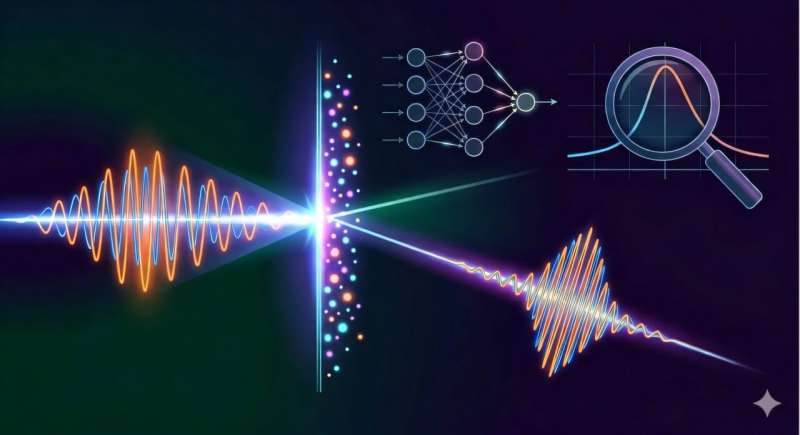
Researchers from Skoltech and the Shanghai Institute of Optics and Fine Mechanics have developed an approach that helps optimize the parameters of a laser-plasma source of attosecond pulses—ultrashort flashes of light used in physics experiments. Instead of relying on a large number of time-consuming calculations, the team trained a neural network to quickly identify promising settings and thereby speed up the optimization of the sophisticated laboratory equipment.
The results were published in Communications in Nonlinear Science and Numerical Simulation.
Attosecond pulse sources are used as research tools. They are applied in ultrafast spectroscopy, studies of magnetic materials, chiral molecules, and electron dynamics in matter. The goal of this work is to make it faster to tune a light source with the required properties for such experiments.
In practice, selecting parameters for these regimes requires computationally intensive modeling: the plasma-mirror response depends on multiple laser-pulse characteristics and target properties, while direct particle-in-cell simulations take substantial computing time.
In the new study, the researchers combined physical modeling with machine learning. They trained a neural network on the results of one-dimensional PIC simulations to rapidly predict the ellipticity of the reflected attosecond pulse—one of the key parameters of its polarization—depending on the conditions of the problem. The model used a multilayer perceptron with Fourier encoding of the input parameters.
Once trained, the model can evaluate new configurations much faster and be used inside an optimization loop, leaving only a limited number of precise checks to the full physical simulation. This makes the search for promising regimes significantly more efficient than direct brute-force parameter sweeps.
According to the authors, the proposed approach makes it possible to identify parameter sets that yield higher ellipticity of the reflected pulse and demonstrates stable performance across varying laser-pulse characteristics and target parameters. The method is also scalable and can be extended to higher-dimensional parameter spaces.
“In such problems, the main challenge is the high cost of direct physical simulation: the parameter space is large, and every validation run requires substantial computational resources. We have shown that combining a neural-network surrogate model with accurate PIC calculations makes it possible to significantly accelerate the search for promising regimes without sacrificing the physical relevance of the result,” said Sergey Rykovanov, the head of the AI and Supercomputing Laboratory at the Skoltech AI Center.
The proposed approach opens up opportunities for the practical design of attosecond pulse sources with tailored polarization at a much lower computational cost. It may also be applied to other problems where expensive physical simulations need to be accelerated with neural-network models.
More information
M. Smorkalov et al, Learning the nonlinear plasma-mirror response: Fast surrogate modeling and optimization of ellipticity of attosecond pulses, Communications in Nonlinear Science and Numerical Simulation (2026). DOI: 10.1016/j.cnsns.2026.109994
Leave a Reply