
April 16, 2026 by Sam Jarman, Phys.org
Collected at: https://phys.org/news/2026-04-laser-plasma-free-electron-hours.html
For the first time, researchers have demonstrated that a laser-plasma accelerator can reliably drive a free-electron laser for more than eight hours. Published in Physical Review Accelerators and Beams, the result was achieved by a team led by Finn Kohrell at Lawrence Berkeley National Laboratory, in collaboration with Texas-based company Tau Systems—and could soon make the technology vastly more accessible for a broad range of applications in industry and research.
Unavoidable noise
Free-electron lasers (FELs) generate intense, coherent pulses of light, most often in the ultraviolet to X-ray range. This involves sending high-energy electron bunches through an undulator: a device that alternates a magnetic field to accelerate electrons back and forth, causing them to emit increasingly bright and coherent radiation.
By harnessing this radiation as laser light, researchers can probe matter at the atomic scale and capture ultrafast processes in real time, making it invaluable to a vast array of applications.
Yet despite the relative simplicity of this principle, today’s FEL facilities are enormous: the European X-ray Free Electron Laser, for example, sits at the end of a 3.4-kilometer linear accelerator. For many groups in research and industry, this size requirement has made the technology extremely inaccessible so far.
Laser plasma accelerators (LPAs) offer an enticing alternative. By firing intense laser pulses into a plasma target, they generate powerful fields that can accelerate electrons to near the speed of light over just a few centimeters.
So far, however, LPA-driven electron beams have been unable to limit fluctuations in laser focus, pulse energy, and duration. This generates significant instability between laser shots, making it extremely difficult for users to sustain accurate results over long-term use.
Stabilizing additions
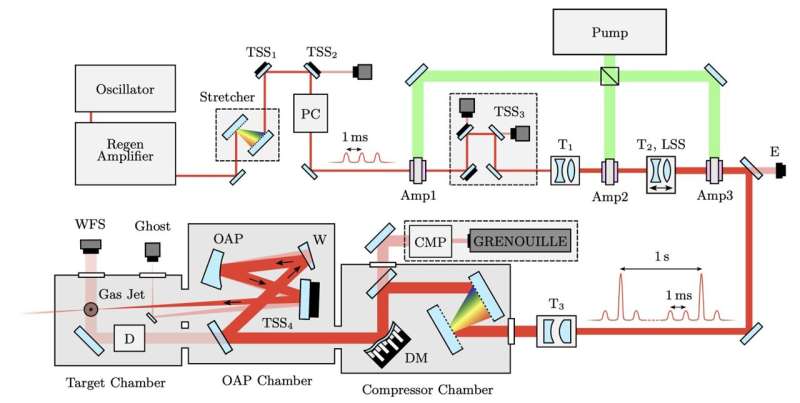
To tackle these challenges, Kohrell’s team integrated five active stabilization systems onto the Hundred Terawatt Undulator beamline at Berkeley Lab’s BELLA center. These included real-time corrections to the transverse and longitudinal focal position of the drive laser, as well as its pulse energy and duration.
On top of these corrections, the researchers also applied a low-power “ghost” beam: a copy of the main drive beam which could detect subtle fluctuations, invisible to direct monitoring of the primary beam.
With these additions, the LPA was able to deliver an extremely stable succession of 100 MeV electron bunches for over 10 hours, at a rate of 1,000 bunches per second. This allowed for more than eight continuous hours of FEL operation at a wavelength of 420 nm—falling within the visible range.
A milestone for FEL operation
Based on the data they have gathered so far, Kohrell’s team will now aim to refine their control systems even further. Their next target is operating at 500 MeV, which would push the FEL output to between 20 and 30 nm—straddling the boundary between ultraviolet and X-rays on the electromagnetic spectrum.
Altogether, their achievement opens up a new chapter in the development of next-generation light sources, and could help bring compact, affordable sources of coherent ultraviolet and X-ray light within reach of a far broader range of users across science and industry.
More information
F. Kohrell et al, Over 8 hours of continuous operation of a free-electron laser driven by a laser-plasma accelerator, Physical Review Accelerators and Beams (2026). DOI: 10.1103/z2d3-bhyt
Leave a Reply