
April 16, 2026 by Sumner S Brown Gibbs, Oak Ridge National Laboratory
Collected at: https://phys.org/news/2026-04-altermagnetism-abundant-mineral.html
Also known as magnetoelectronics, spintronics rely on electron spin rather than electron charge, as found in traditional electronics. Although spintronics is still an emerging field, spintronic technologies are already found in hard disk drives and giant magnetoresistance sensors used in industrial and automotive applications. Once the right foundational materials are discovered and verified, including economical materials for altermagnets, spintronics could advance technologies from wireless communication to quantum computing.
Researchers using neutrons at the Department of Energy’s Oak Ridge National Laboratory’s Spallation Neutron Source (SNS) discovered that hematite, essentially rust, can help design energy-efficient spintronics.
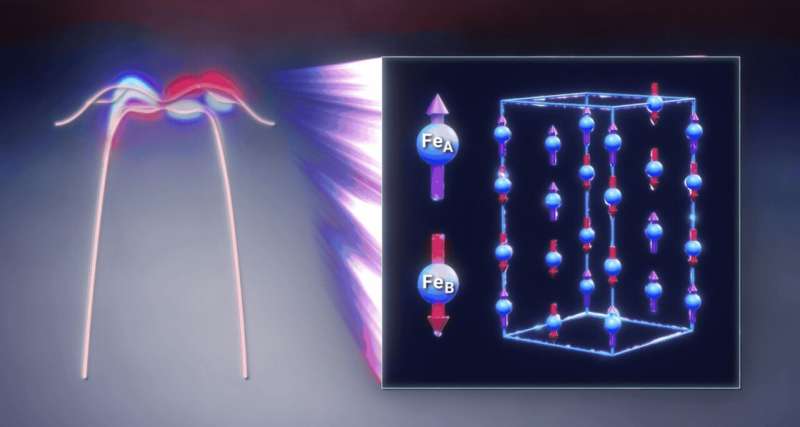
The team’s findings, published in Physical Review Letters, confirmed a key signature of altermagnetism (a new type of magnetism discovered in 2022) in hematite. Altermagnets are magnetic materials in which electron spins align in opposite directions, allowing pure spin currents to flow without a net electric charge—ideal conditions for spintronics. The team measured spin waves, which move through a material’s magnetic order similar to how sound waves move through air. They discovered that these waves show a clear separation in energy, a unique signature that confirms the material’s altermagnetic nature.
“Hematite is abundant, chemically stable and nontoxic,” said Qiyang Sun, a postdoctoral researcher in ORNL’s Neutron Scattering Division and project lead. “By confirming its altermagnetic nature, we open a new platform for engineers to design high-speed, low-power quantum electronics using materials that are inexpensive and widely available.”
Hematite is one of the most common minerals on Earth. Its stability across a wide temperature range—more than 1,200°F—makes it an attractive candidate for room-temperature spintronics applications without the need for excessive power for cooling. Unlike other altermagnetic materials that must be synthesized, hematite occurs naturally in great quantities.
Neutrons suited to study spintronics
To verify hematite’s properties, the team used inelastic neutron scattering at SNS. This technique is used to better understand magnetism and spin waves at the atomic scale. Neutrons have no electrical charge; however, they do have a magnetic moment. This makes them well suited to provide researchers with information about magnetic phenomena in altermagnetic materials, such as hematite. Such information cannot be obtained with any other technique.
“Inelastic neutron scattering is the only method capable of resolving these fine spectral features,” Sun said. “It provides simultaneous momentum and energy resolution, which allowed us to detect the subtle magnon splitting that defines altermagnetism.”
The research combined experimental measurements with advanced modeling using internally developed software, Sunny, and calculations using high-performance computing at ORNL. Sunny was designed specifically for the study of quantum magnetism.
“This was an excellent example of where we combined large experimental data sets with modeling and were able to compare the results in a timely manner in a fast‑moving research area,” said Wei Tian, a neutron scattering scientist also in ORNL’s Neutron Scattering Division. “It’s exciting to see everything come together so quickly thanks to internal collaboration.”
Future work will explore how spin-wave gaps influence heat transport in hematite, potentially revealing new mechanisms for heat management in spintronic systems.
“The confirmation of altermagnetism in hematite—a material as common as rust—demonstrates that a potential component for the next revolution in high-speed, low-power quantum electronics may already be all around us,” said Sun.
Publication details
Qiyang Sun et al, Observation of Chiral Magnon Band Splitting in Altermagnetic Hematite, Physical Review Letters (2025). DOI: 10.1103/7yhz-jptc
Journal information: Physical Review Letters
Leave a Reply