
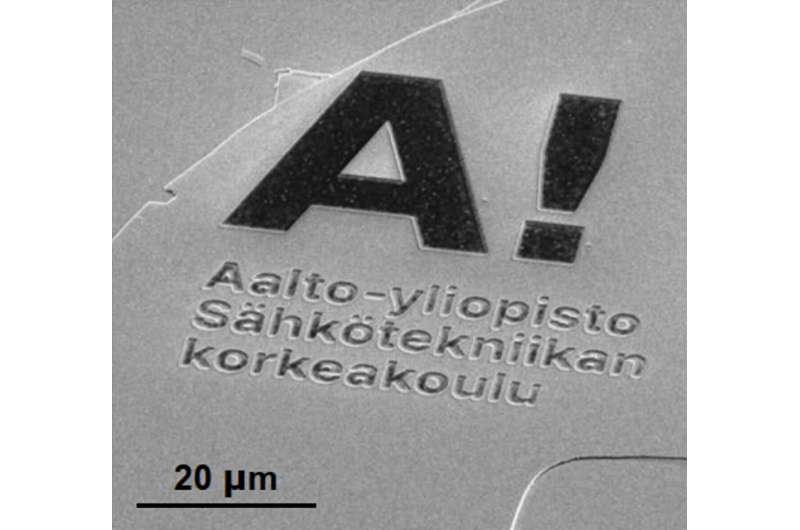
April 13, 2026 by Aalto University
Collected at: https://phys.org/news/2026-04-photonics-approach-chip-millions.html
For years, scientists have dreamed of using atomically thin van der Waals (vdW) materials to build faster, more efficient photonic chips. These materials can be stacked and tuned with extraordinary precision, opening possibilities far beyond those of conventional technologies. The challenge is that they are extremely fragile, making them notoriously difficult to shape with standard nanofabrication tools.
Now, an international team of researchers including scientists from Aalto University has overcome this long-standing barrier. By developing a method for what can be described as nanoscale surgery, they were able to sculpt these delicate materials without destroying them, achieving record-breaking performance in the process.
Published in Nature Materials, the work marks an important step forward for vdW materials, shifting them from passive coatings toward becoming the active building blocks of future photonic and quantum devices.
A major challenge in next-generation photonics
Since the rise of graphene, vdW materials have attracted worldwide interest because of their exceptional optical and electronic properties. Their surfaces are atomically smooth and naturally free of dangling bonds, which makes them especially attractive for photonics, where even tiny imperfections can scatter light and reduce performance.
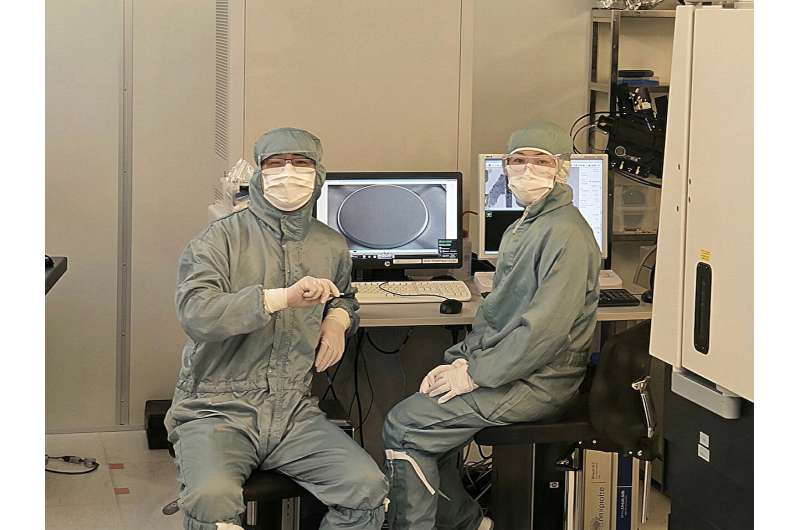
Dr. Xu Cheng (left) and Dr. Jingnan Yang (right) at the OtaNano research facility, holding the tiny chip whose image is displayed on the screen. Credit: Aalto University
“Yet, despite their enormous potential, using vdW materials as structural building blocks has remained a major challenge,” says Xiaoqi Cui, a researcher at Aalto University. “Standard fabrication methods are simply too aggressive.”
Conventional nanofabrication methods, such as focused ion beam lithography, are often too harsh and can damage the crystal lattice or distort the structures needed to trap light efficiently, he explains.
To solve this problem, the researchers introduced a simple but powerful idea. Before carving the vdW material, they coated it with a thin aluminum layer that acts as a temporary protective shield.
“This aluminum layer works like a microscopic suit of armor,” says researcher Andreas Liapis. “It absorbs the destructive impact of the ion beam and allows us to carve the material with sub-100-nanometer precision while preserving its crystal quality.”
Using this shielded fabrication approach, the team created ultra-smooth vdW microdisks, tiny circular structures that act as traps for light. These microscopic disks allow light to circulate again and again with extremely little loss. The devices reached quality factors above 1,000,000, meaning that only around one part per million of the light is lost in each cycle. In practical terms, light can keep circulating inside the disk millions of times before it fades significantly.
“This performance surpasses previous vdW resonant systems by three orders of magnitude, representing a dramatic advance for the field,” says Professor Zhipei Sun.
A 10,000-fold boost in light conversion
Because light remains confined so effectively inside these structures, it interacts much more strongly with the material itself. This greatly enhances nonlinear optical effects, in which light is converted from one color or frequency to another.
When the researchers tested second harmonic generation, an important nonlinear optical process, they observed an increase in efficiency of four orders of magnitude, or 10,000 times, compared with previous records.
By combining the strong intrinsic nonlinearity of vdW materials with ultra-high-quality optical resonances, the work clears one of the biggest roadblocks in vdW photonics.
The advance opens new opportunities for reconfigurable photonic circuits, quantum light sources and highly sensitive optical sensors integrated directly on a chip. More broadly, it shows that materials once considered too fragile to engineer can now be turned into powerful photonic devices.
Publication details
All-van der Waals microcavities for low-loss nonlinear photonics, Nature Materials (2026). DOI: 10.1038/s41563-026-02574-x
Journal information: Nature Materials
Leave a Reply