
April 13, 2026 by Meg Cox, Loughborough University
Collected at: https://phys.org/news/2026-04-rapid-method-uncovers-hidden-materials.html
An international team of scientists, including researchers from Loughborough University, has developed a method to dramatically speed up the discovery and design of advanced materials. The study, published in Physical Review Letters, shows how the new approach can map complex phase diagrams in as little as a day—rather than weeks or months—and pinpoint where important structures, including crystals and quasicrystals, are likely to form.
The method will enable scientists to “scout ahead” and identify where promising structures are likely to form and the conditions needed to create them, rather than using a trial-and-error approach. It could help accelerate the development of advanced materials and technologies that harness the unique properties of quasicrystal structures.
“Our approach is a day’s work for an expert—it’s much faster,” said Professor Andrew Archer, an expert in applied mathematics and theoretical physics at Loughborough University and one of the paper’s authors.
“Trying to find quasicrystals is like looking for a needle in a haystack, unless you know where to look. This paper gives a recipe for knowing where to look.”
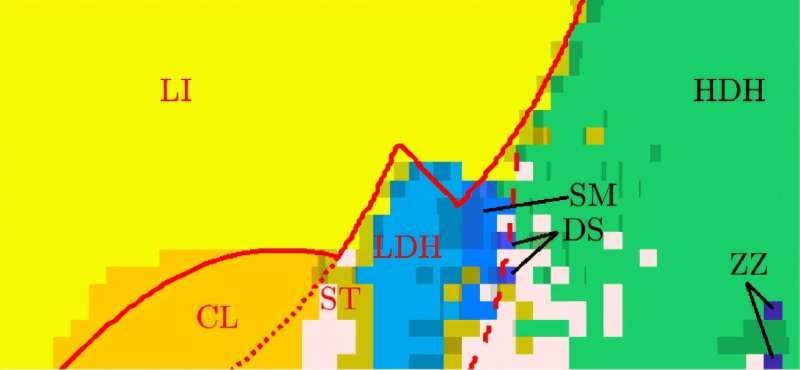
Example phase diagram from the study. The colored regions show different “phases”—or particle structures. The vertical axis is the temperature, and the horizontal is average particle density. Scientists use these diagrams as maps to understand which phase—or structure—is likely to form under different conditions. Credit: Physical Review Letters (2026). DOI: 10.1103/nbvt-fgjy
Using a simple equation to tackle complex phase diagrams
The research tackles a long-standing challenge in physics and materials science: understanding how tiny particles in soft matter organize themselves into different structures.
Soft matter refers to materials whose particle structure and behavior can be altered by changes in conditions, such as temperature and density. These include polymers, gels, liquid crystals, and colloids—where microscopic particles are suspended in another substance.
Phase diagrams are used by scientists to predict how particles will arrange under different conditions. Typically shown as graphs with colored regions, each region represents a possible “phase”—a different way the particles can be arranged. While familiar phases include solid, liquid and gas, particles can form a range of structures, making these diagrams complex and often difficult to navigate.
“Colloidal suspensions can have very complicated phase diagrams,” said Professor Archer, “One case we considered has at least 10 different phases in the phase diagram. Anything that simplifies navigating your way through a phase diagram is a good thing.”
Until now, exploring these diagrams has relied on slow experiments or energy-intensive computer simulations that can take weeks or even months.
The new approach uses a simple mathematical method, based on classical density functional theory, to quickly map out complex phase diagrams and predict where interesting structures are likely to appear. The team tested it on systems known to produce a wide range of structures and found it to be reliable.
“The mathematical formula is so simple that a computer can evaluate it quicker than the time it takes you to type it in,” said Professor Archer, “It’s surprising that something so simple works so well!”
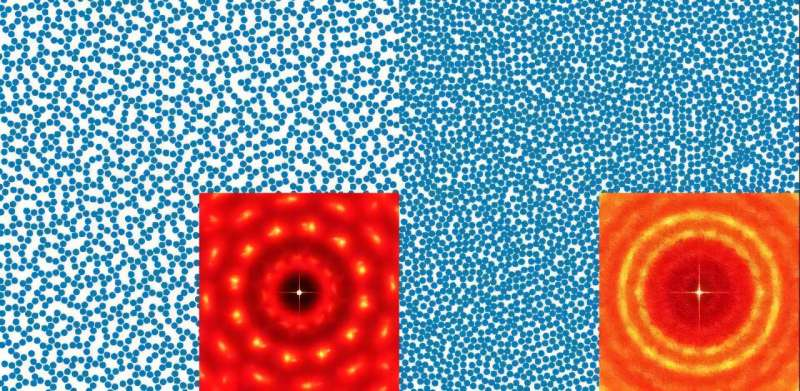
A closer look at the quasicrystals identified in the study. These highly ordered but non-repeating structures are difficult to find, and the new method helps pinpoint where they are likely to form. Credit: Physical Review Letters (2026). DOI: 10.1103/nbvt-fgjy
Unlocking new materials
The tool can be used to identify roughly where crystal phases will appear in the phase diagram and gives hints as to what the crystal structures are.
Crystal structures are important because they determine a material’s properties, meaning the same particles can behave very differently depending on how they are arranged. By predicting where different crystal structures form, scientists can design materials with specific properties more quickly and efficiently.
Quasicrystals are of particular interest because, although ordered, they do not repeat in a regular pattern, giving them unique properties that could be useful in advanced materials and technologies. The researchers hope the technique will guide future experiments and help reduce the time, cost, and energy needed to develop new materials.
“The tool can also be used as an ‘inverse design tool’ to tailor particle interactions such that the related system forms complex phases under suitable external conditions, such as quasicrystals,” said Professor Archer. “I look forward to seeing the interesting ways our method is used.”
Publication details
Michael Wassermair et al, Navigating Complex Phase Diagrams in Soft Matter Systems, Physical Review Letters (2026). DOI: 10.1103/nbvt-fgjy
Journal information: Physical Review Letters
Leave a Reply