
April 10, 2026 by University of Vaasa
Collected at: https://techxplore.com/news/2026-04-ai-driven-imitating-human-brain.html
As traditional power plants are replaced by intermittent sources like solar and wind, maintaining grid stability has become a complex engineering challenge. Hussain Khan’s doctoral dissertation at the University of Vaasa, Finland, introduces advanced AI-based control strategies that ensure local grids remain reliable and resilient.
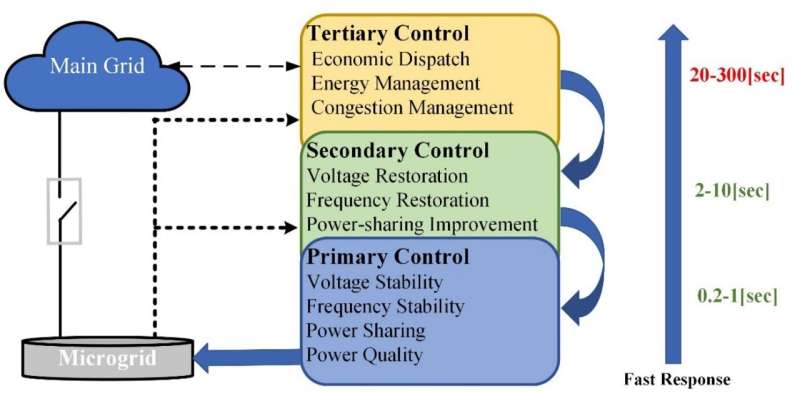
Power systems are undergoing a profound transformation as fossil-based generation is gradually replaced by inverter-based renewable energy. This shift introduces inherent uncertainty and low inertia, making grid operation and voltage stability significantly more complex in AC and DC microgrids.
In his dissertation in electrical engineering, Hussain Khan addresses these challenges. By utilizing Artificial Neural Networks (ANN), Khan has developed controllers that can predict and compensate for grid changes in real time, outperforming traditional control methods.
“ANNs are inspired by the human brain, which processes information through interconnected neurons. This biomimetic approach allows the system to learn from diverse scenarios and adapt to the unpredictability of solar and wind power,” says Khan.
Cost-effective solutions through sensor optimization
Traditional systems rely on multiple physical sensors to monitor voltage, current, and other parameters, adding to costs and increasing the number of potential failure points. Khan’s AI-driven approach demonstrates that sophisticated software can compensate for fewer hardware components.
“By training the neural network effectively, the system can provide the same reliable results with only a single sensor instead of two. This leads to cost optimization and improves overall reliability, as there are fewer physical parts that could fail,” Khan notes.
While AI-based control can improve efficiency and reduce hardware requirements, introducing intelligent controllers into critical infrastructure also raises new considerations.
“The main concern is that AI works like a black box: we can see the inputs and outputs, but not always fully explain what is happening inside. Even so, in our tests the controller performed very well and was validated rigorously in real time,” notes Khan.
Khan’s research supports the broader goal of building carbon-neutral energy systems in the coming decades. By improving stability and reducing hardware requirements, AI-based control could help electricity grids integrate larger shares of renewable energy in the future.
More information
Khan, Hussain (2026) Advanced Predictive and AI-Based Converter Control Strategies for AC and DC Microgrids. Acta Wasaensia 580. Doctoral dissertation. University of Vaasa. urn.fi/URN:ISBN:978-952-395-260-7
Leave a Reply