
Jack Loughran Thu 9 Apr 2026
Collected at: https://eandt.theiet.org/2026/04/09/talking-robot-dog-could-help-ease-shortage-guide-dogs-blind
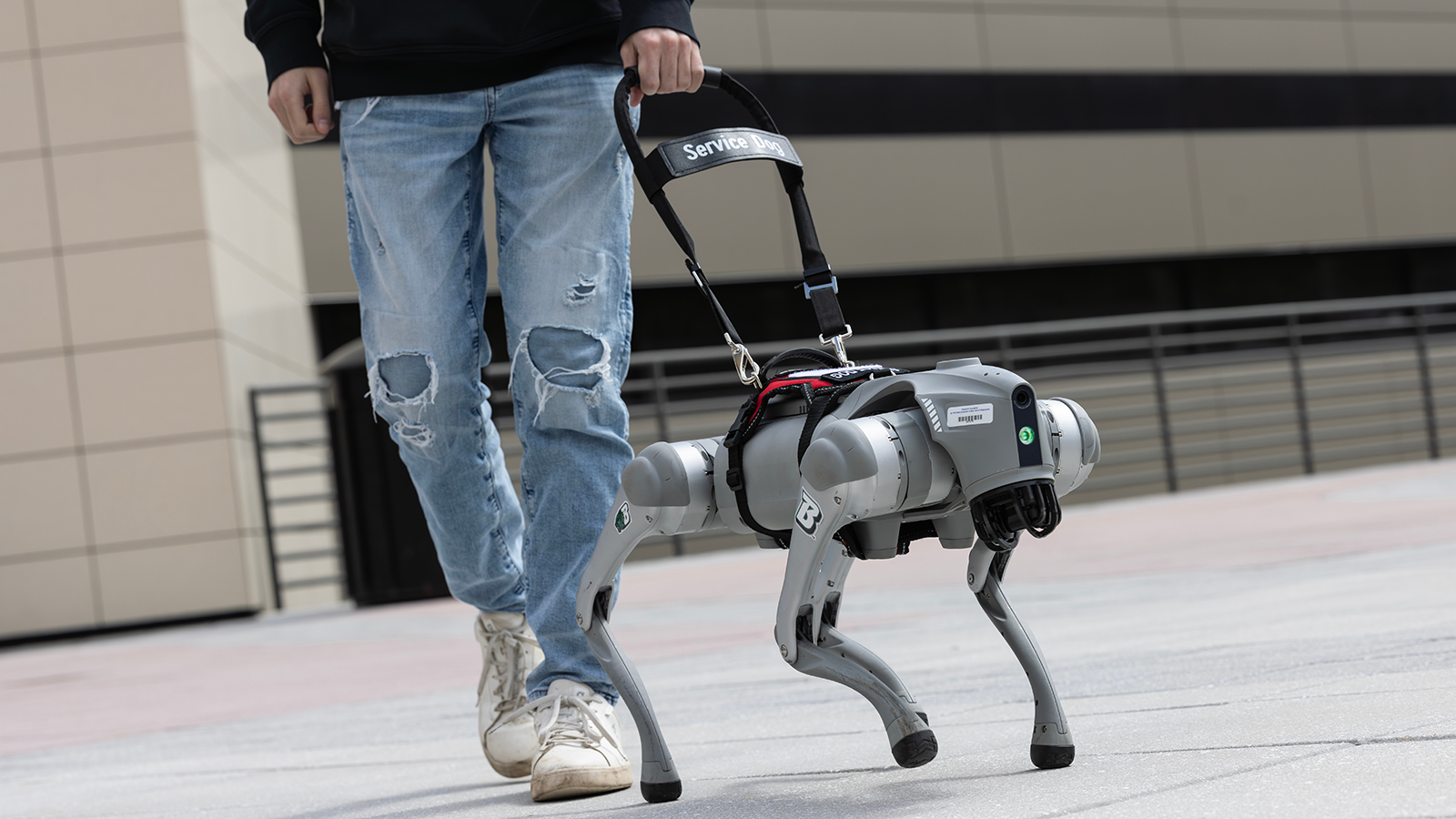
A robot guide dog that can speak to its owners and determine the ideal route to their destination has been developed by a team of researchers at Binghamton University, New York State.
Traditional guide dogs are considered one of the most difficult service dogs to train, with the process normally taking 1.5-2 years and often with a 50% failure rate, as the dogs must be calm, obedient and capable of independent decision-making to ensure their handler’s safety. There is currently a significant shortage of guide dogs globally. In the UK, blind people often have to wait up to two years before they can receive one.
In a bid to alleviate the shortage, the researchers have been working for several years on training robot guide dogs that can lead visually impaired people by responding to a tug on the leash.
But their new system takes the work a step further by creating a spoken back-and-forth between user and dog, and providing more control and situational awareness. The robot offers information about a route both before departure and during travel.
“For this work, we’re demonstrating an aspect of the robotic guide dog that is more advanced than biological guide dogs,” said associate professor Shiqi Zhang. “Real dogs can understand around 20 commands at best. But for robotic guide dogs, you can just put GPT-4 with voice commands. Then it has very strong language capabilities.
“This is very important for visually impaired or blind people, because situational and scene awareness is relatively limited without vision.”
To test the system, the team recruited seven legally blind participants to navigate a large, multi-room office environment. The robot would ask the user where they wanted to go and then present possible routes to the room and the time it would take to reach it. Once the user selected a preferred route, the robot would guide them to the conference room, explaining the surroundings and obstacles to them along the way.
Following the test, the users completed a questionnaire about their experience, rating the system’s helpfulness, ease of communication and usefulness. Overall, a combined approach including planning explanations and real-time narration from the robot was preferred among participants.
The team now plans to conduct more user studies, increase the system’s autonomy and have the robots navigate longer distances, both indoors and outdoors.
“They were super excited about the technology, about the robots,” Zhang said. “They asked many questions. They really see the potential for the technology and hope to see this working.”
Leave a Reply