
Tanya Weaver Tue 20 May 2025
Collected at: https://eandt.theiet.org/2025/05/20/brain-inspired-ai-chip-processes-data-locally-without-need-cloud-or-internet
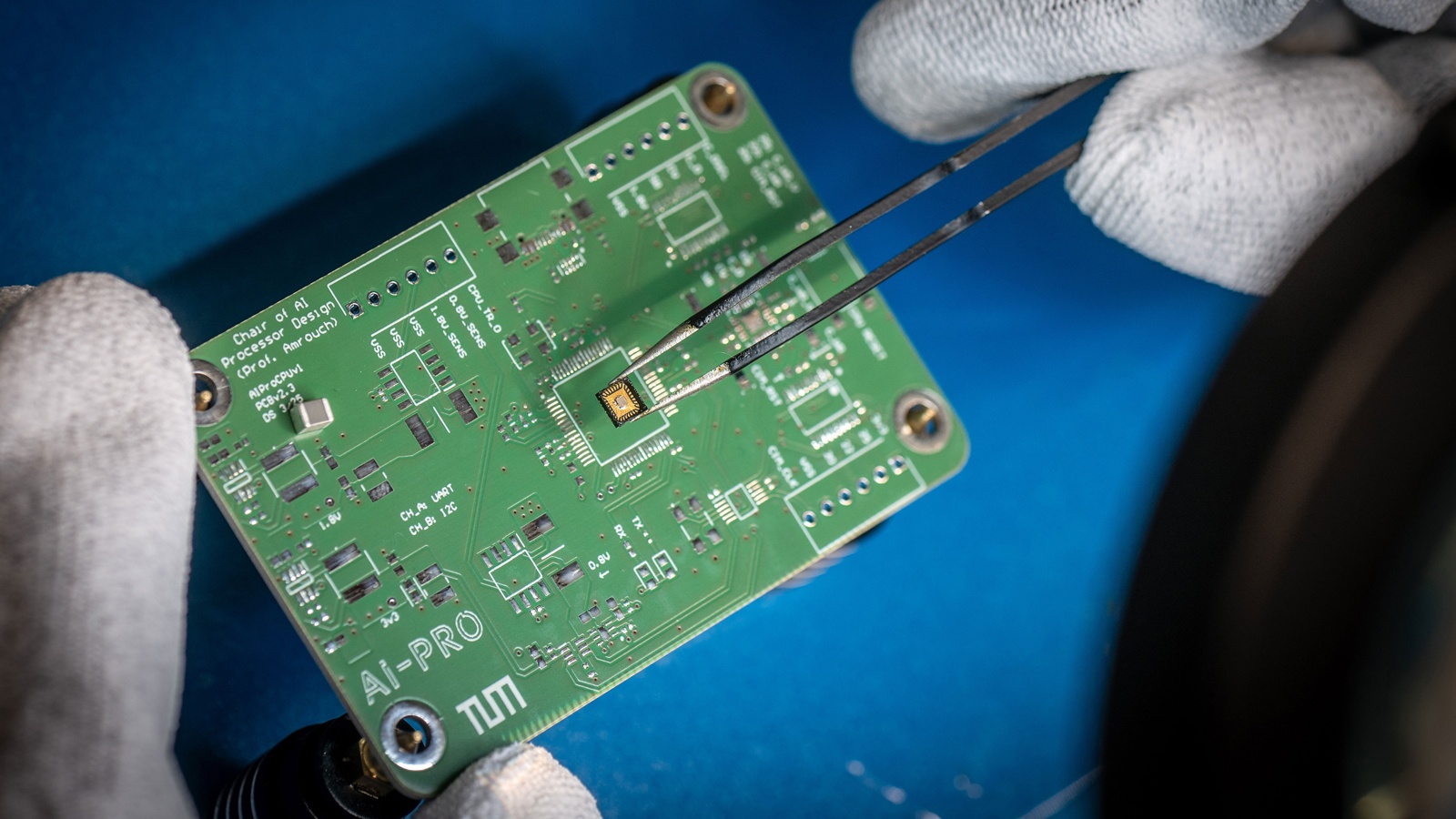
An AI chip developed by researchers at the Technical University of Munich (TUM) in Germany works without a cloud server or internet connections.
Unlike existing chips, the AI Pro chip designed by the team at TUM features neuromorphic architecture. This is a type of computing architecture inspired by the structure and functioning of the human brain.
This architecture enables the chip to perform calculations on the spot, ensuring full cyber security as well as being energy efficient.
The chip employs a brain-inspired computing paradigm called ‘hyperdimensional computing’. With the computing and memory units of the chip located together, the chip recognises similarities and patterns, but does not require millions of data records to learn.
The chip’s designer is Professor Hussam Amrouch, the chair of AI processor design at TUM. How the chip works is that instead of being shown countless images of cars, as with the deep learning method used in conventional AI chips, the AI Pro chip combines various pieces of information, such as the fact that a car has four wheels, usually drives on the road and can have different shapes.
This is the same way that the human brain works. Amrouch said: “Humans also draw inferences and learn through similarities.” Having designed the chip, he had the first prototypes produced by semiconductor manufacturer GlobalFoundries in Dresden.
The prototype AI Pro chip was then used to do a sample task. During this process the chip only consumed 24 microjoules. This is a “record value”, according to Amrouch, as comparable chips require 10-100 times the energy.
He said: “This mix of modern processor architecture, algorithm specialisation and innovative data processing makes the AI chip something special.”

Andreas Heddergott/TUM
The aim for this one square millimetre AI Pro chip with its 10 million transistors is for it to be used for processing data directly on site. The advantage of this is that data does not need to be sent to the cloud for processing along with millions of other datasets before it is sent back again.
This data processing taking place on site not only saves time but server computing capacity. It also reduces the carbon footprint of AI.
Amrouch foresees the chips being customised for specific applications.
He said: “While Nvidia has built a platform that relies on cloud data and promises to solve every problem, we have developed an AI chip that enables customised solutions. There is a huge market there.”
For example, personal and sometimes sensitive data such as heart rate and other vital health data collected via a smartwatch or navigation data from a drone would remain on board the device, rather than sent to the cloud for processing.
For this reason, the AI Pro chip does not rely on stable internet connections. As data is not sent out from the hardware, cyber security is not an issue.
Amrouch concludes: “The future belongs to the people who own the hardware.”


What i don’t realize is in reality how you’re not really a lot more neatly-favored than you might be right now. You’re so intelligent. You already know therefore considerably relating to this topic, produced me individually consider it from numerous numerous angles. Its like women and men are not fascinated until it?¦s something to do with Girl gaga! Your individual stuffs great. At all times maintain it up!

Its like you learn my thoughts! You seem to understand a lot approximately this, such as you wrote the ebook in it or something. I believe that you simply could do with some percent to pressure the message home a little bit, but other than that, this is excellent blog. A great read. I will certainly be back.
Leave a Reply