
May 20, 2025 by Zander Venter, Megan Davies and Samantha L. Scott, The Conversation
Collected at: https://techxplore.com/news/2025-05-satellite-images-reveal-dark-side.html
As winter approaches, memories of the past haunt South Africans in more ways than one. The country has experienced years of rolling blackouts, known locally as load shedding. During the worst periods of these power cuts in 2022 and 2023, South Africans who did not own solar photovoltaic systems or generators would go without electricity for up to 12 hours a day.
Due to the extent of the damaging power outages, solar power was adopted quickly in South Africa. For example, in 2020, smaller systems installed at homes or businesses made up just 38% of the country’s solar systems. At that time, 62% of solar systems were utility-scale solar power. (These included large solar farms that feed electricity directly into the national grid.) But by May 2024, the share of smaller solar power systems had shot up to 74%, far more than that of utility-scale photovoltaic systems.
As a team of researchers specializing in mapping, geography, and renewable energy transitions, we noticed that satellite imagery showed that some parts of South Africa were still brightly lit at night, even during power cuts.
We wanted to find out if this was because these areas were exempt from power cuts or if it was because they’d switched to alternative power sources.
So we compared publicly available nighttime satellite images of 300 suburbs with satellite images of South African rooftops taken during the day. We looked at the images for both day and night between 2016—when there were almost no power cuts—and 2023, when power was cut for almost 79% of the year.
The satellite imagery revealed that nighttime light declined by 20% over urban South Africa between 2016 and 2023. However, some suburbs remained curiously bright even when the power was out.
We overlaid the satellite images with national census maps and found that areas where predominantly Black residents lived darkened twice as much during this time as predominantly white suburbs.
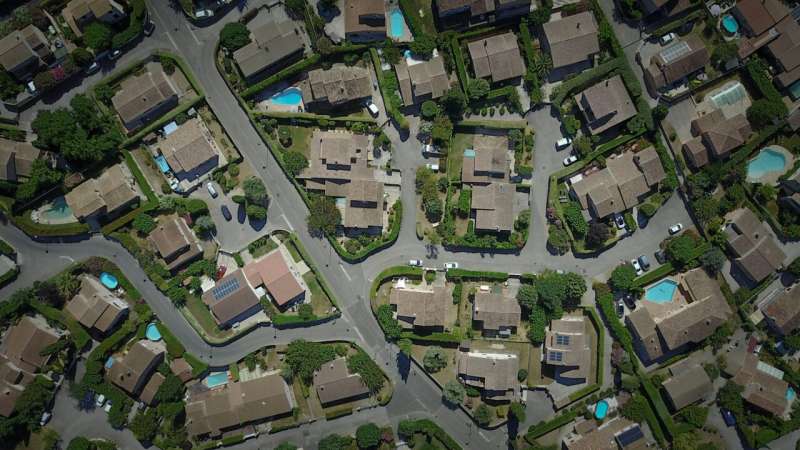
There were virtually zero solar panels in impoverished areas, whereas wealthy suburbs were plush with rooftop solar systems.
This reflected the spatial divisions established under apartheid—that is, the geographic divisions established under South Africa’s former system of racial segregation, where people were forcibly separated into different areas based on race.
Our study shows that while solar energy adoption is booming in South Africa, it is mostly benefiting wealthier, white communities. We believe we are seeing evidence of energy apartheid—access to energy that still follows the racial divisions created by apartheid.
This means that the government needs to take steps to make sure that the green energy transition benefits everyone equally. Without rolling out renewable energy to all, inequality will deepen and millions of people will be left in the dark.
Who gets to keep their lights on?
South Africa’s Electricity Regulation Act aims to ensure that everyone can access electricity on an equal basis. However, there’s no public data on whether the power utility Eskom’s power outages are more severe in some areas, or not. This meant we could not verify whether power cuts were happening fairly and equally across all suburbs.
Instead, we tried to find out who gets to keep their lights on by using daytime satellite images from 300 suburbs for the seven years between 2016 and 2023. These showed us which communities had the most homes with rooftop solar photovoltaic panels.
For example, in the high-income Rietriver Country Estate near Johannesburg, an average of 13 solar panels were detected per house. A middle-income suburb in the town of Benoni, where residents earn half as much, has an average of one solar panel per household. And in Thembisa, a low-income area where residents earn an average of R740 (US$41) per person per month, not one solar installation was recorded in the area, highlighting the stark contrast with wealthier suburbs.
We found that the number of solar systems in predominantly white suburbs was 73 times higher than in areas that mainly house racial groups who were previously disadvantaged by apartheid.
What needs to happen next
Our findings are typical of the extremes of energy injustice in the global south. Here, moving from coal-fired power to cleaner, renewable energy doesn’t solve the problem of energy poverty (where energy is concentrated among more affluent people).
Instead, the green energy transition amplifies social inequality. Our study highlights the risk that South Africa’s move to cleaner energy could make long-standing inequalities even worse. But it also points to ways of overcoming them:
- policy initiatives such as tax rebates for low-income households to help more houses install solar systems
- innovative ownership models where solar panel arrays are owned and managed by a group of households
- targeted subsidies like zero-interest loans or free basic solar systems for low-income groups to help overcome the high upfront costs of solar panels, batteries and inverters.
For these measures to work, they need to be co-designed with diverse stakeholders. They must focus on the specific needs and aspirations of South African households.
For the green energy transition to be inclusive and sustainable, conversations around renewable energy should consider who can access and benefit from solar power.


Hi there would you mind stating which blog platform you’re working with? I’m going to start my own blog soon but I’m having a difficult time deciding between BlogEngine/Wordpress/B2evolution and Drupal. The reason I ask is because your design and style seems different then most blogs and I’m looking for something completely unique. P.S My apologies for getting off-topic but I had to ask!


Leave a Reply