
By Kyushu University May 17, 2025
Collected at: https://scitechdaily.com/solar-superstorm-unleashes-rare-metal-clouds-in-earths-upper-atmosphere/
During a powerful solar storm on Mother’s Day, scientists discovered that a mysterious ionospheric phenomenon, sporadic E layers, became unusually active, especially during the storm’s recovery.
These thin, metal-rich patches appeared to ripple from the poles toward the equator, shedding new light on a region of Earth’s atmosphere that has long been overlooked.
Geomagnetic Storm Spurs Ionized Layers in Ionosphere
Scientists from Kyushu University have uncovered a surprising effect high above Earth’s surface during a powerful geomagnetic storm that occurred on Mother’s Day. Publishing their findings in Geophysical Research Letters, the team reported unusual behavior in a lesser-known part of the atmosphere called the sporadic E layer, which sits about 90 to 120 kilometers above sea level.
This region of the ionosphere is home to mysterious patches of ionized metal particles known as sporadic E clouds. These clouds are thin, just 1 to 5 kilometers thick, but incredibly dense. They appear suddenly, then vanish just as quickly. During the solar storm’s recovery phase, these clouds intensified dramatically.
The researchers discovered that the phenomenon was concentrated over Southeast Asia, Australia, the South Pacific, and the East Pacific. Even more intriguing, they found that these clouds seemed to travel across the globe, first appearing near the polar regions and gradually showing up in lower latitudes. This pattern suggested a large-scale atmospheric wave triggered by the storm.
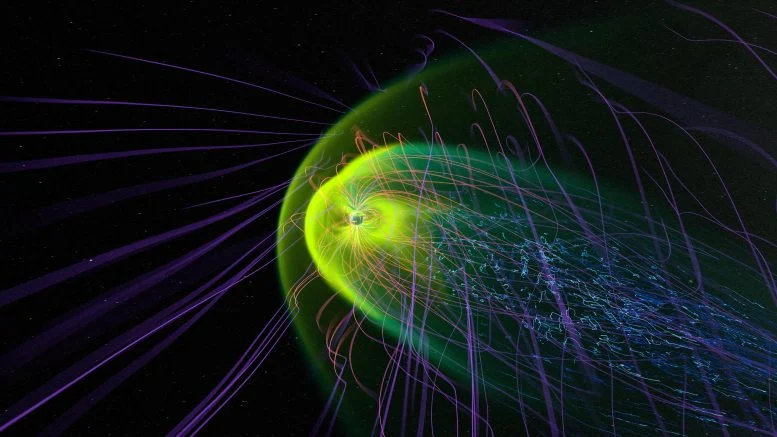
This visualization shows the Earth’s magnetosphere being hit by a geomagnetic storm. The MAGE model simulates real events that happened throughout May 10-11, 2024.
- White orbit trails: All satellites orbiting Earth during the storm
- Orange orbits: Proposed orbits for six GDC spacecraft
- Orange-to-purple lines: Magnetic field lines around Earth
- Blue trails: Solar wind velocity tracers
- Green clouds: Electric field current intensity
Credit: NASA Scientific Visualization Studio and NASA DRIVE Science Center for Geospace Storms
A New Look at an Overlooked Ionospheric Layer
“When studying the Mother’s Day geomagnetic storm, many researchers looked at what happened in the F layer of the ionosphere. It is about 150-500 km above sea level and is where the most ionization occurs,” explains Professor Huixin Liu of Kyushu University’s Faculty of Science, who led the study. “The sporadic E layer hasn’t been studied very much during the storm because it appeared unaffected by solar storms. But we wanted to see if something as powerful as the Mother’s Day geomagnetic storm did anything to the E layer. What we found was very interesting.”
To investigate, the team gathered a massive amount of data. They used 37 ground-based radars called ionosondes, along with measurements from the COSMIC-2 satellite network orbiting Earth. This combination gave them one of the most detailed global maps ever created of sporadic E activity during and after a major solar storm.
Clues From the Poles: Tracking E Layer Movement
“This large amount of data was critical for both detecting the presence of sporadic Es and tracking where they formed as time went by,” continues Liu. “In our analysis, we found that sporadic Es formed after the main phase of the solar storm, during what we call the recovery phase. Sporadic Es were also detected first in the higher latitude regions, around the Earth’s poles. They were then detected gradually in lower latitudes over time. This propagation characteristic from high to low latitudes suggests that sporadic E layers are most likely caused by the disturbed neutral winds in the E region.”
Understanding the activity of the E layer is vital due to its potential to disrupt radio communications in the HF and VHF bands. The research team hopes that their new findings will lead to better insights on Es layer activity and how such unique phenomena are created in the ionosphere.
Forecasting Potential: Mitigating Future Communication Disruptions
“We now know that sporadic Es enhance during the recovery phase of a solar storm, so perhaps we can forecast more accurately sporadic Es using the propagation characteristics found in our study and mitigate potential communication disruptions,” concludes Liu. “We also plan to re-examine the data from other solar storms to see if we can better understand these phenomena.”
Reference: “Sporadic-E Layer Responses to Super Geomagnetic Storm 10–12 May 2024” by Lihui Qiu and Huixin Liu, 23 April 2025, Geophysical Research Letters.
DOI: 10.1029/2025GL115154


It’s the best time to make some plans for the future and it’s time to be happy. I have learn this put up and if I could I want to counsel you few fascinating things or suggestions. Maybe you could write next articles relating to this article. I desire to learn even more issues approximately it!


Good day! I know this is kind of off topic but I was wondering which blog platform are you using for this website? I’m getting sick and tired of WordPress because I’ve had problems with hackers and I’m looking at alternatives for another platform. I would be great if you could point me in the direction of a good platform.


Superb site you have here but I was curious about if you knew of any message boards that cover the same topics discussed here? I’d really like to be a part of group where I can get comments from other experienced individuals that share the same interest. If you have any suggestions, please let me know. Bless you!


Leave a Reply