
May 16, 2025 by Singapore University of Technology and Design
Collected at: https://techxplore.com/news/2025-05-algorithms-aim-real-earth.html
In recent years, the expansion of low Earth orbit (LEO) satellite constellations has made satellite communications cool again. From providing internet access in remote regions to enabling near-instant data delivery across oceans, these networks are set to play an even greater role in the years ahead.
However, as constellations such as SpaceX’s Starlink grow to tens of thousands of satellites, they are evolving beyond their original role as passive relays. Increasingly, satellites are being equipped with onboard computing hardware, capable of processing and analyzing data directly in orbit.
This unlocks transformative capabilities, such as real-time environmental monitoring, object tracking and smart agriculture. But it also introduces a major challenge: How to efficiently schedule and manage computing and communication resources across a vast and constantly shifting network. Traditional methods, typically designed for small-scale systems or delay-tolerant tasks, struggle to keep pace with the dynamism and immediacy now required.
“LEO satellite networks move at high speeds and experience constant changes in connectivity,” explained Dr. Xiong Zehui, Assistant Professor at the Singapore University of Technology and Design (SUTD). “Scheduling strategies must not only deal with these changes in real time but also jointly balance computing and communication resources. It’s a far more complex problem than traditional satellite management.”
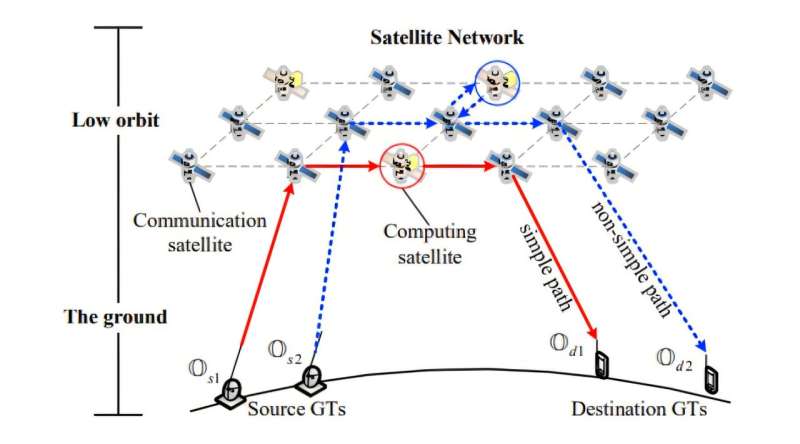
In their research paper “Enabling real-time computing and transmission services in large-scale LEO satellite networks,” published in IEEE Transactions on Vehicular Technology, Assistant Prof Xiong and his team developed two graph-based algorithms that dramatically improve the ability to deliver real-time computing services in space. Built on a temporal graph model that captures the ever-changing nature of satellite networks, the two methods offer complementary approaches for scheduling tasks.
The first, known as the k-shortest path-based (KSP) method, prioritizes communication. It quickly searches for loop-free paths that meet data transmission needs and then verifies if sufficient computing resources are available along these routes. The second, called the computing-aware shortest path (CASP) method, takes a different approach. It first identifies satellites with the required computing resources, then finds the most efficient communication paths to and from them—even allowing for non-simple routes when needed.
“Both methods are designed to be practical and adaptable to real-world satellite constellations,” added Assistant Prof Xiong. “KSP tends to excel when computing resources are abundant but communication links are tight. Meanwhile, CASP is best used when onboard computing resources are scarce. Satellite operators are free to choose between them depending on their network conditions.”
Extensive simulations based on the Starlink network, the world’s largest operating satellite system, showed that the algorithms can support real-time applications even in highly dynamic and resource-constrained environments. By optimizing how satellites share and allocate their resources, the team’s methods help reduce end-to-end delays, improve network resilience and maximize the number of real-time tasks the network can handle.
Excitingly, the team’s research could make a range of critical applications more accessible, whether it is faster disaster monitoring or real-time global logistics tracking.
“Many emerging services, such as remote sensing or smart farming, require satellites to collect data, process it and deliver actionable information within seconds,” said Assistant Prof Xiong. “The services are pretty demanding, but our methods can help turn that vision into reality, which could in turn benefit industries, governments and communities around the world.”
Looking ahead, the team is working on extending their algorithms to support collaborative multi-satellite computing and exploring the use of machine learning to give resource management a further boost. They are also looking forward to contributing to emerging standards in satellite communications for future 6G networks.
As communities all over the world strive for better connectivity, satellite networks will be critical in bridging the digital divide.
“More than 70% of Earth’s surface still lacks reliable terrestrial network coverage,” Assistant Prof Xiong added. “Satellite networks, if properly managed, can fill that gap, enabling communication with anyone, anywhere, at any time. Our goal is to help build the technologies that will make this global vision possible.”
More information: Binquan Guo et al, Enabling Real-time Computing and Transmission Services in Large-Scale LEO Satellite Networks, IEEE Transactions on Vehicular Technology (2025). DOI: 10.1109/TVT.2025.3550806


I know this if off topic but I’m looking into starting my own blog and was wondering what all is required to get setup? I’m assuming having a blog like yours would cost a pretty penny? I’m not very internet savvy so I’m not 100 certain. Any tips or advice would be greatly appreciated. Thanks


Leave a Reply