
May 15, 2025 by Elsevier
Collected at: https://phys.org/news/2025-05-source-tool-greenfeed-livestock-emissions.html
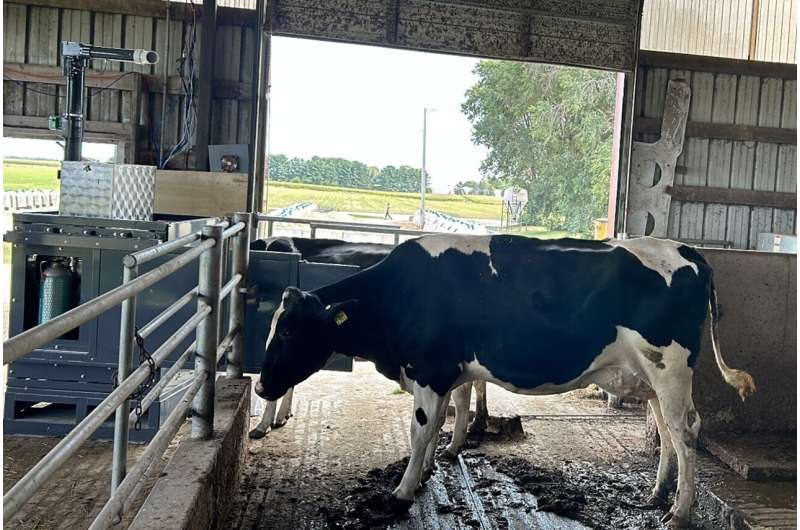
The dairy and agriculture sectors’ pursuit of sustainability and efficiency has fueled a dramatic expansion in research aimed at understanding and reducing livestock greenhouse gas emissions. Central to this effort is the ability to accurately measure methane and carbon dioxide output from cattle on a large scale. GreenFeed is a popular tool helping researchers and producers measure emissions in real time.
A new open-source tool, greenfeedr—outlined in a new technical note in JDS Communications—is simplifying processing and data reporting from GreenFeed systems, making it easier to get flexible, useful, and impactful data and accelerate the work toward a sustainable future for dairy and livestock production.
GreenFeed systems are portable head chambers that measure individual animal gas production in real time, generating substantial amounts of data. Animals voluntarily use the machine, receiving pelleted feed throughout the day, meaning that the system gathers data 24 hours a day, often for weeks at a time. While all of these data are crucial for researchers and producers aiming to understand and mitigate livestock’s contribution to climate change, it comes with challenges. Managing and analyzing this high volume of data—especially across different research projects, dairy herds, and teams—are often time consuming and can lead to error and data inconsistencies.
Guillermo Martinez-Boggio, Ph.D., of the Department of Animal and Dairy Sciences, University of Wisconsin–Madison, and lead author of the article, said, “The sheer volume of data produced by GreenFeed systems can be really overwhelming. We set out to create an open-source tool that simplifies this process, making it more efficient and reproducible, and flexible to the variety of situations in which these systems are used.”
Motivated by the principle of “doing as little as possible by hand and as much as possible with functions,” Dr. Martinez-Boggio, of the Peñagaricano Lab, developed greenfeedr—a toolkit with functions for downloading, processing, and reporting GreenFeed data—all freely and publicly available as an R package, an open-source software and programming language. Interested users can access greenfeedr on the Comprehensive R Archive Network (CRAN) at cran.r-project.org/web/packages/greenfeedr and its source code on GitHub at github.com/GMBog/greenfeedr .
The R package has functions for downloading GreenFeed data (get_gfdata), for generating daily and final reports (report_gfdata), for processing daily and final records (process_gfdata), and extra functions that help to extract information regarding pellet intakes and daily visits (pellin and viseat).
After development, the team demonstrated the package’s capabilities using data from 32 lactating dairy cows. The article demonstrates how greenfeedr can generate comprehensive reports and efficiently process large datasets, allowing for a detailed analysis of methane and carbon dioxide emissions. The package also permits user-defined parameters to allow the best use of each research group’s datasets.
Dr. Martinez-Boggio explained, “We wanted the tool to be as versatile as possible, so it was designed to be used with all livestock species and housing systems, including freestall, tiestall, and pasture-based.
This important advancement allows teams to automate routine processes as they gather data with GreenFeed systems, simplifying formerly complex workflows, saving time, and creating insightful outputs that can inform study results and farm management decisions.
This tool is expected to benefit researchers and producers by enhancing the efficiency and accuracy of GreenFeed data analysis, ultimately contributing to a better understanding of livestock emissions and the development of mitigation strategies.
More information: Guillermo Martinez-Boggio et al, greenfeedr: An R package for processing and reporting GreenFeed data, JDS Communications (2024). DOI: 10.3168/jdsc.2024-0662


I want to show my admiration for your kind-heartedness for folks who really need assistance with in this subject matter. Your special dedication to passing the solution all through had been astonishingly valuable and has made guys like me to get to their objectives. This interesting advice signifies this much to me and extremely more to my peers. Thanks a ton; from everyone of us.

Woah! I’m really enjoying the template/theme of this blog. It’s simple, yet effective. A lot of times it’s difficult to get that “perfect balance” between superb usability and appearance. I must say you’ve done a very good job with this. Also, the blog loads extremely fast for me on Chrome. Outstanding Blog!


I definitely wanted to make a brief comment to be able to thank you for these precious recommendations you are giving out here. My time intensive internet look up has at the end been paid with wonderful content to talk about with my friends and classmates. I ‘d point out that many of us site visitors actually are quite endowed to dwell in a really good network with so many awesome individuals with good basics. I feel very privileged to have come across the website and look forward to tons of more fun times reading here. Thank you again for a lot of things.

Hello there! Quick question that’s entirely off topic. Do you know how to make your site mobile friendly? My web site looks weird when viewing from my iphone. I’m trying to find a template or plugin that might be able to fix this issue. If you have any recommendations, please share. Appreciate it!


Just want to say your article is as amazing. The clearness in your post is just nice and i could assume you’re an expert on this subject. Well with your permission let me to grab your RSS feed to keep up to date with forthcoming post. Thanks a million and please continue the rewarding work.

Howdy! I know this is somewhat off topic but I was wondering which blog platform are you using for this website? I’m getting sick and tired of WordPress because I’ve had problems with hackers and I’m looking at alternatives for another platform. I would be fantastic if you could point me in the direction of a good platform.
Leave a Reply