
By Sissa Medialab May 9, 2025
Collected at: https://scitechdaily.com/are-we-wrong-about-black-holes-a-radical-theory-challenges-einstein/
Black holes may not have singularities after all!
Scientists are exploring new models — including ones without event horizons — that challenge classical physics. With next-gen observations, we might finally glimpse what lies beyond.
Einstein, Schwarzschild, and the Birth of Black Holes
“Hic sunt leones,” remarks Stefano Liberati, director of the Institute for Fundamental Physics of the Universe (IFPU) and one of authors of a new paper published in the Journal of Cosmology and Astroparticle Physics. The Latin phrase, meaning “here be lions,” was once used on ancient maps to mark unknown or dangerous territories. In this case, it refers to the singularity predicted to exist at the center of traditional black holes, those described by Einstein’s general relativity.
To understand why this matters, it helps to revisit the origin of the idea. In 1915, Albert Einstein introduced his groundbreaking theory of general relativity. Just a year later, German physicist Karl Schwarzschild discovered an exact solution to Einstein’s equations, revealing the possibility of objects so dense that nothing, not even light, could escape their gravitational grip. These are the black holes we know today.
But from the outset, the concept raised troubling questions. In the 1960s, scientists realized that, according to the math, spacetime becomes infinitely curved at a black hole’s center. This “singularity” implies a point where gravity becomes infinitely strong and the known laws of physics break down. If such a singularity truly exists, it would mean that general relativity, one of the most successful theories in physics, fails under extreme conditions. For many physicists, referring to a “singularity” is less an explanation and more an admission: we simply don’t yet understand what’s really happening at the core of a black hole.
The Singularity Problem in Physics
Despite these theoretical challenges, evidence for black holes has grown steadily since the 1970s. Major breakthroughs—like the first detection of gravitational waves in 2015, and the Event Horizon Telescope’s images of black holes in 2019 and 2022—have brought us closer than ever to observing black holes directly. These discoveries were even recognized with Nobel Prizes in 2017 and 2020. Yet, none of these observations have been able to confirm or rule out the existence of singularities. What lies at a black hole’s core remains one of the biggest open questions in physics.
Beyond the Event Horizon: Searching for Answers
And this brings us back to the “leones” Liberati refers to: we can describe black hole physics only up to a certain distance from the center. Beyond that lies mystery — an unacceptable situation for science. This is why researchers have long been seeking a new paradigm, one in which the singularity is “healed” by quantum effects that gravity must exhibit under such extreme conditions. This naturally leads to models of black holes without singularities, like those explored in the work of Liberati and his collaborators.
One of the interesting aspects of the new paper is its collaborative origin. It is neither the work of a single research group nor a traditional review article. “It’s something more,” explains Liberati. “It emerged from a set of discussions among leading experts in the field — theorists and phenomenologists, junior and senior researchers — all brought together during a dedicated IFPU workshop. The paper is a synthesis of the ideas presented and debated in the sessions, which roughly correspond to the structure of the article itself.” According to Liberati, the added value lies in the conversation itself: “On several topics, participants had initially divergent views — and some ended the sessions with at least partially changed opinions.”
Rethinking Black Holes: Three Competing Models
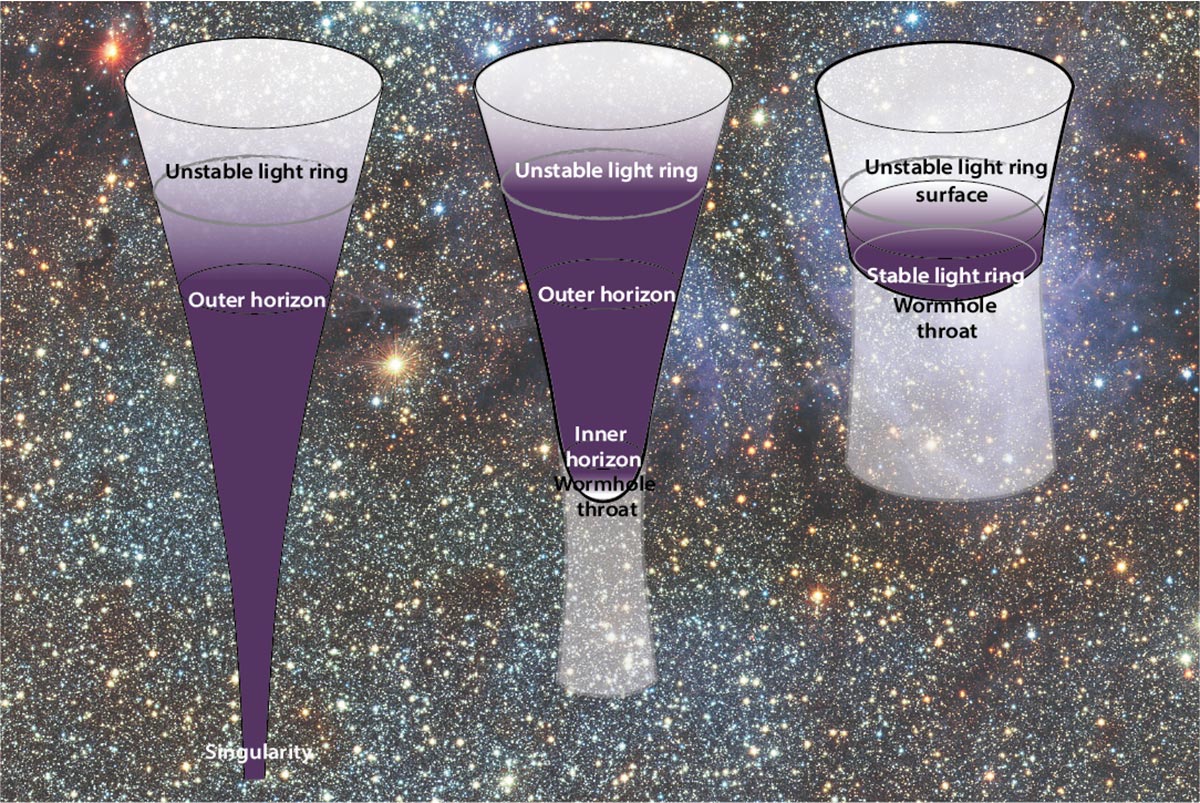
During that meeting, three main black hole models were outlined: the standard black hole predicted by classical general relativity, with both a singularity and an event horizon; the regular black hole, which eliminates the singularity but retains the horizon; and the black hole mimicker, which reproduces the external features of a black hole but has neither a singularity nor an event horizon.
The paper also describes how regular black holes and mimickers might form, how they could possibly transform into one another, and, most importantly, what kind of observational tests might one day distinguish them from standard black holes.
While the observations collected so far have been groundbreaking, they don’t tell us everything. Since 2015, we’ve detected gravitational waves from black hole mergers and obtained images of the shadows of two black holes: M87* and Sagittarius A*. But these observations focus only on the outside — they provide no insight into whether a singularity lies at the center.
“But all is not lost,” says Liberati. “Regular black holes, and especially mimickers, are never exactly identical to standard black holes — not even outside the horizon. So observations that probe these regions could, indirectly, tell us something about their internal structure.”
The Role of Advanced Instruments and Experiments
To do so, we will need to measure subtle deviations from the predictions of Einstein’s theory, using increasingly sophisticated instruments and different observational channels. For example, in the case of mimickers, high-resolution imaging by the Event Horizon Telescope could reveal unexpected details in the light bent around these objects — such as more complex photon rings. Gravitational waves might show subtle anomalies compatible with non-classical spacetime geometries. And thermal radiation from the surface of a horizonless object — like a mimicker — could offer another promising clue.
Toward a Quantum Theory of Gravity
Current knowledge is not yet sufficient to determine exactly what kind of perturbations we should be looking for, or how strong they might be. However, significant advances in theoretical understanding and numerical simulations are expected in the coming years. These will lay the groundwork for new observational tools, designed specifically with alternative models in mind. Just as happened with gravitational waves, theory will guide observation — and then observation will refine theory, perhaps even ruling out certain hypotheses.
This line of research holds enormous promise: it could help lead to the development of a quantum theory of gravity, a bridge between general relativity — which describes the universe on large scales — and quantum mechanics, which governs the subatomic world.
“What lies ahead for gravity research,” concludes Liberati, “is a truly exciting time. We are entering an era where a vast and unexplored landscape is opening up before us.”
Reference: “Towards a non-singular paradigm of black hole physics” by Raúl Carballo-Rubio, Francesco Di Filippo, Stefano Liberati, Matt Visser, Julio Arrechea, Carlos Barceló, Alfio Bonanno, Johanna Borissova, Valentin Boyanov, Vitor Cardoso, Francesco Del Porro, Astrid Eichhorn, Daniel Jampolski, Prado Martín-Moruno, Jacopo Mazza, Tyler McMaken, Antonio Panassiti, Paolo Pani, Alessia Platania, Luciano Rezzolla and Vania Vellucci, 6 May 2025, Journal of Cosmology and Astroparticle Physics.
DOI: 10.1088/1475-7516/2025/05/003

An impressive share, I just given this onto a colleague who was doing a little analysis on this. And he in fact bought me breakfast because I found it for him.. smile. So let me reword that: Thnx for the treat! But yeah Thnkx for spending the time to discuss this, I feel strongly about it and love reading more on this topic. If possible, as you become expertise, would you mind updating your blog with more details? It is highly helpful for me. Big thumb up for this blog post!


Just want to say your article is as astounding. The clarity to your submit is simply cool and that i could assume you’re knowledgeable in this subject. Well together with your permission let me to grab your RSS feed to keep up to date with drawing close post. Thank you a million and please continue the rewarding work.

I was curious if you ever thought of changing the page layout of your site? Its very well written; I love what youve got to say. But maybe you could a little more in the way of content so people could connect with it better. Youve got an awful lot of text for only having 1 or 2 images. Maybe you could space it out better?


Leave a Reply