

By Ian Scheffler, University of Pennsylvania School of Engineering and Applied Science May 2, 2025
Collected at: https://scitechdaily.com/world-first-engineers-train-ai-at-lightspeed/
Breakthrough light-powered chip speeds up AI training and reduces energy consumption.
Engineers at Penn have developed the first programmable chip capable of training nonlinear neural networks using light—a major breakthrough that could significantly accelerate AI training, lower energy consumption, and potentially lead to fully light-powered computing systems.
Unlike conventional AI chips that rely on electricity, this new chip is photonic, meaning it performs calculations using beams of light. Published in Nature Photonics, the research demonstrates how the chip manipulates light to execute the complex nonlinear operations essential for modern artificial intelligence.
“Nonlinear functions are critical for training deep neural networks,” explains Liang Feng, Professor of Materials Science and Engineering and Electrical and Systems Engineering, and senior author of the study. “Our aim was to make this happen in photonics for the first time.”
The Missing Piece in Photonic AI
Most AI systems today depend on neural networks, software designed to mimic biological neural tissue. Just as neurons connect to allow biological creatures to think, neural networks link together layers of simple units, or “nodes,” enabling AI systems to perform complex tasks.
In both artificial and biological systems, these nodes only “fire” once a threshold is reached — a nonlinear process that allows small changes in input to cause larger, more complex changes in output.
Without that nonlinearity, adding layers does nothing: the system just reduces to a single-layer linear operation, where inputs are simply added together, and no real learning occurs.
While many research teams, including teams at Penn Engineering, have developed light-powered chips capable of handling linear mathematical operations, none has solved the challenge of representing nonlinear functions using only light — until now.
“Without nonlinear functions, photonic chips can’t train deep networks or perform truly intelligent tasks,” says Tianwei Wu (Gr’24), a postdoctoral fellow in ESE and the paper’s first author.
Reshaping Light with Light
The team’s breakthrough begins with a special semiconductor material that responds to light. When a beam of “signal” light (carrying the input data) passes through the material, a second “pump” beam shines in from above, adjusting how the material reacts.
By changing the shape and intensity of the pump beam, the team can control how the signal light is absorbed, transmitted, or amplified, depending on its intensity and the material’s behavior. This process “programs” the chip to perform different nonlinear functions.
“We’re not changing the chip’s structure,” says Feng. “We’re using light itself to create patterns inside the material, which then reshapes how the light moves through it.”
The result is a reconfigurable system that can express a wide range of mathematical functions depending on the pump pattern. That flexibility allows the chip to learn in real time, adjusting its behavior based on feedback from its output.
Training at the Speed of Light
To test the chip’s potential, the team used the chip to solve benchmark AI problems. The platform achieved over 97% accuracy on a simple nonlinear decision boundary task and over 96% on the well-known Iris flower dataset — a machine learning standard.
In both cases, the photonic chip matched or outperformed traditional digital neural networks, but used fewer operations, and did not need power-hungry electronic components.
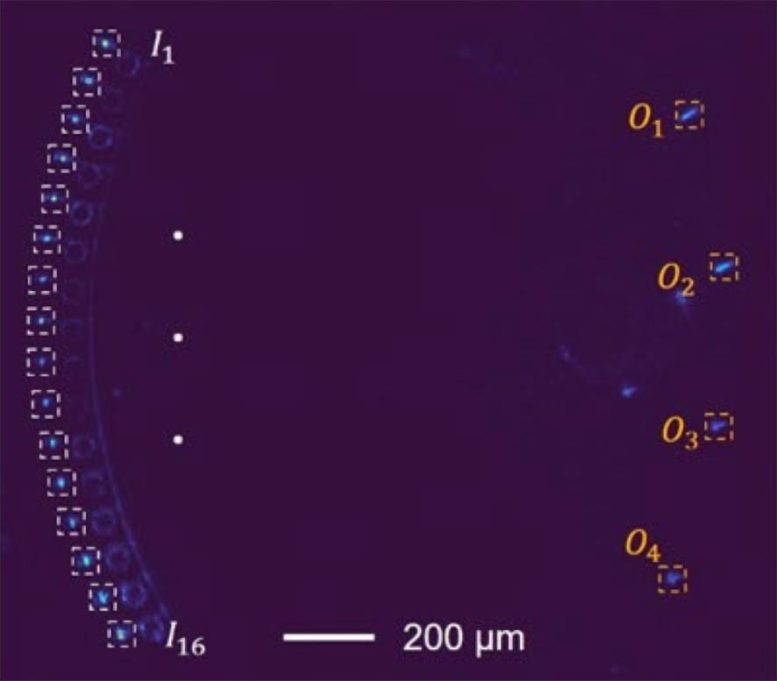
In one striking result, just four nonlinear optical connections on the chip were equivalent to 20 linear electronic connections with fixed nonlinear activation functions in a traditional model. That efficiency hints at what’s possible as the architecture scales.
Unlike previous photonic systems, which are fixed after fabrication, the Penn chip starts as a blank canvas. The pump light acts like a brush, drawing reprogrammable instructions into the material.
“This is a true proof-of-concept for a field-programmable photonic computer,” says Feng. “It’s a step toward a future where we can train AI at the speed of light.”
Future Directions
While the current work focuses on polynomials — a flexible family of functions widely used in machine learning — the team believes their approach could enable even more powerful operations in the future, such as exponential or inverse functions. That would pave the way for photonic systems that tackle large-scale tasks like training large language models.
By replacing heat-generating electronics with low-energy optical components, the platform also promises to slash energy consumption in AI data centers, potentially transforming the economics of machine learning.
“This could be the beginning of photonic computing as a serious alternative to electronics,” says Liang. “Penn is the birthplace of ENIAC, the world’s first digital computer — this chip might be the first real step toward a photonic ENIAC.”
Reference: “Field-programmable photonic nonlinearity” by Tianwei Wu, Yankun Li, Li Ge and Liang Feng, 15 April 2025, Nature Photonics.
DOI: 10.1038/s41566-025-01660-x
This study was conducted at the University of Pennsylvania School of Engineering and Applied Science and supported by the Defense Advanced Research Projects Agency (DARPA) (W911NF-21-1-0340), Office of Naval Research (ONR) (N00014-23-1-2882), and National Science Foundation (NSF) (ECCS-2023780, ECCS-2425529, DRM-2326699, PHYS-1847240, DMR-2326698).


Leave a Reply