
By Tatyana Woodall, Ohio State University May 2, 2025
Collected at: https://scitechdaily.com/alien-earths-everywhere-how-cosmic-light-revealed-a-universe-of-hidden-worlds/
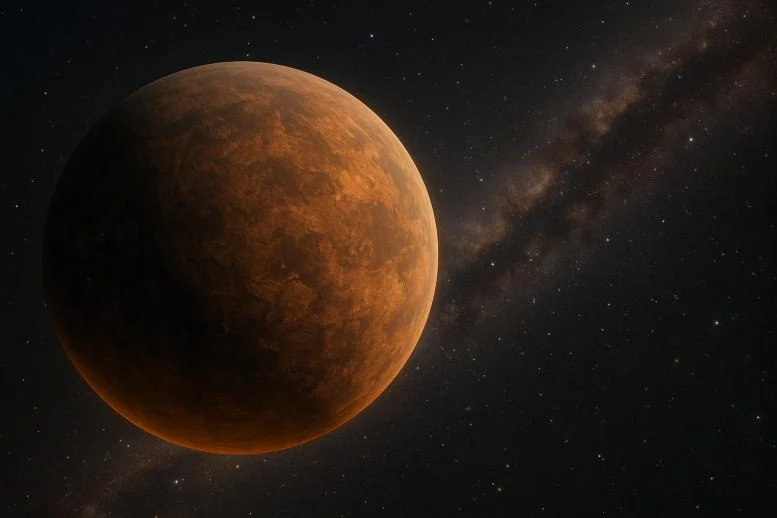
Super-Earths, larger planets similar to Earth, are far more common across the universe than scientists previously believed, according to a groundbreaking microlensing study using KMTNet telescopes.
Researchers discovered that these planets can orbit their stars at vast distances, similar to gas giants like Jupiter, hinting at a hidden abundance of alien worlds. Using rare cosmic alignments and light anomalies, the team not only found new planets but also began piecing together the mysterious processes of planet formation, fueled by international collaborations and innovative telescope technology.
Discovery of Super-Earths Beyond Expectations
Using the Korea Microlensing Telescope Network (KMTNet), an international team of astronomers has discovered that super-Earth exoplanets are far more common across the universe than previously believed, according to a new study.
By analyzing subtle light distortions caused by a newly detected planet’s host star—and comparing their findings with a larger dataset from KMTNet’s microlensing survey—the researchers found that super-Earths can exist at distances from their stars similar to how far our gas giants are from the Sun, explained Andrew Gould, co-author of the study and professor emeritus of astronomy at The Ohio State University.
Hidden Patterns Among Exoplanets
“Scientists knew there were more small planets than big planets, but in this study, we were able to show that within this overall pattern, there are excesses and deficits,” he said. “It’s very interesting.”
Although planets that orbit close to their stars are relatively easy to detect, finding those with wider, more distant orbits is much harder. Even so, the team estimated that for every three stars in the galaxy, there is likely at least one super-Earth with a long, Jupiter-like orbital period. Their findings suggest these massive, rocky planets may be a widespread feature of planetary systems throughout the cosmos—a conclusion Gould says helps advance the growing field of planetary microlensing he helped pioneer.
How Microlensing Sheds Light on Alien Worlds
The findings in this study were made via microlensing, an observational effect that occurs when the presence of mass warps the fabric of space-time to a detectable degree. When a foreground object, such as a star or planet, passes between an observer and a more distant star, light is curved from the source, causing an apparent increase in the object’s brightness that can last anywhere from a few hours to several months.
Astronomers can use these fluctuations, or bumps, in brightness to help locate alien worlds unlike our own. In this case, microlensing signals were used to locate OGLE-2016-BLG-0007, a super-Earth with a mass ratio roughly double that of Earth’s and an orbit wider than Saturn’s.
These observations allowed the team to divide exoplanets into two groups, one that consists of super-Earths and Neptune-like planets and the other comprising gas giants like Jupiter or Saturn. This discovery opens new doors for planetary system science: Having a better understanding of exoplanet distribution can reveal new insights about the processes by which they form and evolve.
Global Collaboration Unlocks Planet Formation Clues
The study, led by researchers in China, Korea and at Harvard University and the Smithsonian Institution in the United States, was recently published in the journal Science.
To explain their results, researchers also compared their findings to predictions made from theoretical simulations of planet formation. Their results showed that while exoplanets can be separated into groups by mass and makeup, the mechanisms that may produce them can vary.
Competing Theories for Planet Birth
“The dominant theory of gas-giant formation is through runaway gas accretion, but other people have said that it could be both accretion and gravitational instability,” said Gould. “We’re saying we can’t distinguish between those two yet.”
Doing so will likely require greater swaths of long-term data from specialized systems such as KMTNet and other microlensing instruments like it, said Richard Pogge, another co-author of the study and a professor of astronomy at Ohio State.
Challenges of Finding Microlensing Events
“Finding a microlensing star event is hard. Finding a microlensing star with a planet is hard-squared,” he said. “We have to look at hundreds of millions of stars to find even a hundred of these things.”
These alignments are so rare that only 237 out of the more than 5,500 exoplanets ever discovered have been identified using the microlensing method. Now, with the help of three powerful custom-built telescopes located in South Africa, Chile and Australia, the KMTNet system routinely allows scientists to scour the cosmos for these amazing events, said Pogge.
Most notably, it was scientists in Ohio State’s Imaging Sciences Laboratory who designed and built the Korean Microlensing Telescope Network Cameras (KMTCam) that the system relies on to identify exoplanets. And as technology continues to evolve, having dedicated, global collaborations like this one will turn visions of scientific theory into real discoveries, said Pogge.
Reconstructing the Universe’s Story
“We’re like paleontologists reconstructing not only the history of the universe we live in but the processes that govern it,” he said. “So helping to bring both of those pieces together into one picture has been enormously satisfying.”
Reference: “Microlensing events indicate that super-Earth exoplanets are common in Jupiter-like orbits” by Weicheng Zang, Youn Kil Jung, Jennifer C. Yee, Kyu-Ha Hwang, Hongjing Yang, Andrzej Udalski, Takahiro Sumi, Andrew Gould, Shude Mao, Michael D. Albrow, Sun-Ju Chung, Cheongho Han, Yoon-Hyun Ryu, In-Gu Shin, Yossi Shvartzvald, Sang-Mok Cha, Dong-Jin Kim, Hyoun-Woo Kim, Seung-Lee Kim, Chung-Uk Lee, Dong-Joo Lee, Yongseok Lee, Byeong-Gon Park, Richard W. Pogge, Xiangyu Zhang, Renkun Kuang, Hanyue Wang, Jiyuan Zhang, Zhecheng Hu, Wei Zhu, Przemek Mróz, Jan Skowron, Radosław Poleski, Michał K. Szymański, Igor Soszyński, Paweł Pietrukowicz, Szymon Kozłowski, Krzysztof Ulaczyk, Krzysztof A. Rybicki, Patryk Iwanek, Marcin Wrona, Mariusz Gromadzki, Fumio Abe, Richard Barry, David P. Bennett, Aparna Bhattacharya, Ian A. Bond, Hirosane Fujii, Akihiko Fukui, Ryusei Hamada, Yuki Hirao, Stela Ishitani Silva, Yoshitaka Itow, Rintaro Kirikawa, Naoki Koshimoto, Yutaka Matsubara, Shota Miyazaki, Yasushi Muraki, Greg Olmschenk, Clément Ranc, Nicholas J. Rattenbury, Yuki Satoh, Daisuke Suzuki, Mio Tomoyoshi, Paul J. Tristram, Aikaterini Vandorou, Hibiki Yama and Kansuke Yamashita, 24 April 2025, Science.
DOI: 10.1126/science.adn6088
Other members of Ohio State’s ISL team include Bruce Atwood, Tom O’Brien, Mark Johnson, Mark Derwent, Chris Colarosa, Jerry Mason, Daniel Pappalardo, and Skip Shaller.
This work was supported by the National Science Foundation, Tsinghua University, the National Natural Science Foundation of China, the Harvard-Smithsonian Center for Astrophysics, the China Manned Space Project, Polish National Agency for Academic Exchange and the National Research Foundation of Korea.


Leave a Reply