
By Amit Malewar Published: April 28, 2026
Collected at: https://www.techexplorist.com/paradoxical-phenomenon-optical-physics/102823/
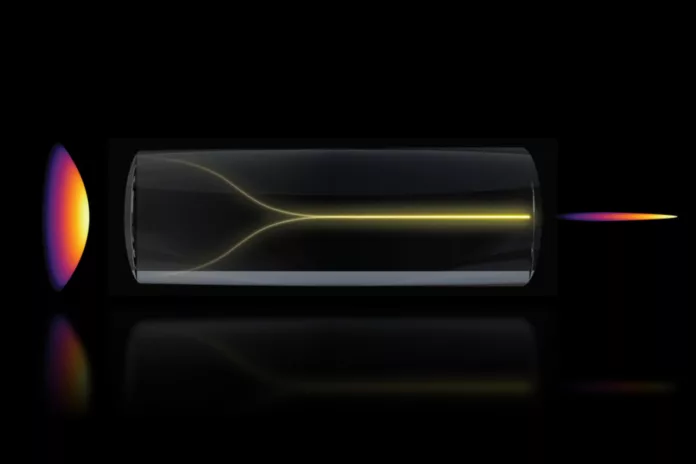
Organized patterns of light in complex systems are key to understanding how light interacts with matter and to developing new ways of shaping light. MIT researchers have uncovered a surprising twist in optical physics: under special conditions, what looks like a chaotic jumble of laser light can suddenly organize itself into a razor‑sharp “pencil beam.”
This self‑organized beam enables them to capture 3D images of the human blood‑brain barrier 25 times faster than today’s best methods, without sacrificing resolution.
The breakthrough means researchers can watch individual brain cells absorb drugs in real time. That could transform how researchers test new treatments for Alzheimer’s, ALS, and other neurodegenerative diseases, revealing, with unprecedented speed and clarity, whether medicines actually reach their targets in the brain.
It is widely believed that increasing the power of this type of laser would always make the light chaotic. However, researchers showed that this is not true.
Sixian You, assistant professor in the MIT Department of Electrical Engineering and Computer Science (EECS), said, “We followed the evidence, embraced the uncertainty, and found a way to let the light organize itself into a novel solution for bioimaging.”
The team had built a precise fiber shaper, a device that allows them to finely tune the laser light traveling through a multimode optical fiber. EECS graduate student Honghao Cao decided to push the fiber to its limits, testing how much power it could withstand. Normally, the rule is simple: the more power you pump in, the more chaotic and scattered the beam becomes. It’s because of tiny imperfections in the fiber.
But when they increased the power close to the burning point, something unexpected happened. Instead of breaking down into disorder, the light did the opposite; it collapsed into a single, needle‑sharp beam.
You said, “Disorder is intrinsic to these fibers. The light engineering you typically need to do to overcome that disorder, especially at high power, is a longstanding hassle. But with this self-organization, you can get a stable, ultrafast pencil beam without the need for custom beam-shaping components.”
To recreate the effect, the researchers discovered two surprisingly simple but very precise requirements. First, the laser must enter the fiber at a perfect zero‑degree angle, a stricter condition than usual. Second, the power must be increased until the light begins to interact directly with the fiber’s glass.
“At this critical power, the nonlinearity can counter the intrinsic disorder, creating a balance that transforms the input beam into a self‑organized pencil beam,” explains Cao.
Most experiments avoid such high power to prevent fiber damage and don’t require such precise alignment. But when combined, these two steps produce a stable, needle‑sharp beam, without the need for complex light‑shaping tricks.
When the team tested this pencil beam, they found it was more stable and sharper than many similar beams. Other beams often produce distracting “sidelobes”, blurry halos of light that distort images, but this one stayed pristine and tightly focused.
Building on that, the researchers used the beam to image the human blood‑brain barrier, a dense wall of cells that shields the brain from toxins but also blocks many medicines. Researchers have long wanted to observe how drugs cross this barrier and whether they reach their targets inside the brain.
With standard optics, the best you can do is capture one flat 2D slice at a time, then stitch many slices together. It’s slow and limited
This new ultrafast, high‑precision pencil beam changed the game: it allowed the team to track cells absorbing proteins in real time, offering a dynamic view of drug delivery inside the brain.
Using this method, the team captured high-quality cellular-level 3D images about 25 times faster.
“Usually, you have a tradeoff between image resolution and depth of focus — you can only probe so far at a time. But with our method, we can overcome this tradeoff by creating a pencil-beam with both high resolution and a large depth of focus,” You say.
Journal Reference:
- Cao, H., Spitz, S., Yu, LY. et al. Self-localized ultrafast pencil beam for volumetric multiphoton imaging. Nat Methods (2026). DOI: 10.1038/s41592-026-03067-0
Leave a Reply