
April 25, 2026 by Ingrid Fadelli, Phys.org
Collected at: https://techxplore.com/news/2026-04-battery-free-textile-real-blood.html
Over the past decades, technological advances have opened remarkable possibilities for the detection and monitoring of various physiological signals associated with heart health (e.g., heart rate and ECG), sleep stages and physical activity. Most existing health and fitness trackers, however, are powered by a battery that needs to be recharged daily, every few days, or weekly.
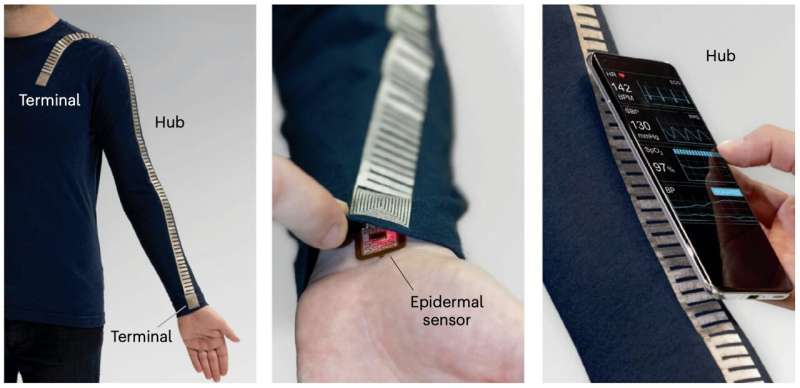
Researchers at National University of Singapore, the University of Arizona and Tsinghua University recently developed a new battery-free wearable system made up of epidermal sensors, thin and flexible devices that stick to the skin and can pick up specific physiological signals. The new system, introduced in a Nature Electronics paper, was found to enable the continuous and reliable monitoring of systolic blood pressure, even while a user is exercising.
“The continuous and precise monitoring of physiological signals via epidermal sensors could be of use in the development of personalized health care,” Selman A. Kurt, Kevin Albert Kasper and their colleagues wrote in their paper. “However, the practical deployment of such sensors is hindered by the need for bulky batteries and limitations in data transfer. We report a battery-free epidermal network that is wirelessly interconnected through a wearable metamaterial and can provide continuous, high-fidelity biosensing.”
The new battery-free epidermal system
The new system created by Kurt, Kasper and their colleagues is comprised of several ultra-thin sensors that stick directly onto the skin. These thin components are connected via a metamaterial textile, a carefully engineered fabric that can direct energy from a smartphone to the sensors, without the need for batteries or other integrated power sources.
“The network separates the power transfer (13.56 MHz) and data communication (2.4 GHz) channels through a dual-mode metamaterial textile, providing efficient wireless power transfer and low-latency data communication,” wrote the authors. “We use a smartphone as a hub to wirelessly deliver power to and acquire biological signals from multiple networked epidermal sensors mediated by the metamaterial, which is integrated in clothing. The network can continuously monitor systolic blood pressure, including in dynamic environments such as during exercise.”
The main novelty of the team’s design is their newly created metamaterial, which can separate the transfer of energy and data into two distinct frequency channels. This prevents interference between the two and allows the system to source power from a nearby smartphone while collecting and transmitting physiological data.
Promising results and future applications
The researchers evaluated their textile sensing system in a series of tests, assessing its ability to accurately monitor the user’s systolic pressure while they were resting and exercising. Systolic pressure is a measurement of the maximum force with which blood pushes against artery walls when the heart is contracting and beating.
In initial tests, the new system was found to perform remarkably well, accurately measuring systolic pressure even when a wearer was exercising. In the future, it could be improved and refined further to enable the detection of other physiological signals.
Eventually, the team’s design could be used to create smart items of clothing or textile accessories that also serve as health & fitness trackers. Concurrently, it could inspire the development of similar health-monitoring systems that operate continuously, using nearby smartphones or other devices as power sources.
Publication details
Selman A. Kurt et al, A battery-free wireless epidermal sensor network for continuous systolic blood pressure monitoring, Nature Electronics (2026). DOI: 10.1038/s41928-026-01597-1.
Journal information: Nature Electronics
Leave a Reply