
April 22, 2026 by Ingrid Fadelli, Phys.org
Collected at: https://phys.org/news/2026-04-route-plasma-based-particle.html
Plasma, the fourth state of matter, consists of a gas in which electrons are no longer bound to atoms, which allows electricity to flow freely. When beams of particles moving close to the speed of light travel through plasma, they disturb electrons and drive so-called plasma waves.
Researchers at the ELI Beamlines Facility and Czech Technical University in Prague recently explored the possibility of leveraging plasma waves driven by fast-moving beams of charged particles, such as protons or electrons, to create a relativistic mirror, a concept rooted in Einstein’s theory of special relativity.
Their theoretical analyses and the results of simulations testing their predictions were published in Physical Review E and Physical Review Research.
“The two papers grew out of our interest in a very powerful idea: if light reflects from a mirror moving close to the speed of light, the reflected light can be strongly compressed in time and shifted to much higher frequencies,” Dr. Marcel Lamač, lead author of the paper and postdoctoral researcher at ELI-Beamlines, told Phys.org.
“This concept goes back to Einstein’s early discussions of special relativity, and it has long been recognized as a possible route toward extremely bright and ultrashort X-ray pulses, with the main challenge being that such a mirror is very difficult to realize in practice.”
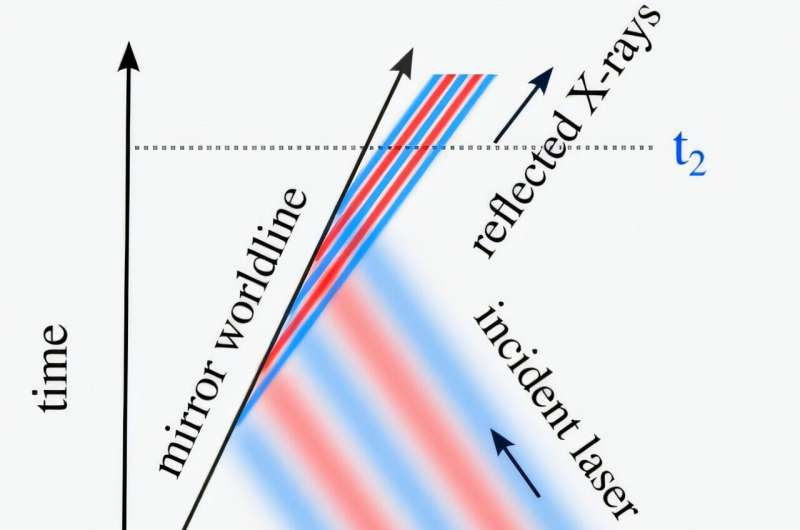
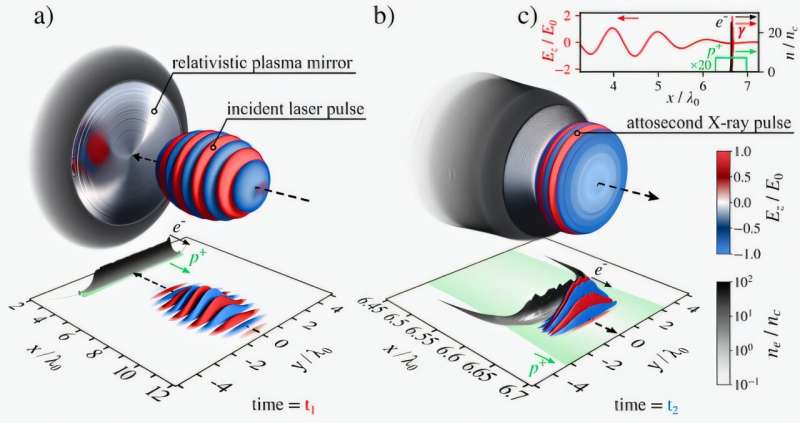
A spacetime diagram showing a mirror moving with velocity close to the speed of light (black line). An electromagnetic pulse travels along the light cone towards the mirror (colored lines). Propagation along the light cone must continue upon reflection, compressing the pulse in space and increasing its amplitude and frequency, a phenomenon known as the relativistic (double) Doppler effect. Times t1 and t2 represent the simulation results shown in image 2. Credit: Physical Review Research (2026). DOI: 10.1103/w9yj-4hh5.
The concept of beam-driven nonlinear plasma waves
The main goal of the recent studies by Lamač and his colleagues was to investigate the possibility that plasma waves could be leveraged to realize relativistic mirrors. Their theoretical work specifically focused on nonlinear plasma waves that are driven by beams of charged particles.
“The main objective of the letter in Physical Review Research was to show that such beam-driven relativistic plasma mirrors could generate bright attosecond X-ray pulses in very compact plasmas, while the Physical Review E article was written to develop the foundation needed to understand and design the underlying beam-driven nonlinear plasma waves from first-principles analytical theory,” said Lamač.
Past studies demonstrated that when a charged particle beam passes through plasma, it can act as a plow, pushing electrons and leaving behind a positively charged region that generates strong electric fields. This region somewhat resembles the wake left by a boat, but it is instead made up of oscillating plasma electrons.
“When the driving particle beam is dense enough, this wave becomes nonlinear, meaning its behavior is far richer and more complex than in the small-amplitude case,” explained Lamač.
“One of the surprising findings of our theory is that, unlike linear plasma waves, beam-driven nonlinear plasma waves can behave very differently in the wake region and in the interior of the driver.”
The team’s theory suggests that under specific circumstances, a plasma wave can form inside a particle beam, rather than behind it. The researchers also ran computer simulations that confirmed their theoretical predictions.
In their paper, they show that these beam-driven nonlinear plasma waves could potentially be used as moving mirrors that reflect laser light. This approach could be applied to the development of new advanced technologies to conduct particle physics experiments.
Informing the development of plasma-based particle accelerators
If demonstrated experimentally, the ideas introduced by Lamač and his colleagues could have important implications for the future of physics experiments. In fact, they could inform the design of beam-driven relativistic plasma mirrors and plasma wakefield accelerators.
These plasma-based accelerators are smaller and yet far more powerful than conventional radiofrequency particle accelerators. They increase the strength of acceleration by 1,000 times, allowing particles to reach high energies after traveling for meters, as opposed to the kilometers for which they travel in conventional accelerator technology.
“We connected a fundamental idea from relativity to a realistic plasma-based mechanism that, as our work suggests, could produce bright coherent attosecond X-ray pulses in a much smaller footprint than current large-scale facilities,” said Prof. Sergei Bulanov, co-author of the paper and theory group leader at ELI-Beamlines.
“At the same time, we developed an analytical theory of beam-driven nonlinear plasma waves that reveals new features, such as wave-breaking limits, which are essential for designing highly reflective plasma mirrors and for understanding the limits of plasma-based accelerators.”
The researchers’ theoretical work opens new possibilities for the realization of compact, ultrafast, X-ray sources. Concurrently, it enriches the present understanding of strongly nonlinear beam-plasma interactions and plasma-driven wakefields, which might pave the way for the creation of new plasma-based accelerators.
“In the future, we would like to test this concept experimentally, using laser wakefield acceleration to produce the driving particle beam,” added Dr. Petr Valenta, co-author of the paper and postdoctoral researcher at ELI Beamlines.
“Meanwhile, we are continuing to work on new concepts that could further improve the efficiency of plasma-based relativistic mirrors.
“Another promising research direction will be to shape the beam-driven relativistic mirror itself, which could allow us to control the focusing of the attosecond X-ray pulses, or to investigate the laser-induced damage threshold of these mirrors in order to validate their robustness.”
Publication details
M. Lamač et al, Theory of beam-driven nonlinear plasma wake and interior waves, Physical Review E (2026). DOI: 10.1103/v341-6sgn.
M. Lamač et al, Coherent attosecond x-ray pulses from beam-driven relativistic plasma mirrors, Physical Review Research (2026). DOI: 10.1103/w9yj-4hh5.
Journal information: Physical Review Research , Physical Review E
Leave a Reply