
April 20, 2026 by Sam Jarman, Phys.org
Collected at: https://phys.org/news/2026-04-sought-quantum-milestone-fermionic-atom.html
Two independent research teams have each demonstrated collisional quantum gates using fermionic atoms: a long-sought milestone in quantum computing where logic operations are performed through the direct physical overlap of atoms, rather than forcing them into fragile, highly excited states.
The studies have been published simultaneously in Nature: the first led by Petar Bojović at the Max Planck Institute for Quantum Optics in Garching, Germany, and the second by Yann Kiefer and colleagues at ETH Zurich, Switzerland.
The struggle for reliable gates
As the building blocks of quantum computers, quantum gates are the basic logic operations that manipulate qubits (the quantum equivalents of classical bits). In the latest architectures, they are implemented using atoms that are briefly excited to Rydberg states: loosely bound, highly extended configurations. However, these atoms are vulnerable to disruption from noise in the surrounding environment, making them difficult to scale up.
In contrast, collisional quantum gates are logic operations where qubits interact through the direct physical overlap of their wave functions. They have long been considered desirable for quantum computing as they rely on a comparatively stable physical mechanism rather than fragile Rydberg states.
One of the most promising routes to implementing these gates lies with fermions, including electrons and protons. This class of particles obey the “Pauli exclusion principle,” which forbids two identical fermions from occupying the same quantum state simultaneously. This constraint acts as a natural safeguard against certain gate errors, making fermions an appealing building block.
Yet despite proposals dating back to the late 1990s, researchers have consistently struggled to implement these fermionic gates in practice. So far, their attempts have been limited by excessive heating from laser light, combined with the inability to image individual qubits with sufficient precision.
Gates with fermionic atoms
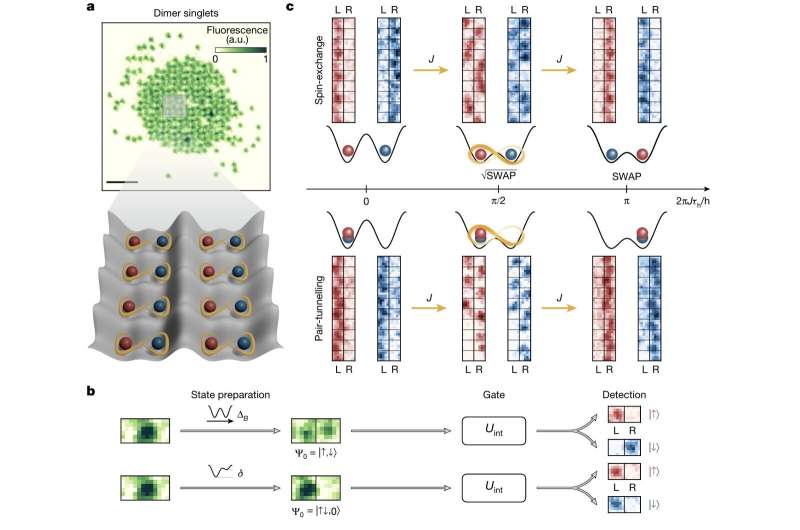
To tackle these challenges, both Bojović and Kiefer’s teams started with atoms of lithium-6—a fermionic isotope. They hold the atoms in optical lattices: periodic structures formed by intersecting laser beams that trap atoms at regular intervals. From this framework, the two teams took slightly different approaches.
In their study, the German team controlled the interactions between qubits by manipulating the potential barriers separating neighboring atoms, using an extremely stable optical lattice alongside a quantum gas microscope, capable of resolving individual atomic sites.
In contrast, the Swiss team controlled how strongly the quantum states of neighboring atoms couple together by tuning the “bias voltage.” According to the team, this approach made the gate intrinsically more resistant to noise, with its robustness rooted in fundamental symmetry properties rather than careful experimental fine-tuning.
High-fidelity entanglement
In each case, the teams achieved two-qubit gates capable of generating quantum entanglement with accuracies exceeding 99%. While Bojović’s team recorded a peak accuracy of 99.75%, Kiefer’s team achieved a loss-corrected figure of 99.91% across a system of more than 17,000 atom pairs. Both results comfortably surpass the threshold generally considered necessary for quantum error correction.
Together, the results make a strong case that collisional gates based on fermionic atoms could complement, and potentially even outperform the latest platforms for quantum computing.
Researchers in quantum chemistry are already interested in the potential of the approach to simulate molecular behavior, and both teams are now working towards demonstrating complete sets of quantum logic operations: a prerequisite for a fully programmable quantum computer.
Publication details
Petar Bojović et al, High-fidelity collisional quantum gates with fermionic atoms, Nature (2026). DOI: 10.1038/s41586-026-10356-3
Yann Kiefer et al, Protected quantum gates using qubit doublons in dynamical optical lattices, Nature (2026). DOI: 10.1038/s41586-026-10285-1
Journal information: Nature
Leave a Reply