
April 20, 2026 by Sungkyunkwan University
Collected at: https://techxplore.com/news/2026-04-gas-battery-pollution-electricity-air.html
A research team has introduced a new concept device termed the Gas Capture and Electricity Generator (GCEG), which produces electrical power as greenhouse gases are adsorbed from the atmosphere. This innovation goes beyond conventional approaches that merely capture greenhouse gases, transforming them into a usable energy resource.
The team, which includes Professor Ji-Soo Jang from the Department of Nanoengineering, in collaboration with Professor Taekwang Yoon of Ajou University and Professor Hansel Kim of Chungbuk National University, published their work in the journal Energy & Environmental Science.
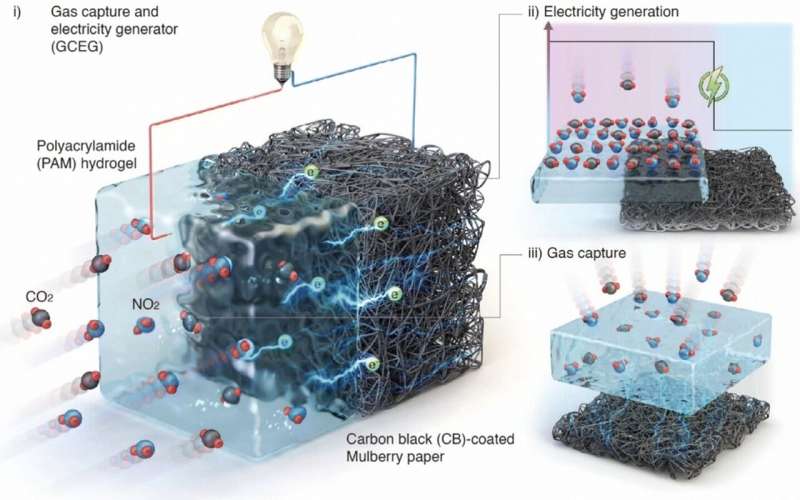
Amid growing global efforts to address climate change, carbon capture, utilization, and storage (CCUS) technologies have gained attention. However, existing CCUS systems typically require substantial energy input for gas collection and processing. To overcome this limitation, the research team proposed a fundamentally new mechanism that directly converts the physicochemical energy generated during gas adsorption on electrode surfaces into electrical energy.
The developed GCEG device consists of an asymmetric structure combining carbon-based electrodes with hydrogel materials. When greenhouse gases such as nitrogen oxides (NOx) or carbon dioxide (CO₂) are adsorbed, charge redistribution and ion migration occur within the device, enabling continuous direct current (DC) power generation without any external power source. In essence, atmospheric pollutants act as the “fuel” for electricity generation, simultaneously purifying the environment while supplying energy.
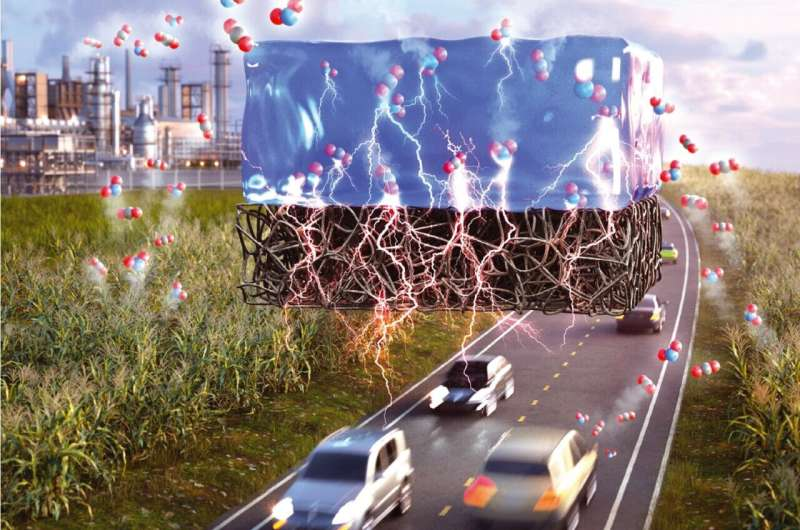
Cover image showing the greenhouse gas adsorption-based power generation device, Gas Capture and Electricity Generator (GCEG). Credit: Energy & Environmental Science (2026). DOI: 10.1039/d5ee06789h
This technology is expected to be widely applicable in self-powered smart environmental sensors, battery-free IoT systems, and industrial facilities where large volumes of emissions are generated. In such settings, it could enable simultaneous energy harvesting and carbon reduction. In particular, its integration into distributed energy systems is anticipated to accelerate the realization of carbon neutrality.
Professor Ji-Soo Jang stated, “This research demonstrates that greenhouse gases are not merely pollutants to be managed, but can serve as a new energy resource. We aim to further develop this technology into an environmental platform that not only achieves carbon neutrality but also generates energy.”
Publication details
Tae Gwang Yun et al, Electrical power generation from asymmetric greenhouse gas capture, Energy & Environmental Science (2026). DOI: 10.1039/d5ee06789h
Journal information: Energy & Environmental Science
Leave a Reply