
By Sara Webb, Swinburne University of Technology April 16, 2026
Collected at: https://scitechdaily.com/one-of-the-universes-largest-stars-may-be-getting-ready-to-explode/
A massive star’s sudden transformation may signal an approaching supernova.
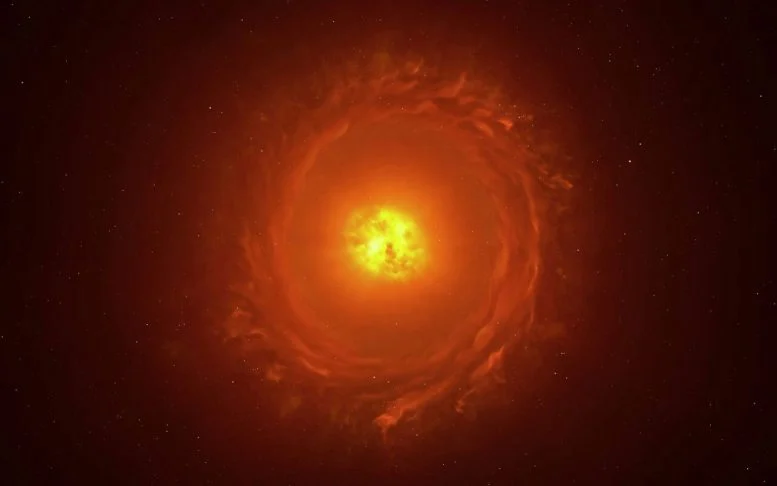
One of the largest stars ever discovered has undergone a dramatic transformation, and scientists believe it may be nearing a violent end.
New research led by Gonzalo Muñoz-Sanchez at the National Observatory of Athens, published in Nature Astronomy, finds that the enormous star WOH G64 has evolved from a red supergiant into the much rarer yellow hypergiant stage. This shift is thought to signal that the star could be approaching a supernova.
Data show that WOH G64 is actively shedding its outer layers while shrinking and heating up. These changes suggest astronomers may be witnessing a short-lived and crucial phase in the evolution of a massive star as it heads toward collapse.
A very special star
WOH G64 was first recognized in the 1970s as an unusual object in the Large Magellanic Cloud, a small galaxy that orbits the Milky Way.
Further study revealed it is not only extremely bright but also enormous, with a radius more than 1,500 times that of the Sun.
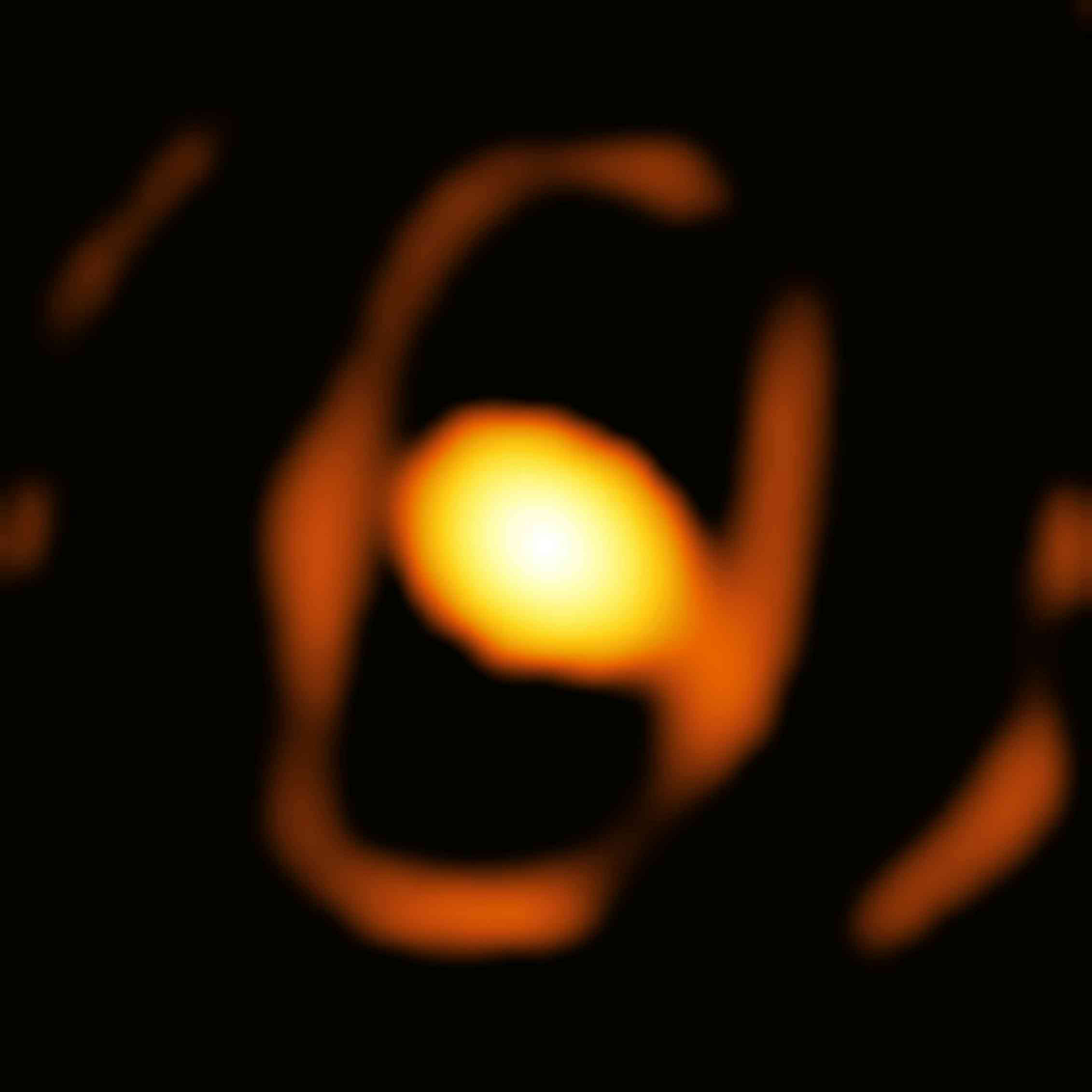
In 2024, astronomers captured the first detailed image of a star outside our galaxy using the Very Large Telescope Interferometer. The image revealed a thick, dusty shell surrounding WOH G64, providing clear evidence that it is losing mass as it evolves.
From supergiant to hypergiant, big is big
WOH G64 is a young star in the grand scheme of the cosmos, with an estimated age of less than 5 million years old. Unlike our Sun (currently about 4.6 billion years old), WOH G64 is destined to live fast and die young.
WOH G64 was born big, forming from a huge cloud of gas and dust collapsing until the pressure made it ignite. Like our Sun, it would have burned hydrogen in its core by nuclear fusion.
Later it would have expanded and burned helium, becoming what is called a red supergiant.
Not all supergiants become hypergiants. It’s been theorized that hypergiants form when very large stars quickly burn and evolve from burning hydrogen to burning helium.
During this transition, these stars start to shed their outer layers, while their cores begin to shrink inwards. Once a star becomes a hypergiant, it is destined for a quick death in the fiery explosion of a supernova.
What has caused this change seen in WOH G64?
So what happened to WOH G64 in 2014? The new study proposes that a large part of the original supergiant’s surface was ejected away from the star.
This may have been due to interactions with a companion star, which the authors have confirmed exists by looking at the spectrum of light from WOH G64.
Another theory: the star is getting ready to explode. We know stars this big will inevitably go kaboom, but exactly when it will happen can be hard to determine in advance.
One possible scenario is that the transition we’re seeing is due to a pre-supernova “superwind” phase. This is theorized to occur due to strong internal pulsations as the fuel in the core is spent quickly.
Only time will tell
Most stars live for tens of millions or even tens of billions of years. It was never a given we would witness and be able to document so much transformation in a star, let alone one outside our galaxy.
If we are lucky, we will see the death of WOH G64 in our lifetimes – not only providing an incredible intergalactic spectacle but also helping scientists complete the puzzle of this fascinating star.
Reference: “The dramatic transition of the extreme red supergiant WOH G64 to a yellow hypergiant” by Gonzalo Muñoz-Sanchez, Maria Kalitsounaki, Stephan de Wit, Konstantinos Antoniadis, Alceste Zoe Bonanos, Emmanouil Zapartas, Konstantina Boutsia, Evangelia Christodoulou, Grigoris Maravelias, Igor Soszyński and Andrzej Udalski, 23 February 2026, Nature Astronomy.
DOI: 10.1038/s41550-026-02789-7
Adapted from an article originally published in The Conversation.
Leave a Reply