
April 15, 2026 by ECMWF
Collected at: https://phys.org/news/2026-04-machine-tool-optimal-tree-powerful.html
Afforestation—establishing forests on previously non-forested land, or where forests have not existed for a long time—is one of the nature-based and cost-effective solutions for climate change mitigation because it offsets carbon emissions through carbon storage and can help reduce the effects of flooding. The European Union’s Biodiversity Strategy for 2030 targets converting at least 10% of agricultural land into forest.
However, previous modeling studies suggest that while afforestation can help lessen the impact of flooding, conversely, it can exacerbate water scarcity and exacerbate wildfires when implemented on a large scale. Studies also show the benefits of afforestation depend on factors such as species choice, soil and landscape conditions, regional climate and spatial configuration.
In an article published in Communications Sustainability, Fredrik Wetterhall, Senior Hydrologist, and his colleagues at the European Center for Medium-Range Weather Forecasts outline how a smart, data-driven algorithm can help identify optimal sites, minimizing the known negative effects of afforestation on water availability.
“Afforestation is a careful balancing act between reducing flooding and managing water scarcity,” said Wetterhall. “Our study examines the hydrological impacts of converting abandoned croplands in Europe into forests. Where, and how much to plant, matters. Optimized afforestation, guided by ecological and hydrological criteria, can reduce river peaks while preserving groundwater.”
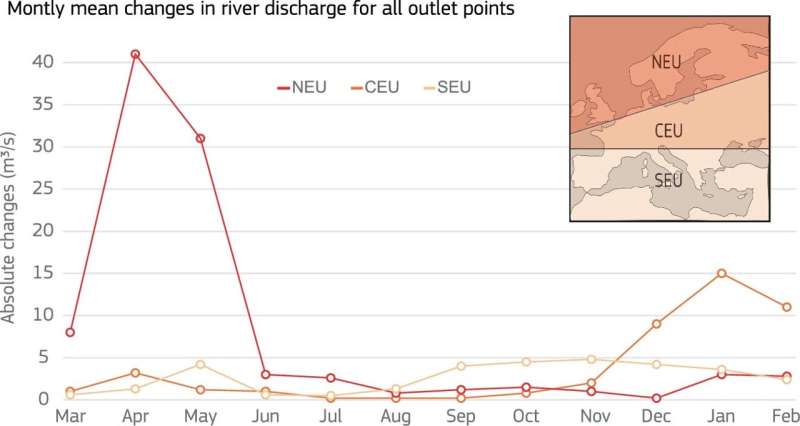
The study shows that, with a targeted selection of afforestation sites, river flooding could be reduced by up to 43% with a median reduction of 3.1%. Random selection only leads to flood reduction in a few cases and has mostly no effect. Optimized afforestation also curbs evapotranspiration, the transfer of water from plants to the atmosphere, reducing water loss and thereby preserving available groundwater by up to 60%, a critical save, given the growing need to conserve water in a changing climate. The combined effects lead to a “sweet spot” of optimal afforestation between 40% and 80%.
Siham El Garroussi, the machine learning scientist who developed the genetic algorithm used in the study, explains that the model was optimized to enhance water retention. Its flexibility, however, allows other criteria to be incorporated, such as reducing wildfire risk or improving ecological biodiversity. “The constraints guiding the machine learning model‘s decisions are defined by a physical discharge model, showing the power of combining physical understanding with machine learning.”
The team also tested how both strategies perform under a +2°C warming scenario and found that both are similarly affected. “This means the optimized approach would remain the most effective option and is likely to stand the test of time in a warming climate,” added Wetterhall.
The study highlights that implementing nature-based solutions can be more complex than expected and may involve trade-offs. Data-driven technologies can support large-scale, smarter planning—delivering benefits for both carbon mitigation and sustainable water management.
More information
Siham El Garroussi et al, Optimized afforestation reduces flood risk and limits water loss in Europe, Communications Sustainability (2026). DOI: 10.1038/s44458-026-00057-3
Leave a Reply