
April 4, 2026 by Daegu Gyeongbuk Institute of Science and Technology
Collected at: https://phys.org/news/2026-03-microscopic-mechanism-quantum-collapse-real.html
A research team has, for the first time in the world, elucidated the microscopic mechanism by which quantum order is lost and collapses in “open quantum environments” existing in nature. Since perfectly isolated quantum systems cannot exist in reality, this study is expected to provide a decisive breakthrough in bridging the gap between ideal quantum theory and quantum technologies that must operate in real-world environments.
The study is published in the journal Advanced Science. The study was led by Professor JaeDong Lee of the Department of Physics and Chemistry at DGIST.
Decoding ultrafast electronic decoherence
“High-order harmonics,” generated when intense light is irradiated onto solid materials, have high academic and industrial value, as they are used for material characterization as well as for generating ultrafast pulses and high-energy light. However, during this process, a phenomenon known as “ultrafast electronic decoherence” occurs, in which the intrinsic quantum state becomes disrupted within an extremely short timescale of 1–2 femtoseconds. The fundamental cause of this phenomenon had remained unknown despite more than a decade of extensive research worldwide.
To solve this puzzle, Professor JaeDong Lee’s team developed and applied a novel computational approach based on the “Lindblad master equation,” overcoming the limitations of conventional quantum master equations. This enabled the establishment of a microscopic theoretical research framework that can precisely account for not only electron–electron interactions but also interactions between electrons and their surrounding environment.
Unraveling superradiance and broadband emission
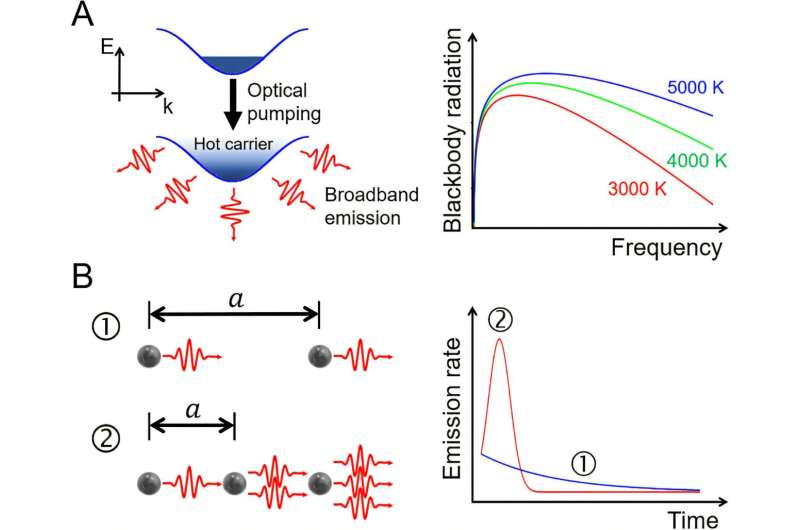
The team analyzed the phenomena of “superradiance” and “broadband emission” observed in the process of high-order harmonic generation in solids, and newly found that interference occurs between the two, leading to mutual cancellation.
As a result, they confirmed that interactions with the environment (such as superradiance) in open quantum environments play a decisive role in governing ultrafast electronic decoherence in solids, thereby resolving a long-standing challenge in the field.
Implications for practical quantum technologies
“Through this study, we have found that ultrafast electronic decoherence in solids—long regarded as a mystery for over a decade—originates from environmental interactions in open quantum systems,” stated Professor JaeDong Lee of the Department of Physics and Chemistry at DGIST. “The true significance of this research lies in opening a pathway to connect ideal quantum theory to practical and reliable quantum engineering, and it will pose a new and substantial challenge to existing quantum technology concepts based on the assumption of isolated quantum systems.”
Publication details
Gimin Bae et al, Superradiance and Broadband Emission Driving Fast Electron Dephasing in Open Quantum Systems, Advanced Science (2026). DOI: 10.1002/advs.202522729
Journal information: Advanced Science
Leave a Reply