
April 3, 2026 by Sam Jarman, Phys.org
Collected at: https://phys.org/news/2026-04-quantum-coherence-large-scales-realistic.html
Quantum states are notoriously fragile, and can be destroyed simply through interactions, measurements, and exposure to their surrounding environments. In a new theoretical study published in Physical Review X, Rohan Mittal and colleagues at the University of Cologne have discovered a new way to protect quantum behavior on large scales within systems driven far from equilibrium. Their results could have promising implications for the design of more robust quantum devices.
The decoherence problem
When quantum many-body systems are driven out of equilibrium, they undergo decoherence, causing quantum correlations and superpositions to break down. Even when such a system is built from entirely quantum components, the effect can cause its behavior to become indistinguishable from that of a classical system on larger scales, making it unsuitable for technologies such as quantum computing or sensing.
So far, researchers have attempted to solve the decoherence problem by fine-tuning two independent parameters: one to push the system to the boundary between two distinct quantum phases, and another to ensure that quantum coherence is maintained at this boundary. In practice, however, the need to account for two parameters simultaneously has made this approach both fragile and experimentally daunting.
Building with fermions
To address this challenge, Mittal’s team constructed a model from fermions: a family of particles including electrons, which are governed by strict rules about how many particles can occupy a given quantum state. One key feature of fermions is that at finite temperatures, they can only contribute to a system’s large-scale behavior when the entire system exists in a pure quantum state.
Taking advantage of this, the researchers considered how interactions between fermions and their surrounding environments could be engineered so that the system settles into configurations immune to decoherence, known as “dark states.”
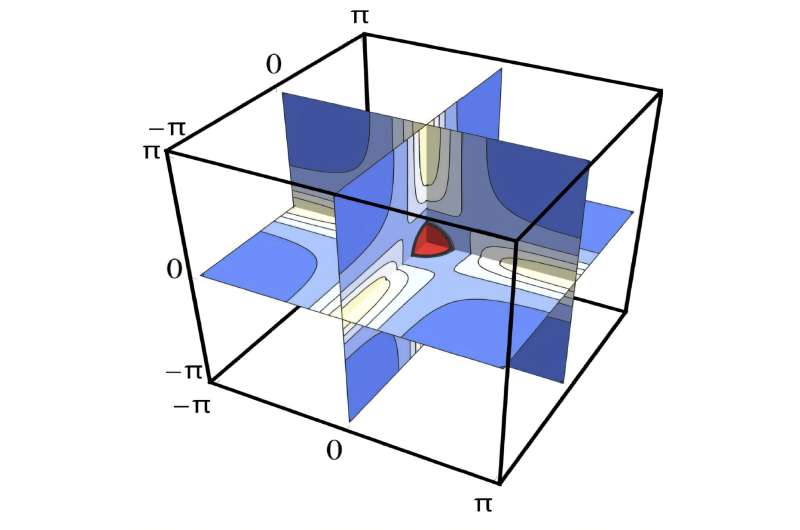
By fine-tuning a single parameter, they could drive the system between two topologically distinct dark states, producing a quantum phase transition while keeping the fermions fully coherent throughout.
Symmetry as a shield
Crucially, the team identified a combination of two mathematical transformations that leave the system’s equations unchanged, which they call a fermionic dark-state symmetry. Beyond eliminating the need for two tunable parameters, this symmetry protects the purity of the fermion states against the effects of their surroundings.
Through this shielding mechanism, the team’s calculations reveal how quantum coherence could survive in open, driven systems, making them far better suited to real-world applications.
If it can be demonstrated experimentally, Mittal’s team are hopeful that their mechanism could serve as a design principle for quantum devices that can be continuously measured and controlled without losing their coherence.
To reach this goal, they will now aim to identify experimental platforms that could realistically satisfy the requirements for fermionic dark-state symmetry, and run simulations to validate their predictions.
Publication details
Rohan Mittal et al, Fermion Quantum Criticality far from Equilibrium, Physical Review X (2026). DOI: 10.1103/nj2d-l6pz
Journal information: Physical Review X
Leave a Reply