
April 1, 2026 by Olivia Maule, Stanford University
Collected at: https://phys.org/news/2026-04-astronauts-safe-deep-space.html
The Artemis II mission launches this week as a first step toward returning to the moon and reaching Mars. Materials scientist Debbie Senesky explains the material tech that makes these missions possible.
NASA’s Artemis II mission—the first crewed lunar flyby in more than 50 years—is slated to send four astronauts on a roughly 10-day, flyby voyage around the moon. While no landing is planned, the mission is designed to stress-test the systems, hardware, and materials that will eventually sustain humans in deep space.
Debbie Senesky is an interdisciplinary engineer who studies advanced materials for space applications, from ultralight graphene aerogels to mushroom-based composites she hopes will one day be used to build habitats on the lunar surface. We asked her what it really takes to keep people alive—and comfortable—beyond Earth orbit.
Artemis II is described as a test of critical life support systems. What does ‘life support’ actually mean in practice for a 10-day crewed mission?
People often jump straight to food and water—but life support is really a whole ecosystem of systems working together. You need clean air, which means filtration systems constantly scrubbing the cabin environment. You need pressure control that mimics the conditions humans evolved in, even though you’re hundreds of thousands of miles from Earth. And then you have crew health monitoring—collecting vital sign data throughout the mission, which can feed directly into planning for longer-duration missions down the road.
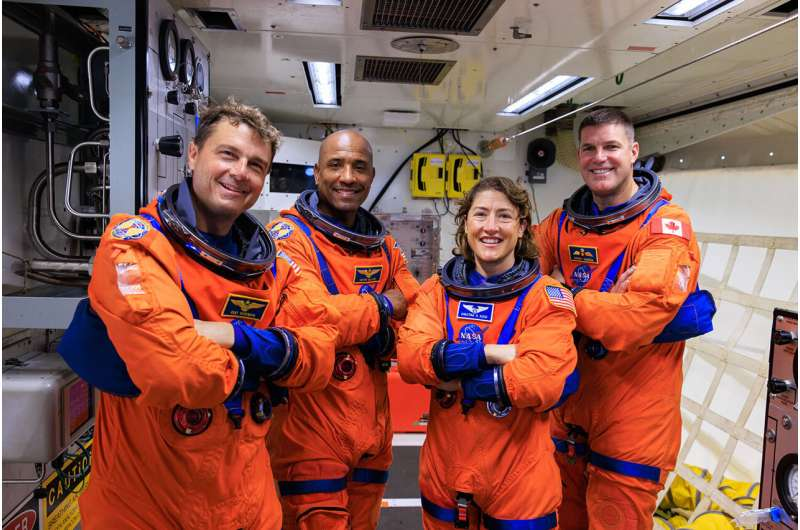
Artemis II NASA astronauts (left to right) Reid Wiseman, Victor Glover, and Christina Koch, and CSA (Canadian Space Agency) astronaut Jeremy Hansen. Credit: NASA / Frank Michaux
Food is genuinely interesting from an engineering perspective. You want it to be nutrient-dense and energy-dense, but every gram you put on a spacecraft costs fuel. So the food that goes up is almost nothing like what you’d eat at home—think dehydrated, compact, fortified with vitamins and supplements, reactivated with water. There are companies now that have gotten remarkably good at making that kind of food palatable.
Keeping humans comfortable is one challenge—developing a space-ready vehicle is another. What materials innovations have made missions like Artemis II possible?
The aerospace industry is, by nature, very conservative about materials. Once something has been tested, qualified, and successfully flown, what’s called “flight heritage,” there’s a strong incentive not to change it. Qualification is an extensive process: structural tests, shock tests, radiation tests, tests to make sure nothing off-gases toxic compounds into a crewed environment. It’s rigorous for good reason.
That said, composites have advanced considerably. Carbon fiber is a great example. The way carbon atoms bond together in certain configurations creates a material that can be stronger than steel at a fraction of the weight. Engineers lay carbon fibers in specific orientations within an epoxy matrix so the material is optimized for strength exactly where it’s needed. And 3D printing has opened up real possibilities: Rather than carving a complex nozzle shape out of a solid block of metal and wasting material, you can now print that shape directly. Some companies are printing in carbon fiber too, which is remarkable.
What about the spacesuits themselves—what materials challenges do those present?
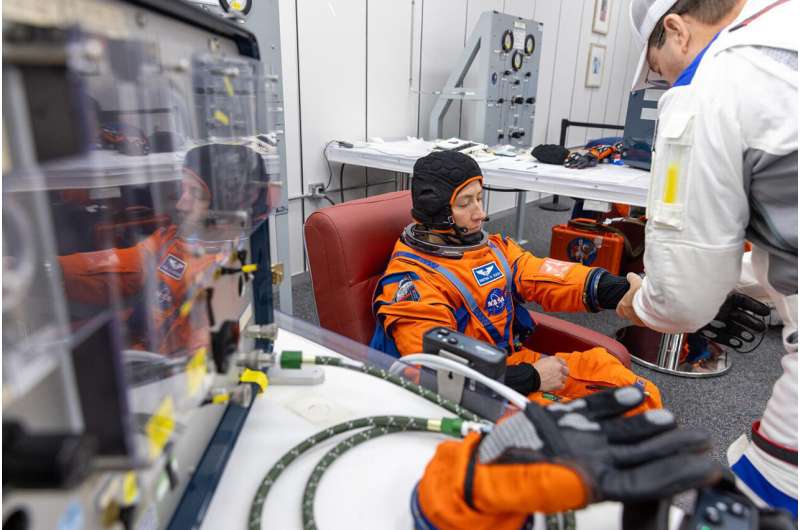
Spacesuits are essentially wearable spacecraft. They have to maintain pressure around the body, resist radiation, and be flame-retardant, all while giving the astronaut enough mobility to actually move. The classic image of Neil Armstrong’s suit—huge and bulky—reflects where the technology was. What you’re seeing in newer suit designs is a push toward something more form-fitting and ergonomic, so astronauts can be more dexterous, especially if they’re going to be doing complex surface operations.
One problem that doesn’t get talked about enough is cleaning. There’s no washing machine on a spacecraft. For a 10-day mission you can manage, but as we think about missions to Mars that could last years, you need either self-cleaning materials or some novel cleaning process—for example, non-liquid cleaning or optical sterilization processes can be employed to enable reuse of garments. These kinds of approaches become very relevant when water is a precious resource and you can’t just de-orbit a bag of dirty laundry.
Some of your research involves mycelium, or the root structure of fungi, as a building material. How does that fit into the future of space exploration?
This is the work I’m most excited about, even though it’s still a long way from flying. The concept is this: The moon is covered in regolith, a fine, sharp dust. If you could bind that dust together using mycelium—the fibrous root network of fungi—you could potentially grow structural bricks directly on the lunar surface, rather than launching construction materials from Earth. You’d send up mycelium in powder form, activate it in molds filled with lunar regolith, let it grow through and around the dust particles, then dehydrate it. The result is a porous, composite structure that might be used as building material.
What makes mycelium particularly compelling is how tunable it is. Depending on the strain you use and the conditions you grow it in, you can produce something rigid and bricklike, or something flexible. People have already made artificial leather from mycelium. Imagine furniture, structural panels, or even elements of a spacesuit all from the same biological feedstock you grew onsite.
The challenge is that tunability cuts both ways: It also means the material can be hard to control and characterize. Two batches grown under slightly different conditions can have radically different mechanical properties, which is a real problem when you’re trying to qualify a material for a flight mission. We’re also working to understand how lunar gravity and radiation exposure would affect the growth and final properties of the material. But I genuinely believe mycelium biocomposites could become one of the most important materials for sustained lunar and eventually Martian habitation. We just have a long road ahead before they earn flight heritage.
Leave a Reply