
March 2, 2026 by Lawrence Livermore National Laboratory
Collected at: https://phys.org/news/2026-03-laser-mev-ray-radiography-picoseconds.html
Lawrence Livermore National Laboratory’s National Ignition Facility (NIF) is the hottest place on Earth for the briefest of moments during an experiment. Now, it can be one of the brightest places thanks to the Advanced Radiographic Capability (ARC), NIF’s laser-within-a-laser. How this is possible and how it’s measured is detailed in a paper in Physics of Plasmas titled “Development and scaling of MeV X-ray radiography at NIF-ARC.”
“This paper is a culmination of 13 NIF experiments over five years of data gathering, analyzing experiments, modeling and refining diagnostics,” said LLNL physicist Dean Rusby, the paper’s first author. “We’re able to create and measure an MeV X-ray source that can’t be done anywhere else on Earth.”
How ARC turns lasers into MeV X-rays
ARC compresses two of the laser facility’s beamlines to deliver kilojoules of laser energy in picoseconds. ARC is currently the most energetic short-pulse laser in the world. Using this intense burst of energy, ARC creates high-energy (MeV) X-ray radiographs of materials of interest. Such experiments help scientists understand how those materials react to extreme conditions.
This work establishes the technology basis for a future capability that would radiograph explosively driven hydrodynamics experiments at the sub-microsecond time scale, such as those performed at LLNL’s Site 300. The benefit of a laser approach is increased spatial resolution over current high-energy flash X-ray techniques.
Building on earlier ARC photon research
This paper follows on LLNL research published in Physics of Plasmas in 2023. LLNL scientist Shaun Kerr was the lead author of that paper, “Development of a bright MeV photon source with compound parabolic concentrator targets on the National Ignition Facility Advanced Radiographic Capability (NIF-ARC) laser,” which included Rusby.
When taking radiographs of moving objects, brightness—the number of photons generated by the X-ray source—and source size—the volume over which the photons are emitted—matter. The brighter the X-ray source and the smaller the source size, the clearer the image and finer the details. Over the last five years, Rusby and colleagues optimized MeV X-ray generation with the ARC laser system, but one of the challenges was measuring the MeV X-rays.
Cracking the problem of measuring MeV X-rays
“From the first shots, we knew that NIF-ARC was generating a lot of MeV X-rays,” Rusby said. “But the diagnostics to measure and characterize the MeV X-rays were not yet available. Detecting and diagnosing high-energy X-rays is hard for the same reason we like to use them for radiography: their high penetrating power allows them to easily go through materials but also makes them hard to detect.”
Combining the existing NIF Gamma Reaction History diagnostic and Electron Proton Positron Spectrometers with newly deployed nuclear activation diagnostics enabled characterization.
Pushing radiography through dense materials
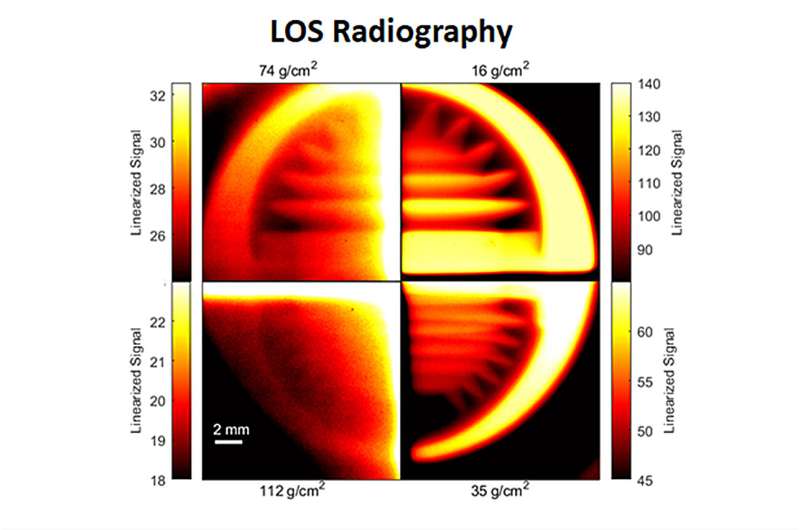
The radiography samples for the experiments were 2-centimeter lead balls with interior ripples of a feature size in the 100s of microns. In some experiments, the target was placed behind a 1- to 3-centimeter layer of tungsten as a further challenge. Both lead and tungsten are extremely dense materials, which makes imaging more difficult.
With the help of modeling and simulation, the researchers also tried different experimental setups inside the NIF target chamber. The best images came when the objects were placed along the ARC laser axis line-of-sight, which required the development of new sample and diagnostic holders.
The researchers are now working to further optimize the process, including working on smaller spatial scales, pushing the spatial resolution down to about 10 microns.
Publication details
D. R. Rusby et al, Development and scaling of MeV x-ray radiography at NIF-ARC, Physics of Plasmas (2025). DOI: 10.1063/5.0294704
Journal information: Physics of Plasmas
Leave a Reply