
By Jennifer Chu, Massachusetts Institute of Technology January 28, 2026
Collected at: https://scitechdaily.com/scientists-crack-mystery-behind-jupiter-and-saturns-wild-polar-weather/
Jupiter and Saturn host strikingly different polar storms, despite being similar giant planets, and scientists have long wondered why. New simulations suggest the answer may lie deep below the clouds.
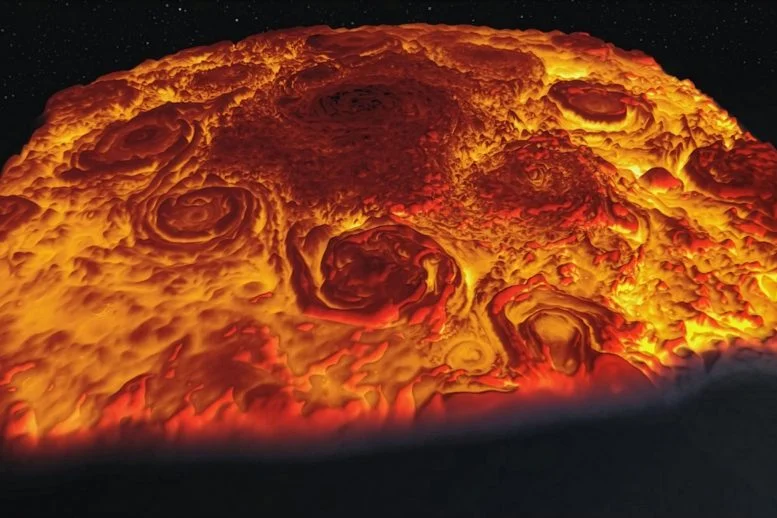
Spacecraft flybys have given scientists a front row seat to some of the strangest weather in the solar system, especially over the poles of Jupiter and Saturn. Saturn’s north pole is dominated by one giant storm that traces out a surprising hexagon, while Jupiter’s polar region looks more like a tightly packed cluster: a central vortex ringed by eight smaller ones.
That contrast is hard to dismiss as a surface-level quirk. Jupiter and Saturn are similar in size and built largely from the same gases, yet their polar storms settle into very different long-lived arrangements.
A team at MIT argues the answer may be hidden below the cloud tops. In work published in the Proceedings of the National Academy of Sciences, the researchers used computer simulations to watch orderly vortex patterns emerge from random churning on a gas giant. Depending on the conditions, the simulated winds either merged into a single dominant polar vortex like Saturn’s, or stabilized into multiple large circulations resembling Jupiter’s.
The key divider was a trait the team calls the “softness” of a vortex’s base, which reflects a planet’s interior composition. They describe each vortex as a spinning cylinder extending through many atmospheric layers. If the lower portion sits in softer, lighter material, the vortex hits a growth limit, leaving room for several smaller storms to coexist. If the base is harder and denser, the vortex can expand far more, swallowing nearby vortices until one massive system remains.
That link between what happens deep inside a planet and the patterns seen from above adds a new twist to images returned by missions like Juno at Jupiter and Cassini at Saturn. If the model is right, the geometry of a planet’s polar storms could act as a clue to what is happening beneath the clouds, where direct measurements are far harder to obtain.
“Our study shows that, depending on the interior properties and the softness of the bottom of the vortex, this will influence the kind of fluid pattern you observe at the surface,” says study author Wanying Kang, assistant professor in MIT’s Department of Earth, Atmospheric and Planetary Sciences (EAPS). “I don’t think anyone’s made this connection between the surface fluid pattern and the interior properties of these planets. One possible scenario could be that Saturn has a harder bottom than Jupiter.”
The study’s first author is MIT graduate student Jiaru Shi.
Spinning up
Kang and Shi’s new work was inspired by images of Jupiter and Saturn that have been taken by the Juno and Cassini missions. NASA’s Juno spacecraft has been orbiting around Jupiter since 2016, and has captured stunning images of the planet’s north pole and its multiple swirling vortices. From these images, scientists have estimated that each of Jupiter’s vortices is immense, spanning about 3,000 miles across — almost half as wide as the Earth itself.
The Cassini spacecraft, prior to intentionally burning up in Saturn’s atmosphere in 2017, orbited the ringed planet for 13 years. Its observations of Saturn’s north pole recorded a single, hexagonal-shaped polar vortex, about 18,000 miles wide.
“People have spent a lot of time deciphering the differences between Jupiter and Saturn,” Shi says. “The planets are about the same size and are both made mostly of hydrogen and helium. It’s unclear why their polar vortices are so different.”
Shi and Kang set out to identify a physical mechanism that would explain why one planet might evolve a single vortex, while the other hosts multiple vortices. To do so, they worked with a two-dimensional model of surface fluid dynamics. While a polar vortex is three-dimensional in nature, the team reasoned that they could accurately represent vortex evolution in two dimensions, as the fast rotation of Jupiter and Saturn enforces uniform motion along the rotating axis.
“In a fast-rotating system, fluid motion tends to be uniform along the rotating axis,” Kang explains. “So, we were motivated by this idea that we can reduce a 3D dynamical problem to a 2D problem because the fluid pattern does not change in 3D. This makes the problem hundreds of times faster and cheaper to simulate and study.”
Getting to the bottom
Following this reasoning, the team developed a two-dimensional model of vortex evolution on a gas giant, based on an existing equation that describes how swirling fluid evolves over time.
“This equation has been used in many contexts, including to model midlatitude cyclones on Earth,” Kang says. “We adapted the equation to the polar regions of Jupiter and Saturn.”
The team applied their two-dimensional model to simulate how fluid would evolve over time on a gas giant under different scenarios. In each scenario, the team varied the planet’s size, its rate of rotation, its internal heating, and the softness or hardness of the rotating fluid, among other parameters. They then set a random “noise” condition, in which fluid initially flowed in random patterns across the planet’s surface. Finally, they observed how the fluid evolved over time, given the scenario’s specific conditions.
Over multiple different simulations, they observed that some scenarios evolved to form a single large polar vortex, like Saturn, whereas others formed multiple smaller vortices, like Jupiter. After analyzing the combinations of parameters and variables in each scenario and how they related to the final outcome, they landed on a single mechanism to explain whether a single or multiple vortices evolve: As random fluid motions start to coalesce into individual vortices, the size to which a vortex can grow is limited by how soft the bottom of the vortex is. The softer, or lighter the gas is that is rotating at the bottom of a vortex, the smaller the vortex is in the end, allowing for multiple smaller-scale vortices to coexist at a planet’s pole, similar to those on Jupiter.
Conversely, the harder or denser a vortex bottom is, the larger the system can grow, to a size where eventually it can follow the planet’s curvature as a single, planetary-scale vortex, like the one on Saturn.
If this mechanism is indeed what is at play on both gas giants, it would suggest that Jupiter could be made of softer, lighter material, while Saturn may harbor heavier stuff in its interior.
“What we see from the surface, the fluid pattern on Jupiter and Saturn, may tell us something about the interior, like how soft the bottom is,” Shi says. “And that is important because maybe beneath Saturn’s surface, the interior is more metal-enriched and has more condensable material which allows it to provide stronger stratification than Jupiter. This would add to our understanding of these gas giants.”
Reference: “Polar vortex dynamics on gas giants: Insights from 2D energy cascades” by Jiaru Shi and Wanying Kang, 20 January 2026, Proceedings of the National Academy of Sciences.
DOI: 10.1073/pnas.2500791123
This research was supported, in part, by a Mathworks Fellowship and endowed funding from MIT’s Department of Earth, Atmospheric and Planetary Sciences.
Leave a Reply