
November 10, 2025 by Navdeep Arya, Stockholm University
Collected at: https://phys.org/news/2025-11-faint-quantum-space.html
Researchers from Stockholm University and the Indian Institute of Science Education and Research (IISER) Mohali have reported a practical way to spot one of physics’ strangest predictions: the Unruh effect, which says that an object speeding up (accelerating) would perceive empty space as faintly warm. But, trying to heat something up by accelerating it unimaginably fast is a nonstarter in the lab. The team has shown how to convert that tiny effect into a clear, timestamped flash of light.
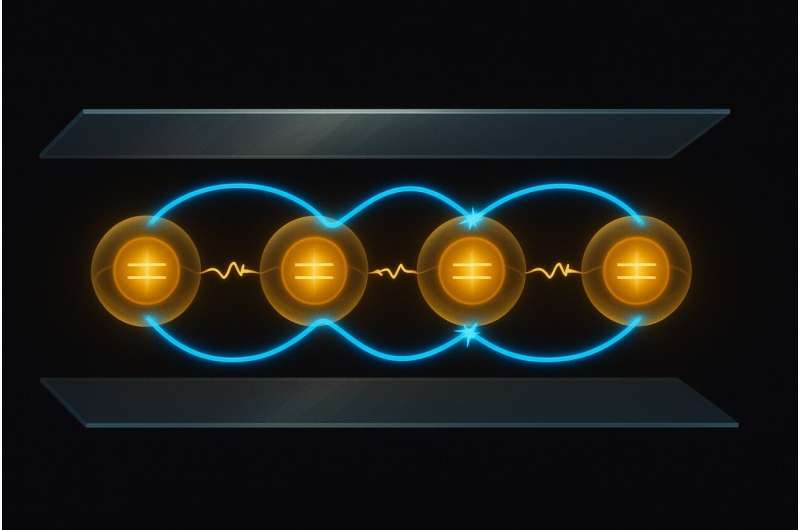
Here’s the simple picture. Imagine a group of atoms between two parallel mirrors. The mirrors can either speed up or slow down light emission from the atoms. When these atoms cooperate, they can emit together like a choir—much louder than solo singers. This collective outburst is called superradiance.
The new study explains how the acceleration-induced warmth of empty space, if experienced by the atoms, quietly nudges them so that the choir’s burst happens earlier than it would for atoms sitting still. That earlier-than-expected flash becomes a clean, easy-to-spot signature of the Unruh effect. The work, co-authored with Kinjalk Lochan and Sandeep K. Goyal of IISER Mohali, is now published in Physical Review Letters.
“We’ve found a way to turn the Unruh effect’s whisper into a shout,” said Akhil Deswal, a Ph.D. student at IISER Mohali. “By using carefully spaced high-quality mirrors, we make ordinary background signals quieter while the acceleration-seeded burst comes out early and clean.”
Crucially, the proposal demands significantly lower acceleration compared to the requirement in the absence of high-quality mirrors.
“Timing is the key,” added Navdeep Arya, a postdoctoral researcher at Stockholm University. “The choir of atoms is not only louder but also shouts earlier if they feel the faint Unruh effect-related warmth of empty space. That simple clock-like marker can make it easier to separate the Unruh signal from everyday noise.”
By theoretically addressing a decades-old detection challenge, the idea opens a bridge between available laboratory devices and phenomena usually linked to extreme conditions. Because acceleration and gravity are closely related, similar timing tricks might one day help researchers probe subtle, gravity-driven quantum effects—right on the lab bench.
More information: Akhil Deswal et al, Time-Resolved and Superradiantly Amplified Unruh Effect, Physical Review Letters (2025). DOI: 10.1103/6z1l-kkmk
Journal information: Physical Review Letters
Leave a Reply