
November 6, 2025 by Paul Arnold, Phys.org
Collected at: https://phys.org/news/2025-11-quantum-aid-room-temperature-superconductors.html
For the first time, a quantum computer has successfully measured pairing correlations (quantum signals that show electrons teaming up in pairs), which is essential to helping scientists find one of the holy grails of physics—superconductors that work at room temperature.
Superconductors are materials that can conduct electricity with zero resistance, meaning no energy is lost as heat. To work, they need to be cooled to extremely low temperatures, which makes them expensive and impractical for widespread use. Physicists have been trying to tweak their structure to make them work at room temperature, and many believe that understanding and manipulating electron-pairing correlations are key to that breakthrough.
The Fermi-Hubbard bottleneck
For decades, this research was stuck. To map out how electrons behave in potential superconductors, scientists use a mathematical framework called the Fermi-Hubbard model. It allows them to test and predict the behavior of electrons in new superconducting materials. But as you add more particles, the problem quickly becomes too complex to be solved by even the world’s most powerful traditional supercomputers.
So researchers at the quantum computing firm Quantinuum used a new Helios-1 quantum computer to simulate the complex interactions. Instead of trying to calculate a material’s behavior, Helios-1 mimicked the quantum interactions within the material. It uses specially trapped atoms (ions) as its quantum bits (qubits), the fundamental building blocks of a quantum computer.
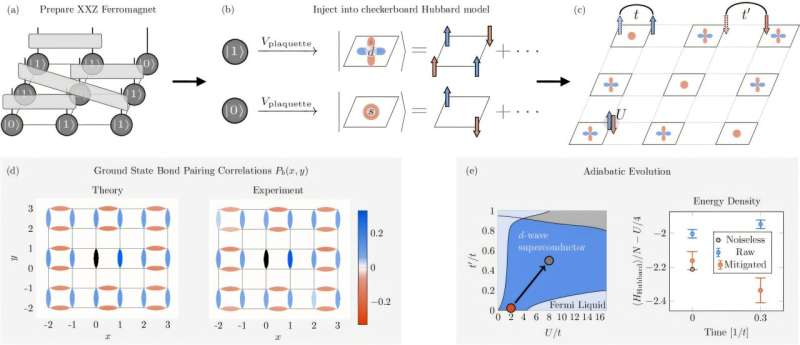
𝐷-wave pairing in the doped checkerboard model. Credit: arXiv (2025). DOI: 10.48550/arxiv.2511.02125
Unlike a classical computer bit that is strictly 0 or 1, a qubit can be both 0 and 1 simultaneously. By mapping the problem onto this quantum hardware, the researchers bypassed the limitations of classical supercomputers and took the first precise measurements of the faint quantum evidence for pairing correlations.
Measurements and results
Helios-1 took these measurements in three different scenarios, including testing a model for brand-new nickel-based superconductors. The experiment demonstrated that quantum computing could be a powerful tool for accelerating the search for room-temperature superconductivity.
“These results show that a quantum computer can reliably create and probe physically relevant states with superconducting pairing correlations, opening a path to the exploration of superconductivity with quantum computers,” commented the researchers in a paper published on the arXiv preprint server.
However, physicists won’t be turning to quantum computing for this problem regularly anytime soon. There are still a few things to iron out. Two major hurdles are noise accumulation, in which environmental interference, such as electromagnetic fields, causes qubits to collapse, and the need for more qubits to simulate large, real-world materials accurately.
More information: Etienne Granet et al, Superconducting pairing correlations on a trapped-ion quantum computer, arXiv (2025). DOI: 10.48550/arxiv.2511.02125
Journal information: arXiv
Leave a Reply