

July 31, 2025 by Mark Thompson, Universe Today
Collected at: https://phys.org/news/2025-07-life-emergence-complex-previously-understood.html
A new study published in July 2025 tackles one of science’s most profound mysteries—how did life first emerge from nonliving matter on early Earth? Using cutting edge mathematical approaches, researcher Robert G. Endres from Imperial College London has developed a framework that suggests the spontaneous origin of life faces far greater challenges than previously understood.
The study, published on the arXiv preprint server, focuses on the difficulty of assembling structured biological information under what could be reasonably expected prebiotic conditions, showing just how hard it would be for the first living cell to form naturally on early Earth. Think of it like trying to write an article about the origins of life for a well renowned space based website by randomly throwing letters at a page. The chances of success become astronomically small as the required complexity increases.
Endres applies information theory and algorithmic complexity to understand what it would take for the first living cell, called a protocell, to spontaneously assemble from chemical building blocks. This mathematical angle reveals just how improbable such an event would be under natural conditions.
The research suggests that relying purely on chance and natural chemical processes may not adequately explain life’s emergence within the timeframe available on early Earth. The tendency for systems to become more disordered rather than more organized, presents significant obstacles to the formation of the highly organized structures necessary for life.
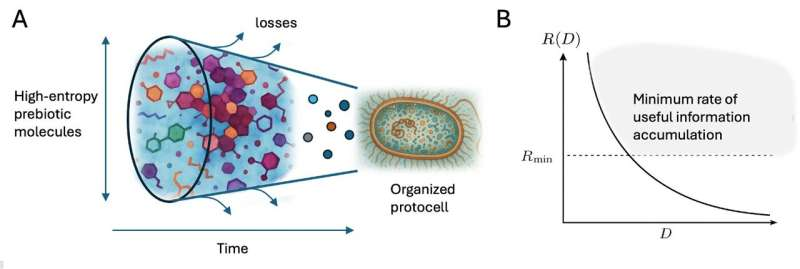
Mathematical framework based on rate-distortion theory. Credit: arXiv (2025). DOI: 10.48550/arxiv.2507.18545
This doesn’t mean life’s origin is impossible, but rather that our current understanding may be incomplete. The study emphasizes that uncovering physical principles for life’s emergence from nonliving matter remains a grand challenge for biological physics.
While maintaining scientific rigor, the paper acknowledges that directed panspermia, originally proposed by Francis Crick and Leslie Orgel, remains a speculative but logically open alternative. This hypothesis suggests that life might have been intentionally seeded on Earth by advanced extraterrestrial civilizations, though the author notes this idea challenges Occam’s razor, the scientific principle favoring simpler explanations.
This research doesn’t disprove the possibility of life emerging naturally on Earth though. Instead, it quantifies the mathematical challenges involved and suggests that we may need to discover new physical principles or mechanisms that could overcome these informational barriers. The work represents an important step toward making the study of life’s origins more mathematically rigorous.
The study also reminds us that some of the universe’s greatest mysteries still await solutions, and that combining mathematical precision with biological questions can reveal new depths to age old puzzles about our existence.
More information: Robert G. Endres, The unreasonable likelihood of being: origin of life, terraforming, and AI, arXiv (2025). DOI: 10.48550/arxiv.2507.18545
Journal information: arXiv

Leave a Reply