
By Amit Malewar 26 May, 2025
Collected at: https://www.techexplorist.com/sources-caused-reionization-universe/99587/
Understanding the Universe’s evolution is an essential aspect of modern astronomy. The reionization era was a mysterious early phase of the Universe when no stars or galaxies existed, and space was shrouded in a thick fog of hydrogen gas.
Then, the first stars formed and emitted powerful radiation, gradually clearing the fog and allowing light to travel freely. Astronomers are still working to understand what produced enough energy to lift this cosmic haze and make the Universe transparent.
Astronomers used the powerful James Webb Space Telescope to study the faintest galaxies from the Universe’s first billion years. Their findings reveal that small dwarf galaxies likely significantly cleared the cosmic fog during reionization by emitting vast amounts of energetic radiation. This helps answer a key question about how the early Universe became transparent.
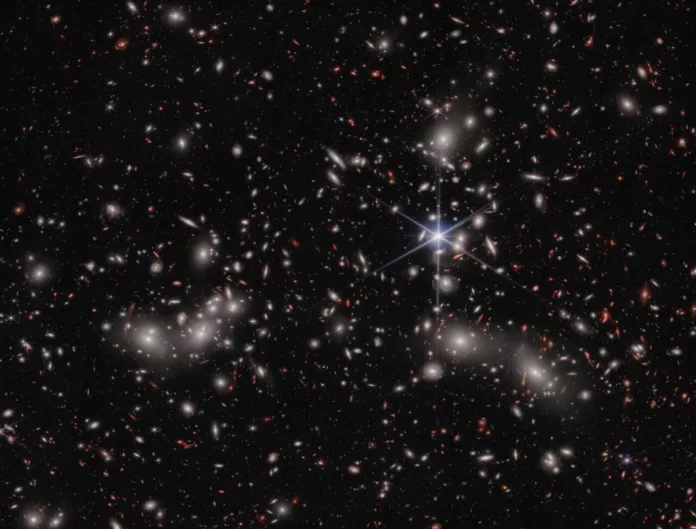
Astronomers used the UNCOVER program to study a galaxy cluster called Abell 2744, also known as Pandora’s Cluster. They relied on gravitational lensing—a natural magnification effect caused by the cluster’s immense gravity—to observe distant galaxies that would otherwise be too faint to detect.
This method revealed eight extremely faint galaxies producing far more ionizing radiation than previously thought, about four times higher than expected. These findings suggest that tiny dwarf galaxies played a crucial role in reionizing the early Universe, clearing the cosmic fog, and making space transparent.
Team member Iryna Chemerynska of the Institut d’Astrophysique de Paris in France said, “This discovery unveils the crucial role played by ultra-faint galaxies in the early Universe’s evolution.
During cosmic reionization, they produce ionizing photons that transform neutral hydrogen into ionized plasma. It highlights the importance of understanding low-mass galaxies in shaping the Universe’s history.”
Despite their tiny size, dwarf galaxies were powerful enough to shape the Universe. Their sheer numbers and intense radiation cleared the hydrogen fog during reionization, transforming cosmic conditions.
To confirm this, astronomers used ultra-deep images from Webb and Hubble to find faint galaxies from this era. Then, they analyzed them with Webb’s NIRSpec instrument, using its Multi-Shutter Assembly to study multiple galaxies simultaneously. This was the first time scientists precisely measured their abundance and ionizing power, proving they were the dominant force behind reionization.
Thanks to Webb’s powerful NIRSpec instrument and the magnification effect of Abell 2744, astronomers were able to study some of the faintest galaxies from the Universe’s first billion years, over 100 times dimmer than the Milky Way.
Next, the GLIMPSE program will take even more profound observations by studying another galaxy cluster, Abell S1063. Scientists aim to find even fainter galaxies and determine whether their ionizing properties are representative of galaxies across the early Universe. This will also help explore Cosmic Dawn, the era when the first galaxies began to emerge just a few million years after the Big Bang.
Journal Reference:
- Atek, H., Labbé, I., Furtak, L.J. et al. Most of the photons that reionized the Universe came from dwarf galaxies. Nature 626, 975–978 (2024). DOI: 10.1038/s41586-024-07043-6
Leave a Reply