
By Radboud University Nijmegen May 25, 2025
Collected at: https://scitechdaily.com/everything-evaporates-from-neutron-stars-to-you-the-universe-is-on-a-clock/
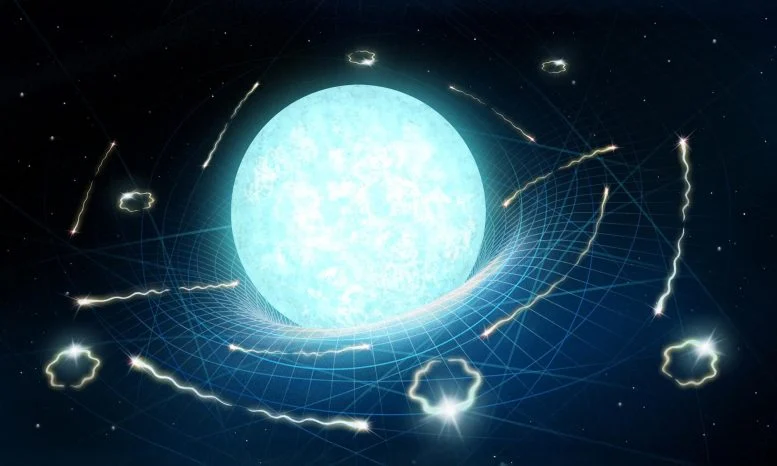
What if black holes weren’t the only things slowly vanishing from existence? Scientists have now shown that all dense cosmic bodies—from neutron stars to white dwarfs—might eventually evaporate via Hawking-like radiation.
Even more shocking, the end of the universe could come far sooner than expected, “only” 1078 years from now, not the impossibly long 101100 years once predicted. In an ambitious blend of astrophysics, quantum theory, and math, this playful yet serious study also computes the eventual fates of the Moon—and even a human.
Black Holes Aren’t Alone
A team of scientists from Radboud University in the Netherlands has taken their bold theory one step further. Black hole expert Heino Falcke, quantum physicist Michael Wondrak, and mathematician Walter van Suijlekom previously proposed that not just black holes, but other dense cosmic objects like neutron stars, could also slowly “evaporate” through a process similar to Hawking radiation.
Their earlier paper caught attention across the scientific world—and beyond. One question kept popping up: How long does this slow cosmic fading actually take? In their latest research, they’ve done the math.
Universe’s Ultimate Deadline
The team found that the ultimate “end” of the universe could arrive in about 1078 years—a 1 followed by 78 zeros—based solely on this Hawking-like radiation. That’s the time it would take for white dwarfs, the most stubborn stars in the cosmos, to fully decay. For comparison, earlier estimates (which ignored this evaporation process) stretched to a mind-boggling 101100 years.
Lead author Heino Falcke: “So the ultimate end of the universe comes much sooner than expected, but fortunately it still takes a very long time.”
The heart of this idea is a fascinating twist on Stephen Hawking’s 1975 theory. Hawking proposed that black holes aren’t entirely black—they can emit faint radiation due to quantum effects near their event horizons. Tiny particle pairs can briefly emerge near the edge of a black hole. One falls in, the other escapes. That escaping particle slowly robs the black hole of mass.
This process, known as Hawking radiation, means that even black holes can shrink and eventually disappear. It was a revolutionary idea—and it challenged Einstein’s view that black holes can only grow. Now, with updated calculations and a broader scope, this research suggests that everything might ultimately fade away, particle by particle.
Density Over Gravity
The researchers calculated that the process of Hawking radiation theoretically also applies to other objects with a gravitational field. The calculations further showed that the ‘evaporation time’ of an object depends only on its density.
To the researchers’ surprise, neutron stars and stellar black holes take the same amount of time to decay: 1067 years. This was unexpected because black holes have a stronger gravitational field, which should cause them to ‘evaporate’ faster. “But black holes have no surface,” says co-author and postdoctoral researcher Michael Wondrak, “They reabsorb some of their own radiation, which inhibits the process.”
Moon and Man’s Final Fate
Because the researchers were at it anyway, they also calculated how long it takes for the Moon and a human to evaporate via Hawking-like radiation. That’s 1090 years (a 1 with 90 zeros). Of course, the researchers subtly note, there are other processes that may cause humans and the moon to disappear faster than calculated.
Co-author Walter van Suijlekom, professor of mathematics at Radboud University, adds that the research is an exciting collaboration of different disciplines and that combining astrophysics, quantum physics, and mathematics leads to new insights. “By asking these kinds of questions and looking at extreme cases, we want to better understand the theory, and perhaps one day, we will unravel the mystery of Hawking radiation.”
Reference: “An upper limit to the lifetime of stellar remnants from gravitational pair production” by Heino Falcke, Michael F. Wondrak and Walter D. van Suijlekom, 12 May 2025, Journal of Cosmology and Astroparticle Physics.
DOI: 10.1088/1475-7516/2025/05/023


I together with my pals have been digesting the good items located on your site and all of a sudden I got a terrible feeling I had not thanked the web blog owner for those tips. These boys had been totally joyful to see them and have in effect definitely been tapping into them. We appreciate you really being so considerate as well as for making a choice on this form of beneficial resources most people are really desperate to understand about. Our sincere apologies for not expressing gratitude to earlier.


Leave a Reply