
By Evan Gough May 22, 2025
Collected at: https://www.universetoday.com/articles/our-solar-system-may-have-a-new-planetary-sibling-another-dwarf-planet
Our understanding of our Solar System is still evolving. As our telescopes have improved, they’ve brought the Solar System’s deeper reaches into view. Pluto was disqualified as a planet because of it. Now, new research says another dwarf planet may reside at the edge of the Solar System. Its presence supports the Planet X hypothesis.
The ongoing effort to understand the distant Solar System led to the discovery of objects like Far Out in 2018. It’s a trans-Neptunian object (TNO), one of thousands without names or numbers. TNOs are primordial objects, unaffected by the Sun at such great distances. They’re significant because they can tell us how the Solar System’s large planets migrated in the distant past.
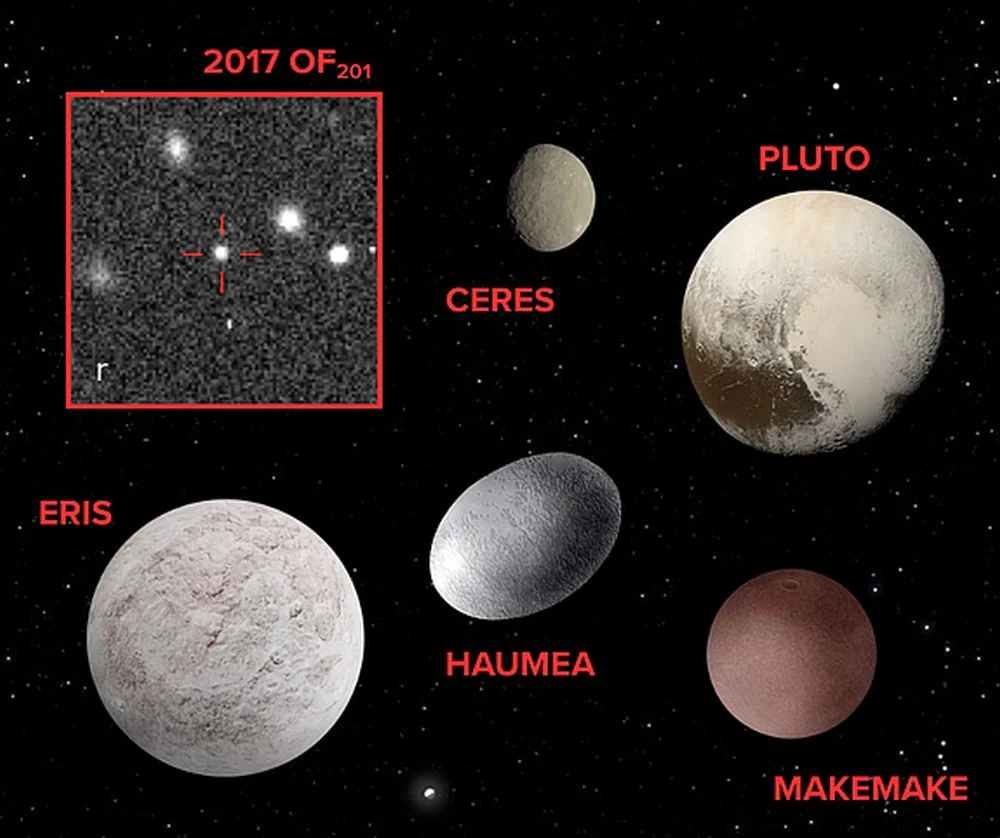
Researchers have found another rare type of TNO called an ETNO, for Extreme trans-Neptunian Object. They’re even more distant from the Sun. TNOs orbit the Sun at a greater distance than Neptune, with a semi-major axis of 30.1 astronomical units. ETNOs have perihelia greater than 70 astronomical units. The object’s working name is 2017 OF201.
The discovery is presented in new research titled “Discovery of a dwarf planet candidate in an extremely wide orbit: 2017 OF201.” The lead author is Sihao Cheng, an astrophysicist associated with the Perimeter Institute for Theoretical Physics and the Institute for Advanced Study.
2017 OF201 is notable for two reasons: its large size and its extremely wide orbit.
“It must have experienced close encounters with a giant planet, causing it to be ejected to a wide orbit.” – Sihao Cheng, Perimeter Institute.
“We report the discovery of a dwarf planet candidate, 2017 OF201, currently located at a distance of 90.5 au,” the authors write. “Its orbit is extremely wide and extends to the inner Oort cloud, with a semi-major axis of 838 au and a perihelion of 44.9 au precisely determined from 19 observations over seven years.”
 This image shows the current positions of Neptune, Pluto, and 2017 OF201. Image Credit: Jiaxuan Li and Sihao Cheng
AT about 700 km in diameter, it qualifies as a dwarf planet. It’s also the second-largest known object in the ETNO population. (For comparison, Pluto is 2,377 km.) Its presence suggests that what astronomers thought was empty space beyond Neptune in the Kuiper Belt isn’t empty after all. “Its high eccentricity suggests that it is part of a broader, unseen population of similar objects totalling about 1 % of Earth’s mass,” the authors write.
“The object’s aphelion—the farthest point on the orbit from the Sun—is more than 1600 times that of the Earth’s orbit,” lead author Cheng said in a press release. “Meanwhile, its perihelion—the closest point on its orbit to the Sun—is 44.5 times that of the Earth’s orbit, similar to Pluto’s orbit.”
The new object’s orbit stands apart from other ETNOs and disagrees with the idea that our Solar System has a ninth planet. “Notably, the orbit of 2017 OF201 lies well outside the clustering of longitude of perihelion observed in extreme trans-Neptunian objects, which has been proposed as dynamical evidence for a distant, undetected planet,” the authors write.
In 2025, researchers computed the most likely orbit for Planet X based on the clustering of other ETNOs. However, 2017 OF201 doesn’t conform to the clustering. “Many extreme TNOs have orbits that appear to cluster in specific orientations, but 2017 OF201 deviates from this,” said co-author Jiaxuan Li.
“These results suggest that the existence of 2017 OF201 may be difficult to reconcile with this particular instantiation of the Planet X hypothesis,” the authors explain.

This illustration shows the orbits of TNOs with extremely wide orbits. Curiously, the new TNO has a distinct orbit, making it an outlier. Planet X’s most likely orbit, according to 2025 research, is shown in black. Image Credit: Cheng et al. 2025.
At such an extreme distance from the Sun, the object takes about 25,000 years to complete one orbit. The last time 2017 OF201 was in the position it’s in now, humans were hunter-gatherers, busy refining stone tools in the Upper Paleolithic period.
The authors think that its orbit tells a tale of gravitational interactions. “It must have experienced close encounters with a giant planet, causing it to be ejected to a wide orbit,” says Yang. “There may have been more than one step in its migration. It’s possible that this object was first ejected to the Oort cloud, the most distant region in our solar system, which is home to many comets, and then sent back,” Cheng adds.
There’s good reason to think that there are many more difficult-to-detect objects in the outer Solar System that qualify as dwarf planets. Finding this one took some good fortune because it’s usually too far away to detect.
“2017 OF201 spends only 1% of its orbital time close enough to us to be detectable. The presence of this single object suggests that there could be another hundred or so other objects with similar orbit and size; they are just too far away to be detectable now,” Cheng states. “Even though advances in telescopes have enabled us to explore distant parts of the universe, there is still a great deal to discover about our own solar system.”
“The discovery of 2017 OF201 suggests a population behind it with hundreds of objects possessing similar properties, because the probability for 2017 OF201 to be close enough and detectable is only 0.5%, given its wide and eccentric orbit,” the authors write. Based on its large size, they also think that the population’s total mass is 1% of Earth’s mass, not an insignificant amount.
Though its presence doesn’t outright falsify the Planet X/Planet Nine hypothesis, it does pose a challenge. However, if the hypothesized planet does exist, it could spell doom for 2017 OF201. “Our N-body simulations suggest that the presence of the Planet X / Planet 9 that produces the clustering will cause ejection of 2017 OF201 in a short timescale around 0.1 Gyr,” the authors write.
If that happens, the tiny dwarf planet will join the population of rogue planets that drift through the Milky Way.
Press Release: An Extreme Cousin for Pluto? Possible Dwarf Planet Discovered at Solar System’s Edge
Research: Discovery of a dwarf planet candidate in an extremely wide orbit: 2017 OF201


I do enjoy the way you have presented this specific matter plus it really does supply me personally a lot of fodder for consideration. However, because of what I have witnessed, I basically hope as the reviews pile on that people today keep on issue and don’t embark upon a tirade involving the news du jour. Anyway, thank you for this fantastic point and although I do not really go along with the idea in totality, I value the point of view.

Leave a Reply