
May 15, 2025 by Tejasri Gururaj , Phys.org
Collected at: https://phys.org/news/2025-05-fundamental-limit-bosonic-dark.html
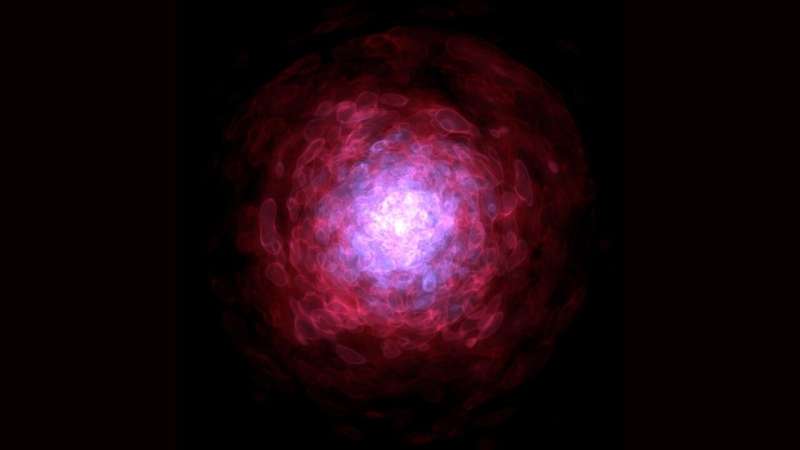
In a new study published in Physical Review Letters, scientists have estimated a new lower bound on the mass of ultra-lightweight bosonic dark matter particles.
Purported to make up about 85% of the matter content in the universe, dark matter has eluded direct observation. Its existence is only inferred by its gravitational effects on cosmic structures.
Because of this, scientists have been unable to identify the nature of dark matter and, therefore, its mass. According to our current model of quantum mechanics, all fundamental particles must be either fermions or bosons.
Previous work has successfully established the lower bound on dark matter’s mass (if it is fermionic) using Pauli’s exclusion principle.
Pauli’s exclusion principle prevents two fermions (electrons, protons, neutrons) from occupying the same quantum state simultaneously. However, this doesn’t apply to bosons (photons, gluons, Higgs particles).
Phys.org spoke to the first author of the study, Tim Zimmermann, a Ph.D. candidate at the Institute of Theoretical Astrophysics, University of Oslo.
Zimmermann said, “Through the lens of astrophysics, a productive way to constrain the properties of dark matter is to extract from observations what it is not. In this work, we establish a new fundamental limit on the mass of the dark matter particle, assuming it falls into the ultralight boson category.”
According to their study, the mass of ultralight bosonic dark matter must be more than 2 × 10-21 electron volts (eV), 100 times more than previous estimates using Heisenberg’s uncertainty principle.
Kinematical observations of Leo II
The team’s method focuses on the data of Leo II, the Milky Way’s satellite galaxy. It is a dwarf galaxy 1,000 times smaller than the Milky Way.
“What we need is a single snapshot of how Leo II looks. Interpreting this snapshot then turns out to be quite simple because it is a close neighbor of the Milky Way, and thus, does not require us to model additional things such as the expansion of the universe to interpret this snapshot,” said Zimmermann.
By studying the movement of the stars within Leo II, researchers can infer how dark matter is distributed within the galaxy. This is because the stars’ movements are governed by the gravitational influence of the total mass of the galaxy, including dark matter.
“We leverage everything we know about Leo II, especially how it looks internally. We go the extra mile and solve Schrödinger’s equation to determine every possible state dark matter can exist in. Our result is data-exhaustive and only uses first-principle physics,” explained Zimmermann.
The team created 5,000 possible dark matter density profiles that are consistent with the observed stellar kinematics in Leo II. For this, they used a Markov-chain–Monte-Carlo sampler tool called GRAVSPHERE that solves the Jeans equation to infer the density profile of dark matter.
They then compared these observation-based profiles with density profiles created by quantum wave functions representing dark matter of different possible masses.
Establishing a lower bound and mixed dark matter
The researchers found that when the dark matter particle is too light (below 2.2 × 10⁻²¹ eV), the quantum wave functions cannot reproduce the observed dark matter density distribution due to fundamental limitations from the uncertainty principle.
The uncertainty principle limits how precisely the position and momentum of a particle can be known simultaneously.
In the case of very light dark matter particles, this creates a quantum fuzziness, where they behave more like waves than localized particles. This quantum fuzziness would prevent dark matter from being concentrated in small regions.
The researchers developed a computational tool called JAXSP to establish their results. The tool allowed them to reconstruct the wave functions of dark matter particles and determine if they could reproduce the ones observed in the density profiles of Leo II.
Through statistical analysis, they could identify the point at which the particle mass became too small to account for the observed galaxy structure.
Compared to previous studies, the researchers improved the lower bound on dark matter mass by two orders of magnitude.
The findings have significant implications for popular ultralight dark matter models, particularly fuzzy dark matter, which typically proposes particles with masses around 10-22 eV.
“Fuzzy dark matter at 10-22 eV was already under heavy pressure by an array of independent studies prior to our work,” stated Zimmermann.
“What has changed is that we can now draw this conclusion more confidently, simply because even if you don’t invoke all these fancy models for how the universe expands, how gas absorbs light, or how stars evolve over millions of years, our result still rules out vanilla fuzzy dark matter.”
Looking ahead, the team is keen to explore mixed dark matter models.
“An increasingly popular idea in the dark matter phenomenology community is mixed dark matter, the idea that dark matter is not just made out of one particle with one mass, but many particles with different masses,” explained Zimmermann.
“Extending our analysis to this scenario, providing a robust limit for mixed dark matter only relying on local universe information, is a natural step forward.”
More information: Tim Zimmermann et al, Dwarf Galaxies Imply Dark Matter Is Heavier than 2.2×10⁻²¹ eV, Physical Review Letters (2025). DOI: 10.1103/PhysRevLett.134.151001
Journal information: Physical Review Letters


I not to mention my pals appeared to be taking note of the nice guidelines on the website and then unexpectedly developed a terrible suspicion I had not expressed respect to the site owner for them. Those men appeared to be for this reason passionate to see all of them and now have sincerely been loving these things. Appreciate your being simply considerate and for getting some helpful areas most people are really desperate to know about. My very own sincere apologies for not expressing appreciation to sooner.


Leave a Reply