
May 14, 2025 by Alyson Chapman, Texas A&M University College of Engineering
Collected at: https://phys.org/news/2025-05-ai-tornado-recovery.html
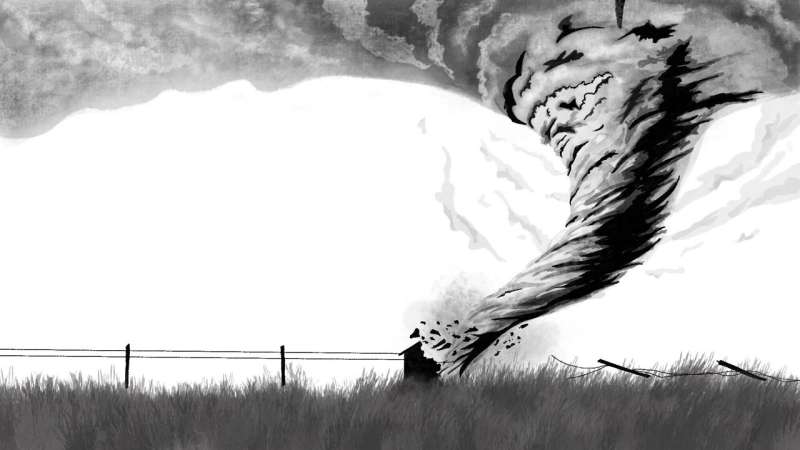
It started as a low, haunting roar building in the distance. It grew into a deafening thunder that drowned out all else. The sky turned an unnatural shade of green, then black. The wind lashed at trees and buildings with brutal force. Sirens wailed. Windows and buildings exploded.
In spring 2011, Joplin, Missouri, was devastated by an EF5 tornado with estimated winds exceeding 200 mph. The storm caused 161 fatalities, injured more than 1,000 people, and damaged and destroyed around 8,000 homes and businesses. The tornado carved a mile-wide path through the densely populated south-central area of the city, leaving behind miles of splintered rubble and causing more than $2 billion in damage.
The powerful winds of tornadoes often surpass the design limits of most residential and commercial buildings. Traditional methods of assessing damage after a disaster can take weeks or even months, delaying emergency response, insurance claims and long-term rebuilding efforts.
New research from Texas A&M University might change that. Led by Dr. Maria Koliou, associate professor and Zachry Career Development Professor II in the Zachry Department of Civil and Environmental Engineering at Texas A&M, researchers have developed a new method that combines remote sensing, deep learning and restoration models to speed up building damage assessments and predict recovery times after a tornado. Once post-event images are available, the model can produce damage assessments and recovery forecasts in less than an hour.
The researchers published their model in the journal Sustainable Cities and Society.
“Manual field inspections are labor-intensive and time-consuming, often delaying critical response efforts,” said Abdullah Braik, co-author and a civil engineering doctoral student at Texas A&M. “Our method uses high-resolution sensing imagery and deep learning algorithms to generate damage assessments within hours, immediately providing first responders and policymakers with actionable intelligence.”
The model does more than assess damage—it also helps predict repair costs and estimate recovery times. Researchers can assess these timelines and costs in different situations by combining deep learning technology, a type of artificial intelligence, with advanced recovery models.
“We aim to provide decision-makers with near-instantaneous damage assessment and probabilistic recovery forecasts, ensuring that resources are allocated efficiently and equitably, particularly for the most vulnerable communities,” Braik said. “This enables proactive decision-making in the aftermath of a disaster.”
How it works
Researchers combined three tools to create the model: remote sensing, deep learning and restoration modeling.
Remote sensing uses high-resolution satellite or aerial images from sources such as NOAA to show the extent of damage across large areas.
“These images are crucial because they offer a macro-scale view of the affected area, allowing for rapid, large-scale damage detection,” Braik said.
Deep learning automatically analyzes these images to identify the severity of the damage accurately. The AI is trained before disasters by analyzing thousands of images of past events, learning to recognize visible signs of damage such as collapsed roofs, missing walls and scattered debris. The model then classifies each building into categories such as no damage, moderate damage, major damage, or destroyed.
Restoration modeling uses past recovery data, building and infrastructure details and community factors—like income levels or access to resources—to estimate how long it might take for homes and neighborhoods to recover under different funding or policy conditions.
When these three tools are combined, the model can quickly assess the damage and predict short- and long-term recovery timelines for communities affected by disasters.
“Ultimately, this research bridges the gap between rapid disaster assessment and strategic long-term recovery planning, offering a risk-informed yet practical framework for enhancing post-tornado resilience,” Braik said.
Testing the model
Koliou and Braik used data from the 2011 Joplin tornado to test their model due to its massive size, intensity and availability of high-quality post-disaster information. The tornado destroyed thousands of buildings, creating a diverse dataset that allowed the model to be trained and tested across various levels of structural damage. Detailed ground-level damage assessments provided a reliable benchmark to check how accurately the model could classify the severity of the damage.
“One of the most interesting findings was that, in addition to detecting damage with high accuracy, we could also estimate the tornado’s track,” Braik said. “By analyzing the damage data, we could reconstruct the tornado’s path, which closely matched the historical records, offering valuable information about the event itself.”
Future directions
Researchers are working on using this model for other types of disasters, such as hurricanes and earthquakes, as long as satellites can detect damage patterns.
“The key to the model’s generalizability lies in training it to use past images from specific hazards, allowing it to learn the unique damage patterns associated with each event,” Braik said. “We have already tested the model on hurricane data, and the results have shown promising potential for adapting to other hazards.”
The research team believes their model could be critical in future disaster response, helping communities recover faster and more efficiently. The team wants to extend the model beyond damage assessment to include real-time updates on recovery progress and tracking recovery over time.
“This will allow for more dynamic and informed decision-making as communities rebuild,” he said. “We aim to create a reliable tool that enhances disaster management efficiency and supports quicker recovery efforts.”
The technology has the potential to transform how emergency officials, insurers and policymakers respond in the crucial hours and days after a storm by delivering near-instant assessments and recovery projections.
More information: Abdullah M. Braik et al, Post-tornado automated building damage evaluation and recovery prediction by integrating remote sensing, deep learning, and restoration models, Sustainable Cities and Society (2025). DOI: 10.1016/j.scs.2025.106286


Nice post. I learn something more challenging on different blogs everyday. It will always be stimulating to read content from other writers and practice a little something from their store. I’d prefer to use some with the content on my blog whether you don’t mind. Natually I’ll give you a link on your web blog. Thanks for sharing.
Leave a Reply