
By Sissa Medialab May 9, 2025
Collected at: https://scitechdaily.com/the-universe-may-not-be-uniform-and-euclid-might-prove-it/
What if one of the most fundamental assumptions in cosmology—that the Universe looks the same in every direction—isn’t actually true?
Using a novel approach with data from the Euclid telescope, scientists are looking for a telltale signal in the bending of light from distant galaxies that could rewrite cosmology’s rules.
Challenging Cosmic Assumptions
“The cosmological principle is like an ultimate kind of statement of humility,” says James Adam, an astrophysicist at the University of the Western Cape in South Africa and lead author of a new study. This principle states that not only are we not at the center of the Universe, there is no center at all. It also assumes the Universe is isotropic, meaning it looks the same in every direction, and homogeneous, meaning matter is distributed evenly on large scales.
These ideas form the foundation of the Standard Model of Cosmology, our best framework for understanding the origin, structure, and evolution of the Universe. While this model is supported by extensive evidence, it remains a work in progress.
However, recent observations suggest there may be subtle irregularities—anisotropies—at the largest cosmic scales. These include inconsistencies in how fast the Universe is expanding, unusual patterns in the cosmic microwave background, and other unexplained data. Although intriguing, these findings aren’t yet definitive. Scientists need more independent data to rule out measurement errors. If multiple methods reveal the same patterns, it could signal a major shift in how we understand the cosmos.
Testing the Universe with Euclid
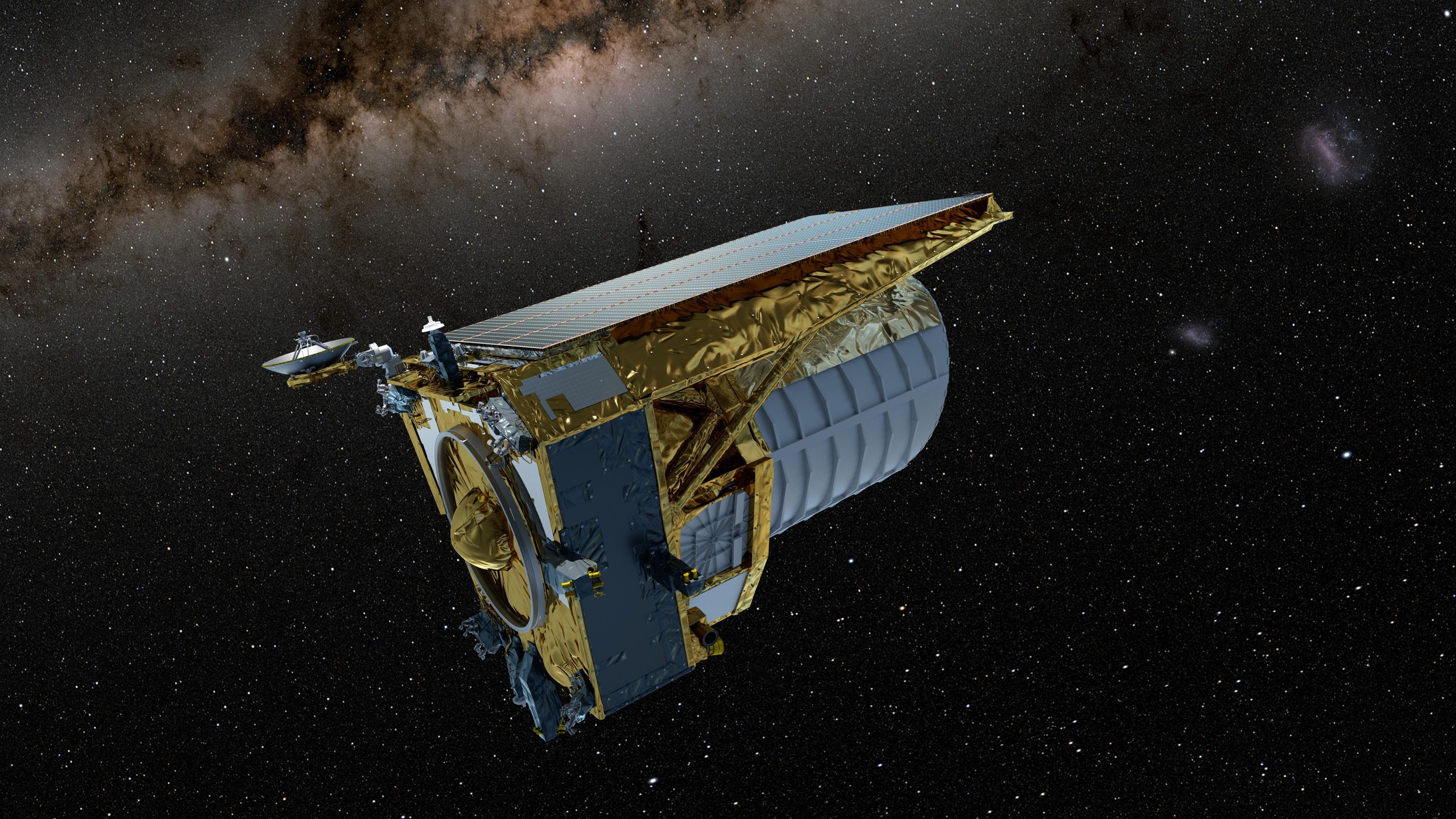
A new study published in the Journal of Cosmology and Astroparticle Physics by James Adam and colleagues introduces a novel method for testing whether the Universe is truly isotropic—that is, the same in all directions. Their approach uses data from cutting-edge instruments like Euclid, a European Space Agency (ESA) space telescope launched in 2023. Euclid has recently started capturing remarkably detailed images of the cosmos, offering an unprecedented combination of power, precision, and resolution.
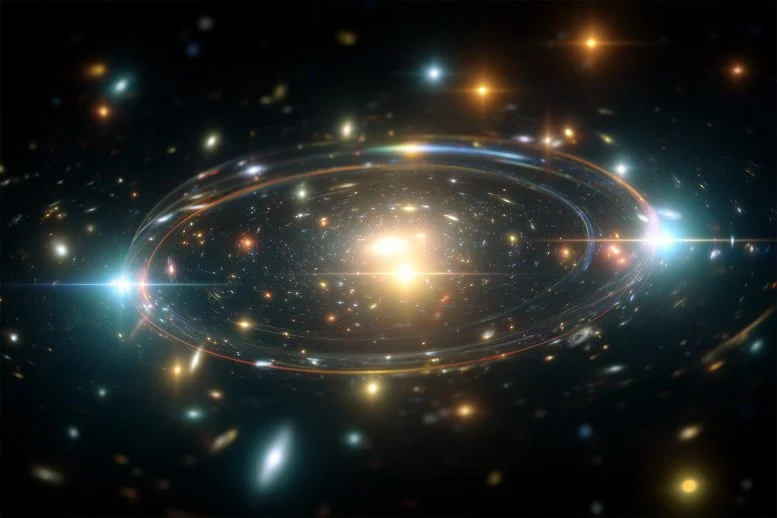
“We investigated a different method of constraining anisotropy, which involved so-called weak gravitational lensing,” says Adam. Weak lensing occurs because matter between us and a distant galaxy slightly bends the galaxy’s light, altering its apparent shape. This specific type of distortion can reveal whether anisotropies exist in the Universe. In fact, the analysis of weak lensing data allows scientists to separate the signal into two components: E-mode shear, which is generated by the distribution of matter in an isotropic and homogeneous Universe, and B-mode shear, which is typically very weak and should not appear on large scales in an isotropic Universe.
Simply observing B-modes on large scales would not be enough to confirm anisotropies, as these signals are very weak and could result from measurement errors or secondary effects. If an anisotropy is real, it would affect both E-modes and B-modes in a non-independent way, generating a correlation between the two signals. Only if Euclid’s data reveal a significant correlation between E- and B-modes would it suggest an anisotropic expansion of the Universe.
Next Steps and Possible Implications
In their study, Adam and colleagues simulated the effects of an anisotropic universe expansion on a computer and developed a model describing how deviations from isotropy would modify the weak lensing signal. They then calculated the E-B cross-correlation to demonstrate that an anisotropic universe would produce a correlation between the two signals, and applied their model to future Euclid data, showing that these observations will be precise enough to detect potential anisotropies.
Euclid is already beginning to provide useful data for these analyses, and new observatories will soon come online. Now that they have developed the proper methodology, Adam and his colleagues intend to apply it to real data. “Once you’ve kind of quadruple-checked your work, then you have to seriously consider whether this fundamental assumption is actually true or not, particularly in the late Universe. Or perhaps it just was never true,” explains Adam.
Rethinking Cosmic Origins
If these anomalies are confirmed, they would open a new chapter in cosmology. It won’t be easy, though: there are already alternative theoretical models that predict anisotropies, but none are as solid or widely accepted as the Standard Model. However, any theoretical revision would also depend on the extent of the anisotropy that could be detected, which remains uncertain.“It could be a serious revision,” concludes Adam, “or just adding a little term here or there. Who knows?”
If you want to learn more…
The Cosmological Principle
We know that the Universe is expanding, and this might lead us to mistakenly imagine that there is a center (where the Big Bang occurred) from which this expansion originated. Instead, we should think of our Universe as if it were the surface of the Earth: we can move in any direction without ever reaching an edge, but there is no center on the surface. If Earth behaved like a balloon being inflated, we would see that the space on its surface expands, but there would be no specific point on it that could be considered the center of the expansion.
According to the Cosmological Principle, not only is there no center or privileged location in cosmic space, but space itself has homogeneous properties everywhere, at least on sufficiently large scales. We know that there are voids and dense regions, such as galaxies and the space between them, but if we zoom out, just like we zoom out on a smartphone with two fingers, these inhomogeneities disappear. This principle forms the foundation of the theoretical model we use today to explain the origin, evolution, and current state of the Universe. It is also very convenient because it implies that the laws of physics apply everywhere in the same way, significantly simplifying our understanding of the cosmos.
Weak Lensing
Weak lensing is based on the principle, described by general relativity, that gravity can bend the path of light. The greater the mass of a celestial body, the stronger the distortion of light passing near it. Galaxies and other objects located behind a massive gravitational field appear subtly distorted, with their shapes and orientations slightly altered.
This effect is similar to looking at an object through a magnifying glass. Just as the curved surface of the lens bends and distorts light, changing the apparent shape and position of objects behind it, the gravitational field of a massive cosmic structure bends and distorts the light from distant galaxies. As a result, an elliptical galaxy may appear slightly squished or rotated.
By carefully analyzing these distortions across billions of galaxies, surveys like Euclid and LSST can detect weak lensing, revealing the presence and distribution of unseen matter, including dark matter.
Reference: “Probing the Cosmological Principle with weak lensing shear” by James Adam, Roy Maartens, Julien Larena and Chris Clarkson, 11 February 2025, Journal of Cosmology and Astroparticle Physics.
DOI: 10.1088/1475-7516/2025/02/016


I have been surfing online more than three hours today, yet I never discovered any attention-grabbing article like yours. It¦s beautiful worth sufficient for me. Personally, if all webmasters and bloggers made good content material as you probably did, the net might be much more helpful than ever before.


Leave a Reply