
By Purdue University February 27, 2025
Collected at: https://scitechdaily.com/mosquitoes-have-a-hidden-ability-that-could-change-sound-technology/
Researchers are unlocking the secrets of mosquito antennae, uncovering how these insects detect sound with remarkable precision.
By mimicking their structure, scientists hope to revolutionize disaster response, creating bio-inspired sensors that could detect faint distress signals amid chaotic environments.
Mosquitoes May Hold the Key to Disaster Response
One of the world’s most unpopular insects could hold the key to a breakthrough in disaster response.
A team of researchers at Purdue University is studying mosquito antennae to understand their ability to detect vibrations. By recreating these structures, scientists hope to improve methods for monitoring and detecting natural disasters like earthquakes and tsunamis.
This research, led by Purdue professors Pablo Zavattieri and Ximena Bernal, has been published in Acta Biomaterialia.
Engineering Insights from Nature’s Tiny Listeners
“We’re still in the early stages but we’re pretty optimistic that we’ll at least learn a great deal,” said Zavattieri, the Jerry M. and Lynda T. Engelhardt Professor of Civil Engineering in Purdue’s College of Engineering. “Taking inspiration from nature and using it to advance scientific research has been a core feature of engineering since the very beginning.”
Despite lacking traditional ears, mosquitoes rely on their antennae to navigate the auditory landscape, homing in on crucial sounds amid the background noise of their own wingbeats.

Unlocking the Secrets of Mosquito Sensory Adaptations
Through analysis of the mosquitoes’ antennal features — particularly the arrangement and morphology of sensory hairs — civil and construction engineering PhD candidate and team researcher Phani Saketh Dasika (MSCE ’23) said they have already gained profound insights into how these adaptations enhance the auditory sensitivity and selective response to environmental cues.
“Using advanced micro-CT imaging to create high-fidelity CAD models for finite element analysis, we found that the architectural features of mosquito antennae enable species- and sex-specific acoustic target detection, even amid nontarget signals like their own wingbeats,” Dasika said. “Our findings also suggest that mosquito antennae are capable of detecting a broader range of frequencies than previously thought, though not all of these may be actively utilized.”
Applying Nature’s Design to Acoustic Sensors
The team’s findings have provided key information for determining if a mosquito’s antennae could inform the design of acoustic sensors.
“By modeling and contrasting the response of the antenna of species of mosquito using sound for different purposes, hearing mates or eavesdropping on frogs, we were able to tease apart features modulating hearing sensitivity and tuning,” said Bernal, a professor of biological sciences in Purdue’s College of Science. “Understanding how these structures work is the first step toward developing acoustic sensors inspired by their sensitive antennae.”

From Mosquitoes to Smart Noise-Canceling Tech
In terms of societal impact, insights from mosquito antennae could also inform the development of smart noise-canceling materials, Zavattieri said. These materials, potentially incorporating microfluidic channels or tunable metamaterials, could be used to create soundproofing panels for buildings, noise-canceling headphones, or even acoustic cloaking devices.
“Imagine urban environments equipped with bio-inspired sensors, akin to ‘big ears,’ capable of discerning specific sounds amid the hustle and bustle of city life,” Zavattieri said. “In times of crisis — such as earthquakes or other disasters — these sensors become invaluable, swiftly detecting faint signals of distress and guiding rescue efforts to those in need.”
Future Steps: 3D-Printing the Mosquito Advantage
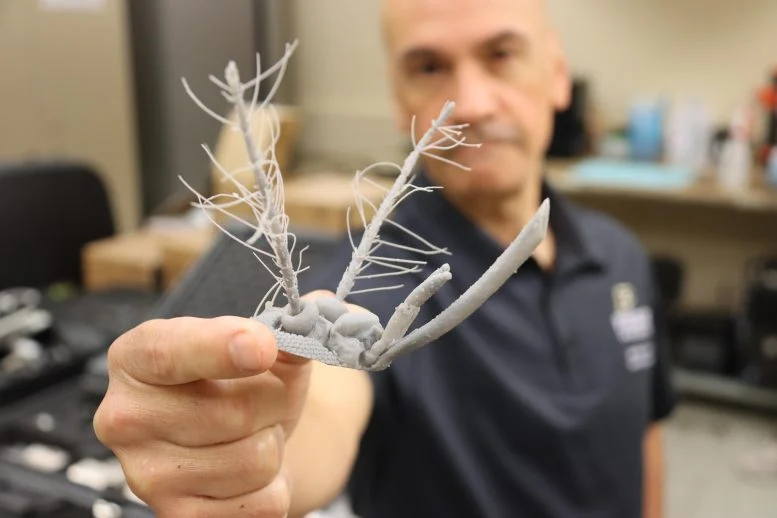
Zavattieri said the team is currently focused on recreating the antennae through 3D printing, using different materials and at varying sizes for frequency testing.
Reference: “Mechanistic insights into mosquito antennal architecture for auditory adaptations” by Adwait A. Trikanad, Phani Saketh Dasika, Hoover Pantoja-Sánchez, Ximena E. Bernal and Pablo D. Zavattieri, 16 December 2024, Acta Biomaterialia.
DOI: 10.1016/j.actbio.2024.12.031
This research is funded by the Air Force Office of Scientific Research Multi-University Research Initiative (AFOSR-FA9550-15-1-0009) and the National Science Foundation (IOS-2054636).
Leave a Reply